'Anti-China Sentiment' Overshadowed... Surge in Travel to China Due to Visa-Free Policy
648,000 Departed from November Last Year to January This Year
Demand Rises Due to Visa-Free Policy and Relatively Low Costs
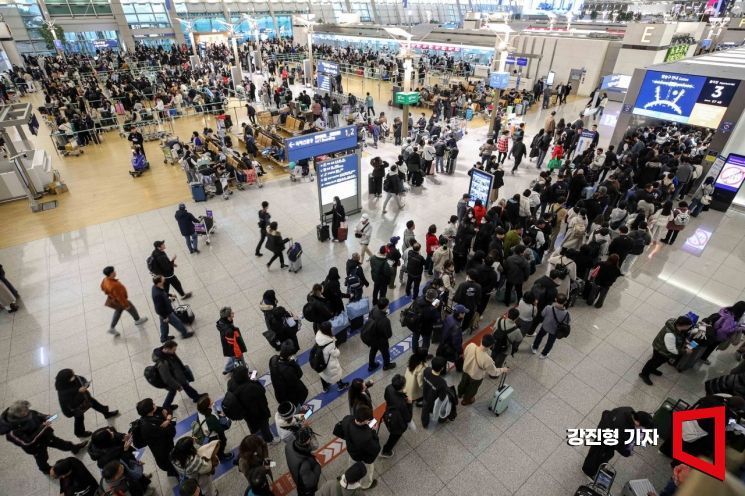 On the 24th of last month, ahead of the Lunar New Year holiday including the temporary public holiday, travelers visiting Incheon International Airport Terminal 1 were lining up to move to the boarding concourse.
As anti-China sentiment in South Korea spreads amid the impeachment turmoil surrounding President Yoon Suk-yeol, the number of travelers departing for China from November last year to January this year has surged, thanks to China’s visa-free policy. Experts view this as a phenomenon that highlights the gap between politically triggered anti-China sentiment and the general public’s actual thoughts.
Since China began allowing visa-free entry for South Koreans in November last year, traveling to China has become a trend. The relatively low cost and time required for travel preparation have made it convenient, leading to Shanghai being dubbed the "second Osaka." Shanghai is about a two-hour flight from Seoul, and round-trip airfare is reasonably priced at around 200,000 to 300,000 KRW.
According to data on "Domestic travelers by destination" submitted by the Ministry of Justice to Park Eun-jung of the Innovation Party on the 24th, 647,901 South Koreans traveled to China from November last year to January this year. This represents a 60.6% increase compared to the 403,470 travelers who visited China during the same period from November 2023 to January last year. It is 24.9 times higher than the same period in 2022, when China enforced quarantine for both domestic and foreign arrivals as part of COVID-19 prevention measures.
During the Lunar New Year holiday, which lasted ten days this year, more than 100,000 travelers visited China. According to Incheon International Airport Corporation’s 2025 Lunar New Year holiday transportation performance data, 138,196 travelers departed for China between the 24th of last month and the 2nd of this month, making China the second most popular destination after Japan in terms of passenger numbers.
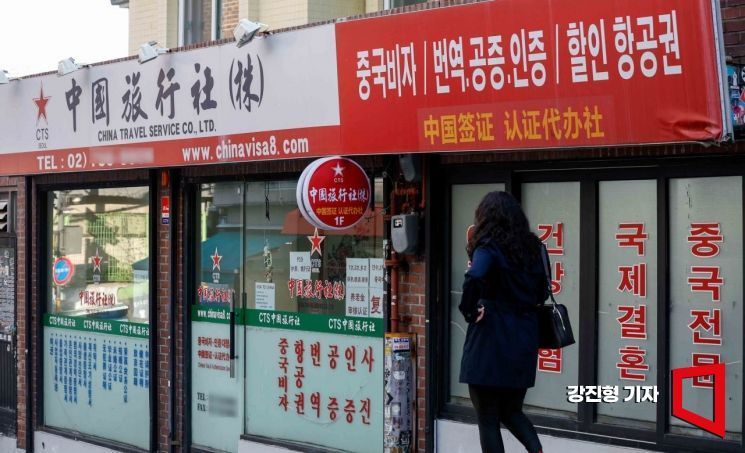 On November 8 last year, when visa-free entry to China was implemented, a citizen is walking toward a travel agency in Seoul that handles China visa issuance.
The surge in travelers to China is attributed to improved accessibility due to China’s visa-free policy eliminating the burden of visa issuance, as well as relatively low airfare and accommodation costs. The time difference is only one hour later than South Korea, and the overwhelmingly low cost of living is also an advantage. A representative from Hana Tour said, "With the visa-free policy reducing the visa issuance cost burden of over 100,000 KRW per person, reservations for destinations mainly visited by young people, such as Shanghai and Qingdao, are rapidly increasing," adding, "The impact of the spread of anti-China sentiment has not yet been felt."
Experts say this phenomenon shows the gap between politically triggered anti-China sentiment and the general public’s views. Seoldong Hoon, a sociology professor at Jeonbuk National University, told Yonhap News Agency, "The anti-China and Sinophobic voices appearing at some rallies are being overrepresented by the media," and added, "It is time for a mature attitude that does not get swayed by unverified extreme anti-China remarks."
Meanwhile, China began a pilot visa-free entry program for South Koreans in November last year. Before the visa-free policy was implemented, individual travelers (not groups) visiting China had to pay more than 75,000 KRW for a visa and wait up to more than ten days. The visa application required personal information of family members and, for men, military service history, which caused many travelers to feel burdened.
© The Asia Business Daily(www.asiae.co.kr). All rights reserved.













