Order to Intensify Military Operations in West Bank Refugee Camps
Second-Phase Ceasefire Negotiations Underway
On the 23rd (local time), Israeli tanks entered the West Bank of the Jordan River for the first time in 23 years. The Palestinian Authority condemned this as a "dangerous escalation."
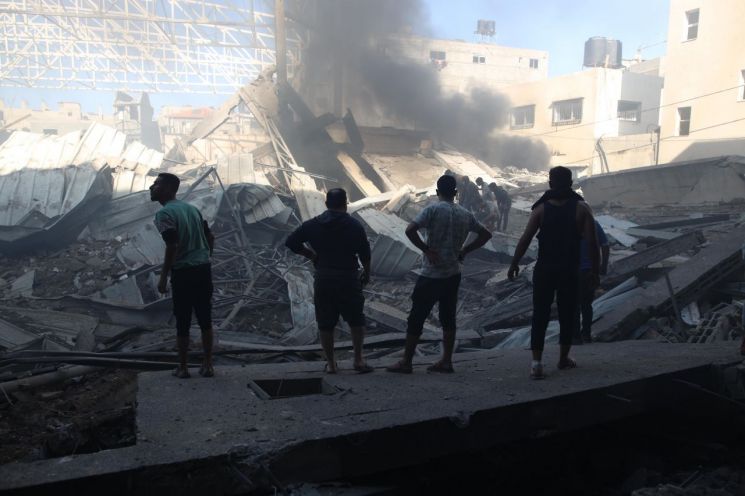
According to the Associated Press, a small number of tanks were seen moving into Jenin in the northern West Bank, which had been a stronghold of armed resistance against Israel. The last time tanks were deployed in this area was in 2002, when the Israeli military fought against a deadly Palestinian uprising. The West Bank is administratively governed by the Palestinian Authority (PA) under international law, but has been occupied by Israel since its victory in the 1967 Six-Day War. Since then, Israel has built Jewish settlements, with about 500,000 Israelis having moved into the West Bank.
The Palestinian Ministry of Foreign Affairs described Israel's move as an "act that heightens the danger of the situation in the West Bank" and urged the international community to intervene against Israel's illegal invasion.
Israeli Defense Minister Yoav Katz ordered the military to "intensify operations to prevent terrorism" in all refugee camps in the West Bank. The AP added that he had previously instructed preparations for a "long-term deployment until next year" in some refugee camps in the West Bank.
Since the ceasefire with the Palestinian armed faction Hamas in the Gaza Strip on the 19th of last month, Israel has been conducting military operations across the West Bank under the pretext of eliminating Palestinian armed groups. As a result, the United Nations (UN) reported that about 40,000 Palestinian residents have been displaced, with thousands forced to leave their homes in three northern West Bank areas near Jenin, Tulkarem, and Tubas. The UN stated that the current Israeli military operations are the longest since the Palestinian uprising in the early 2000s.
The possibility of a ceasefire between Israel and Hamas in the Gaza Strip remains uncertain. If ceasefire negotiations fail, there is a high likelihood of renewed armed conflict between Israel and Palestinians in Gaza. On the 23rd, Israeli Prime Minister Benjamin Netanyahu said, "We are ready to return to intense fighting at any time," and the Israeli military has strengthened its operational readiness around the Gaza Strip.
U.S. Middle East envoy Steve Witkoff told CNN that negotiations for a second-phase ceasefire are expected to proceed, stating, "Since we need to secure an extension of the first-phase (ceasefire), I will probably go to the region this Wednesday to negotiate."
© The Asia Business Daily(www.asiae.co.kr). All rights reserved.

















