Delegation Discusses Industrial Cooperation Agendas with White House and Treasury Department
White House: "Most Productive Discussions"
Proposes Cooperation Models in Six Key Sectors Including Shipbuilding, AI, and Semiconductors
Cho Hyunsang Urges Active Participation in APEC CEO Summit
Choi Tae-won, Chairman of the Korea Chamber of Commerce and Industry (KCCI) and SK Group, emphasized in a meeting with a senior White House official that "Korea has invested more than $160 billion (approximately 230 trillion KRW) in the United States over the past eight years, with most of it concentrated in the manufacturing sector," adding, "Through this, Korean companies have created more than 800,000 jobs, many of which are high-quality jobs with annual salaries exceeding $100,000."
In response, the White House official expressed active interest, stating, "Since President Trump's inauguration, we have met with over 20 economic delegations, but the discussions with this Korean private sector delegation were the most productive," and agreed to continue further discussions. They also responded that excessive regulations delaying corporate investment decisions are being improved more efficiently to enhance the investment environment.
The KCCI announced on the 21st that the "Trade Outreach Delegation to the U.S.," consisting of 26 members including Chairman Choi, met with senior White House officials and key members of Congress in Washington D.C. on the 19th and 20th (local time).
The private economic delegation led by Chairman Choi visited the U.S. for the first time since the launch of Donald Trump's second-term administration, laying the groundwork for expanding economic cooperation between the two countries by discussing strategic industrial cooperation agendas.
Chairman Choi emphasized that Korean companies' investments in the U.S. have substantially contributed to American society through regional economic revitalization, job creation, and tax payments, and requested close cooperation with the Korean government to expand synergies between the two countries.
The participating companies in the economic delegation proposed strategic industrial cooperation plans between Korea and the U.S. focusing on six major sectors: shipbuilding, energy, nuclear power, AI and semiconductors, mobility, and materials, parts, and equipment.
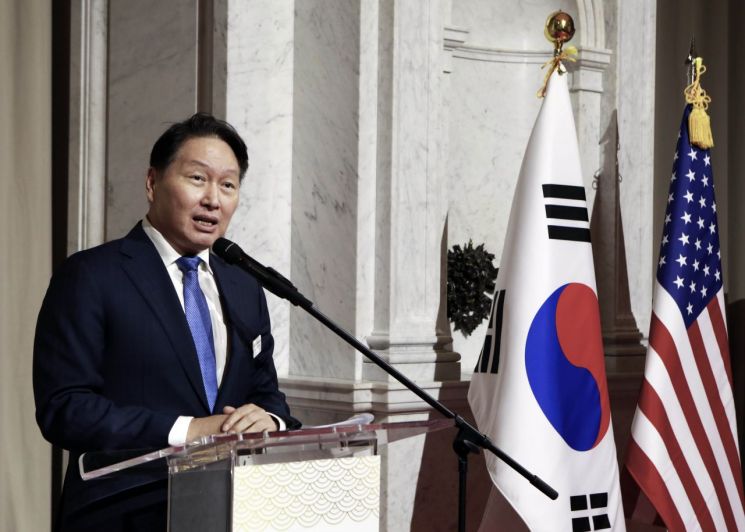 Chairman Chey Tae-won of the Korea Chamber of Commerce and Industry delivered the opening address at the "Korea-US Business Night" held on the 19th (local time) in the Great Hall of the Thomas Jefferson Building at the Library of Congress in Washington, USA. Korea Chamber of Commerce and Industry
For example, in shipbuilding, the plan is to combine Korea's efficient shipbuilding capabilities with the U.S.'s advanced technologies, and in AI and semiconductors, to establish partnerships for developing new AI services and technologies.
Additionally, the plan includes strengthening related energy supply chains, promoting the development of future car services, and building mobility supply chains within the U.S. that include robots and batteries.
The delegation emphasized the need for predictability in U.S. government policies to ensure stable corporate activities.
Chairman Choi requested close cooperation with the Korean government not only to expand the scale of trade and investment between Korea and the U.S. but also to explore cooperation methods that can maximize mutual synergies. Cho Hyun-sang, Vice Chairman of HS Hyosung and Chair of the 2025 Asia-Pacific Economic Cooperation (APEC) Business Advisory Council (ABAC), urged U.S. business leaders to actively participate in the APEC CEO Summit.
In a meeting with Treasury officials on the 20th, Chairman Choi stated, "Investments in sectors requiring strategic cooperation will continue," and emphasized, "We ask the Treasury Department to take an interest in activating financial functions to further facilitate this."
The participating companies requested the Treasury Department's role in creating a stable macroeconomic environment and investment conditions in strategic industries such as shipbuilding, energy, nuclear power, AI, mobility, and materials, parts, and equipment, noting that the U.S. can also gain benefits such as budget savings and tax revenue through fostering strategic industries.
On the evening of the 19th, the KCCI held the "Korea-U.S. Business Night" gala dinner at the Great Hall of the Thomas Jefferson Building of the U.S. Library of Congress.
Despite the House being in recess, over 250 attendees including current U.S. senators and representatives, governors, former ministers, and businesspeople from both countries participated. The KCCI noted this was more than double the originally planned 100 attendees.
In his welcoming remarks, Chairman Choi emphasized the strategic cooperative relationship between the U.S. and Korea, stating, "The relationship between our two countries, which has evolved from security to an economic alliance over the past century, must now leap forward into a partnership leading advanced technologies and future values."
Matt Murray, U.S. Ambassador to APEC, said in his congratulatory speech, "The Korea-U.S. relationship is an alliance based on shared values and cannot be explained merely by quantitative trade and investment transactions," adding, "The APEC summit to be held in Korea this year will be a great opportunity to showcase Korea's leadership."
At the event, the delegation explained the necessity of expanding Korean companies' investments in the U.S. and strategic industrial cooperation. Each company also held individual meetings with officials from states where major investments have been made.
The delegation included Chairman Choi, Vice Chairman Cho Hyun-sang, Samsung Electronics President Kim Won-kyung, SK On Vice Chairman Yoo Jung-joon, SK Supex Communication Chairman Lee Hyung-hee, Hyundai Motor President Sung Kim, Hyundai Motor Vice President Kim Dong-wook, LG Global Strategy Development Institute Director Yoon Chang-ryeol, Lotte Holdings Vice President Lim Sung-bok, HD Hyundai Vice Chairman Cho Seok, and James Kim, Chairman of the American Chamber of Commerce in Korea. Representatives from key industries such as automobiles and semiconductors, which are major export items to the U.S., as well as steel, shipbuilding, energy, and platforms, participated in large numbers.
Meanwhile, Chairman Choi is scheduled to return to Korea after conducting outreach activities in the U.S. through the Trans-Pacific Dialogue (TPD), hosted by the Choi Jong-hyun Academy, held from the 21st to 22nd.
© The Asia Business Daily(www.asiae.co.kr). All rights reserved.
![Clutching a Stolen Dior Bag, Saying "I Hate Being Poor but Real"... The Grotesque Con of a "Human Knockoff" [Slate]](https://cwcontent.asiae.co.kr/asiaresize/183/2026021902243444107_1771435474.jpg)
















