The National Changgeuk Company, the resident troupe of the National Theater of Korea, will premiere its new work Boheoja (步虛子): The Walker in the Void from March 13 to 20 at the Daloreum Theater of the National Theater.
This original changgeuk (Korean traditional opera) is based on the story of Sejong’s second son, Grand Prince Anpyeong, who was sacrificed due to the power ambitions of Sejo (Prince Suyang), the 7th king of Joseon, and creatively reinterprets Korean traditional emotions through Korean music.
Boheoja, meaning “the walker in the void,” is one of the musical pieces transmitted from the Song Dynasty during the Goryeo period and adopted into the court music of Goryeo and Joseon. The piece carries the wish for the listener’s health, longevity, and peaceful times. Also called “Jangchunbulrojigok,” it is connected to Taoist philosophy that admires the existence of immortals beyond human realms. In this work, Boheoja refers to those who long for a life in harmony with the natural order, unbound by constraints, yet live a life seemingly walking in the void, trapped by reality and with nowhere to stand.
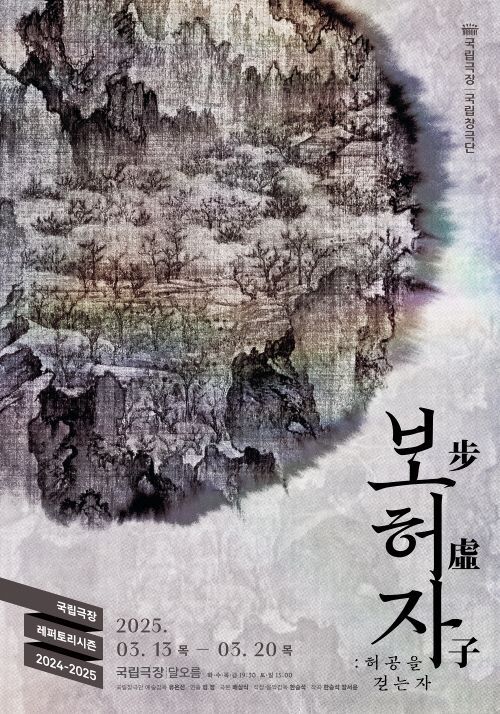
Playwright Bae Samsik focused on the fact that Grand Prince Anpyeong, who was stripped of power by Sejo and exiled to Ganghwa Island and Gyodong Island, was executed just eight days after exile, yet no traces remain of his tomb, placenta burial site, or epitaph. In the play, Anpyeong appears as a traveler, and Suyang appears as a spirit visible only to Anpyeong after death.
The changgeuk Boheoja begins with the story of those left behind 27 years after the Gyeyujeongnan (the coup in which Sejo murdered Kim Jongseo, Hwangbo In, and others to seize power) tragedy in 1480 (the 11th year of King Seongjong’s reign).
Anpyeong’s daughter and only blood relative, Musim (無心), returns after a long life as a slave on the frontier. The painter An Gyeon (安堅), who served Anpyeong, was Anpyeong’s concubine but became a government slave and secretly cares for Daeohyang (對御香), who was injured physically and mentally in an accident. An Gyeon searches for Musim to meet her. During this process, they meet at the ruins of the old house, Suseonggung, where they share memories and reminisce. An unnamed traveler (Anpyeong), who remembers Anpyeong, joins their conversation. On the traveler’s shoulder is a spirit (Suyang) visible only to him. Together, they embark on a journey to Daejaam, a royal temple where the Mongyudowondo (Dream Journey to the Peach Blossom Land) painted by Anpyeong in a dream is kept, confronting the longed-for dreams of the past.
The direction of Boheoja is by Kim Jeong, who gained attention by winning the 54th Dong-A Theater Award and the 9th Doosan Yonkang Arts Award. This is Kim’s first attempt at directing changgeuk. Kim said, “This is the story of characters who lived the life of Boheoja, drifting in the void with nowhere to stand. Through the journey toward the Mongyudowondo, which was a dream and hope, it represents our story of living in the present with hope somewhere, even in a reality that is not free.”
The core roles of lyricist, composer, and music director are taken by Han Seungseok, a professor in the Department of Traditional Arts at Chung-Ang University, who has participated in many National Changgeuk Company works such as Byeonggangsoe Jeomjjigo Ongnyeo, Gwito, and Riar.
Stage design is by Lee Taeseop, who designed the stages for the changgeuk Riar and The Merchant of Venice, depicting the “ruins of dreams” left behind after tragedy. Joining him are lighting designer Shin Dongseon, who won the 2022 Dong-A Theater Award for stage arts with his sensitive lighting design in plays such as Welkin, Richard III, and The Sense of a Wife, and costume designer Yoo Miyang, active in various works including the changgeuk Jeongnyeon-i, completing the stage aesthetics. Choreography is by contemporary dance choreographer Kwon Ryeongeun, who delicately and sensitively expresses the characters’ psychology through movement.
The role of the traveler (Anpyeong) is played by Kim Junsu, who was praised for portraying an 80-year-old man at a young age in his 30s in the changgeuk Riar. He delicately expresses Anpyeong’s regret, who dreamed of paradise but was left with only emptiness in life. Kim Geummi, who appeared in The Women of Troy and Farewell My Concubine, plays the roles of the nun Bon-gong and Dochang of Daejaam. Lee Gwangbok plays Suyang, the spirit lingering near Anpyeong. Min Eungyeong plays Anpyeong’s daughter Musim, Kim Mijin plays Daeohyang, the woman Anpyeong loved, and Yoo Taepyeongyang plays An Gyeon, the painter who drew Anpyeong’s dream.
© The Asia Business Daily(www.asiae.co.kr). All rights reserved.












