The Bank of Korea has forecasted that changes in trade policies led by U.S. President Donald Trump could put South Korea's key industries at risk.
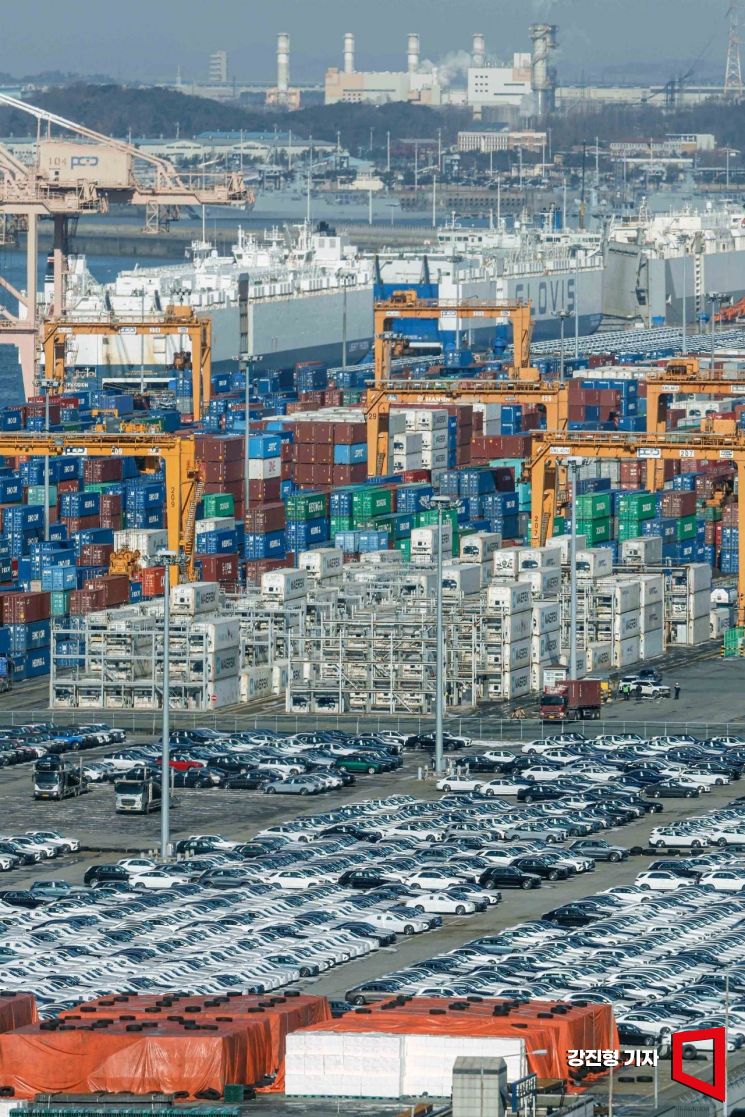 President Donald Trump signed a proclamation imposing a 25% tariff without exceptions on steel and aluminum products imported into the United States, and stated that tariffs on automobiles and semiconductors are also under consideration. On the 13th, export vehicles were waiting to be loaded at Pyeongtaek Port, Gyeonggi Province. 2025.2.13. Photo by Kang Jin-hyung
On the 19th, in its 'Key Industry Monitoring Report,' the Bank of Korea explained regarding this year's semiconductor market, "With the inauguration of the second Trump administration in the U.S., high policy uncertainty is expected to persist for the time being," adding, "The downside risks to the growth of the domestic semiconductor industry will expand."
Regarding automobile exports, it predicted, "Despite dry demand in North America, automobile exports are expected to decline due to sluggish sales in Europe and increased local production in response to strengthened U.S. protectionist policies."
For the petrochemical industry, it forecasted, "Due to delays in the improvement of the global manufacturing economy and oversupply, production and exports are unlikely to increase significantly." The steel industry is also expected to be hit due to domestic construction downturn, delayed recovery of China's real estate market, and the U.S. imposing a 25% tariff.
However, for the shipbuilding industry, it provided a positive outlook, stating, "While the shipbuilding market continues to be favorable, selective orders focusing on eco-friendly and high value-added vessels are ongoing, and profitability is expected to improve further." Additionally, it evaluated the second Trump administration's fossil fuel-centered energy policies, increased cooperation with allied countries, and the reflexive benefits from checks on China as positive factors.
© The Asia Business Daily(www.asiae.co.kr). All rights reserved.
![From Bar Hostess to Organ Seller to High Society... The Grotesque Con of a "Human Counterfeit" [Slate]](https://cwcontent.asiae.co.kr/asiaresize/183/2026021902243444107_1771435474.jpg)
















