Jeon Yonggi of the Opposition Party:
"Fare Hikes Will Cause Public Inconvenience...
Urgent Countermeasures Needed"
KORAIL's debt is projected to exceed 22 trillion won this year, according to its own forecast. Amid ongoing deficits, the increasing burden of electricity costs has led the government and KORAIL to discuss the possibility of fare hikes.
On the 18th, according to data received by Jeon Yong-gi, a member of the National Assembly's Land, Infrastructure and Transport Committee from the Democratic Party of Korea, KORAIL's debt is estimated to reach 22.3 trillion won (preliminary settlement) this year. This is an increase of 1.2 trillion won compared to last year (21.1 trillion won).
The operating deficit is also severe. Following losses of 436.3 billion won in 2022 and 474.3 billion won in 2023, an operating loss of 294 billion won is expected this year.
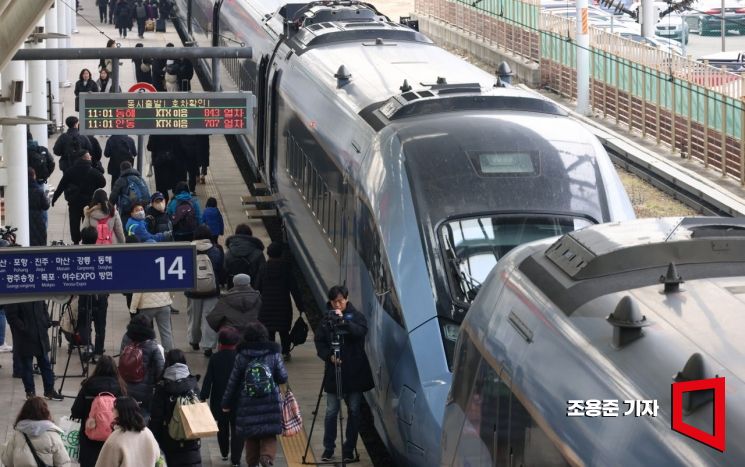
The direct cause is identified as the snowballing burden of electricity costs. According to KORAIL, since the introduction of the fuel cost linkage system in 2021, the Korea Electric Power Corporation's (KEPCO) electricity rates have been raised eight times up to last year.
As the largest public enterprise in domestic power consumption, KORAIL's electricity expenses have increased annually from 363.7 billion won in 2020 to 368.7 billion won in 2021, 427.2 billion won in 2022, and 532.9 billion won in 2023. Last year, it recorded 579.6 billion won. This year, due to the 10.2% rate hike implemented in October last year, electricity costs are expected to increase by 60 billion won to reach 637.5 billion won.
KORAIL stated in this regard, "Although electricity unit prices have risen by 143.5% compared to 2011, the core reason for the accumulated deficit is the freezing of trunk passenger fares for 14 years due to being a public transportation service."
KORAIL told Assemblyman Jeon, "It is necessary to establish an electricity rate system at the level of public service industries and improve systems such as offsetting regenerative energy from railway vehicles." Regenerative energy refers to the energy converted into electricity and reused when trains decelerate or stop. They emphasized the need to increase utilization by, for example, deducting this energy from electricity bills.
In fact, KORAIL has recently been reported to have held detailed discussions with the Ministry of Land, Infrastructure and Transport regarding the reform of the electricity rate system and plans to raise trunk passenger fares.
Assemblyman Jeon said, "KORAIL's financial situation is difficult to improve independently without government support," and added, "The Ministry of Land, Infrastructure and Transport should closely examine unreasonable elements of the electricity rate system in the railway industry in consultation with the Ministry of Trade, Industry and Energy and prepare drastic measures."
He also warned, "If it leads to a railway fare increase, there is a concern that public inconvenience will intensify."
© The Asia Business Daily(www.asiae.co.kr). All rights reserved.












