Announcement of 'K-Food+ Export Expansion Strategy' on the 18th
Expansion of Joint Logistics Centers and Cold Chains in Export Countries
Establishment of Dedicated Agricultural Food Trade Centers in Potential Markets
Expanded Support for Export Vouchers in Package Form
The government has decided to expand the support for easing the self-payment rate of foreign exchange fluctuation insurance, which was previously applied only to the Japanese yen, to include the US dollar in order to respond to export risks in the agricultural food and agricultural industry sectors. Starting next month, small-scale exporters or companies subscribing to this insurance for the first time will be able to reduce their self-payment rate to as low as 0%.
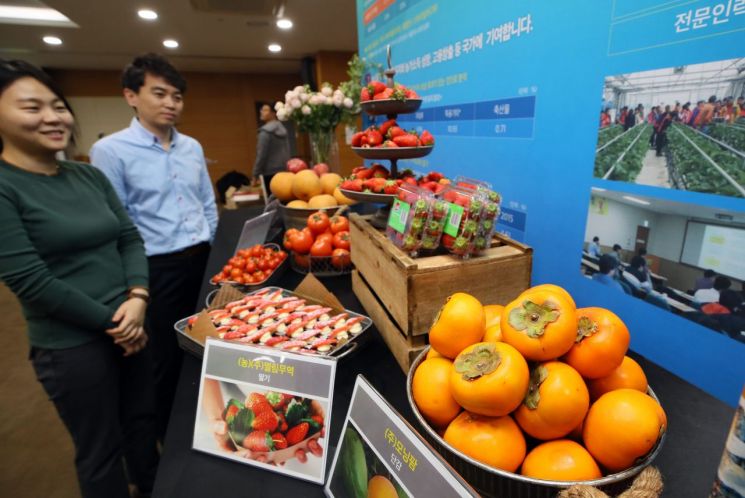
On the 18th, the government held the 6th Export Strategy Meeting at the Government Complex Seoul in Jongno-gu, Seoul, chaired by Choi Sang-mok, Acting Prime Minister and Minister of Economy and Finance. At this meeting, the Ministry of Agriculture, Food and Rural Affairs announced the 'K-Food(+) Export Expansion Strategy' to increase this year's exports of agricultural food (K-Food), smart farms, and agricultural machinery to $14 billion.
Last year, K-Food+ exports amounted to approximately $13 billion, marking a 6.7% increase compared to the previous year. To continue this export growth trend this year, the Ministry of Agriculture, Food and Rural Affairs has prepared four major strategies to respond to changes in the trade environment, centered around the 'K-Food+ Export Expansion Promotion Headquarters,' which involves both the public and private sectors. These strategies include ▲responding to external export risks ▲diversifying export markets and items ▲marketing linked to global trends and upgrading ▲resolving export difficulties and strengthening competitiveness.
The Ministry of Agriculture, Food and Rural Affairs plans to strengthen export insurance support such as foreign exchange fluctuation insurance to respond to external export risks including exchange rate fluctuations, rising logistics costs, and strengthened non-tariff barriers. To mitigate losses from exchange rate gains and losses, the support to reduce the corporate self-payment rate of foreign exchange fluctuation insurance to as low as 0% will be expanded from the Japanese yen to the US dollar. This support will be provided during the first half of the year starting next month, and the possibility of extension will be reviewed in the second half based on export conditions.
Kang Hyo-ju, Director of the Agricultural Food Export Promotion Division at the Ministry of Agriculture, Food and Rural Affairs, said, "Foreign exchange fluctuation insurance is a concept applied when exchange rates fall, and since the yen depreciation has been prolonged, it was only applied to the Japanese yen," adding, "(The dollar) has a strong exchange rate but is likely to have increased volatility, so we decided to expand its application." She also explained that the 0% self-payment rate support target is "companies with small export volumes or those subscribing to foreign exchange fluctuation insurance for the first time."
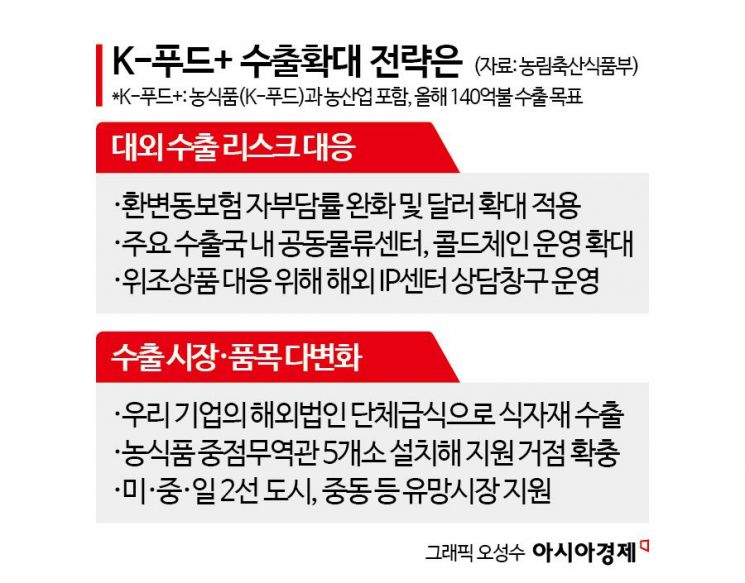
The Ministry of Agriculture, Food and Rural Affairs also included plans to expand the operation of joint logistics centers and cold chains in major export countries from 104 to 110 locations. Collaborating with the Korean Intellectual Property Office and the Intellectual Property Protection Agency, they will newly operate overseas IP center consultation desks to combat counterfeit K-Food products. They will also respond to non-tariff trade barriers through customs clearance and certification support using overseas specialized agencies and by operating visit programs for key export country officials (such as quarantine officers).
To diversify export markets and items, they will promote entry into secondary cities in the United States, China, and Japan. In particular, this year they will support the export of food ingredients such as kimchi and tteokbokki linked to group catering for overseas subsidiaries of Korean companies for the first time. To enter potential markets, Korea Trade-Investment Promotion Agency (KOTRA) will establish dedicated agricultural food trade centers in South Africa, Uzbekistan, Laos, Chile, and Guatemala, where it has a presence.
To resolve export difficulties and strengthen competitiveness, a total of 1.2724 trillion won in loans will be provided to alleviate cost burdens related to purchasing raw materials and ingredients, storage, and processing. The agricultural food export voucher support will be expanded from 32.8 billion won to 36 billion won, and support will continue in cooperation with the Ministry of SMEs and Startups. The voucher will be offered in a package form with multiple items, allowing exporters to select the necessary items to apply for.
Song Mi-ryeong, Minister of Agriculture, Food and Rural Affairs, said, "To achieve $14 billion in exports, we will diversify and upgrade markets and items based on global consumers' awareness and trust in K-Food," adding, "We will closely cooperate with related ministries centered on the K-Food+ Export Expansion Promotion Headquarters to promptly resolve difficulties faced by export companies in the field."
© The Asia Business Daily(www.asiae.co.kr). All rights reserved.