Emphasizing the Importance of Deng Xiaoping's "Let Some Get Rich First" Theory
Specific Tasks Include Removing Barriers to Competition and Resolving Private Enterprise Financing Issues
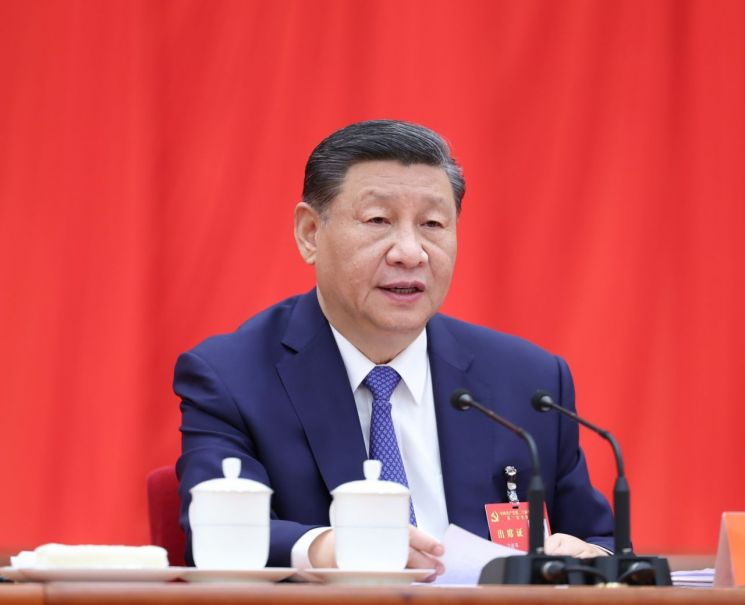 Chinese President Xi Jinping is delivering a speech at the 3rd Plenary Session of the 20th Central Committee of the Communist Party held at the Jingxi Hotel in Beijing on July 18 last year. Amid the ongoing US-China trade war, President Xi met directly with Chinese big tech entrepreneurs on the 17th (local time) and urged them to contribute to national development. / Photo by Xinhua News Agency and Yonhap News Agency
Amid the ongoing US-China trade war, Chinese President Xi Jinping met directly with entrepreneurs from China's big tech companies on the 17th, urging them to contribute to national development.
According to China's state-run Xinhua News Agency, President Xi stated at the previous day's Private Enterprise Symposium (forum), "I hope that those who get rich first will promote common prosperity."
While Xi has previously emphasized the policy direction of income redistribution under the slogan of "common prosperity," this time he also highlighted the importance of Deng Xiaoping's "the rich get rich first" theory.
He added, "The development of the private economy has great potential, and it is timely that many private enterprises and entrepreneurs are emerging," and "The focus now is to steadily implement policy measures to promote the development of the private economy."
He mentioned specific tasks to be promoted, including ▲removing obstacles to fair market competition ▲resolving financing difficulties for private enterprises ▲addressing private enterprises' debt default issues ▲rectifying unfair pressures and protecting legitimate rights and interests.
He urged party committees and governments at all levels to comprehensively and effectively implement policy measures to promote the development of the private economy based on actual conditions. Private enterprises were called upon to become builders of socialism with Chinese characteristics, strengthen independent innovation, foster new quality productive forces, improve corporate governance and risk prevention mechanisms, and actively participate in public welfare and charitable activities.
President Xi also pointed out, "The current difficulties and challenges faced by the development of the private economy have emerged during the process of reform, development, and industrial transformation," adding, "They are temporary, not long-term, and can be overcome with solutions."
Attendees listened attentively during President Xi's speech, with most taking detailed notes. Among the private entrepreneurs, six representatives spoke on behalf of the industry, including Ren Zhengfei, founder of Huawei; Wang Chuanfu, chairman of BYD, the world's number one electric vehicle company; Liu Yonghao, chairman of Xinxiwang Group, a major Chinese feed producer; Wei Er, founder of semiconductor giant Wei'er Semiconductor; Wang Xingxing, chairman of Unitree, which recently gained prominence with its humanoid robot unveiling; and Lei Jun, chairman of Xiaomi, China's top smartphone maker also venturing into electric vehicles.
Also present were Jack Ma, founder of Alibaba, one of China's largest e-commerce platforms; Leng Youbin, vice chairman of the All-China Federation of Industry and Commerce; and Nan Chunhui, chairman of transformer manufacturer Zhengtai Group. Notably, Liang Yuanfeng, founder of DeepSeek, which recently caused a global sensation with the release of a low-cost, high-efficiency generative artificial intelligence (AI) model, was also among the attendees, Reuters reported citing Chinese economic media Caixin. This was Liang's first public appearance since DeepSeek's rise. Liang had attended a symposium hosted by Premier Li Chang on the 20th of last month when DeepSeek launched its inference AI model 'R1,' but had remained reclusive amid worldwide attention since then.
The event took place after US President Donald Trump imposed an additional 10% tariff on China and ahead of the upcoming Two Sessions (Lianghui)?the National People's Congress and the Chinese People's Political Consultative Conference?scheduled for early next month, where this year's economic growth targets and supporting economic policies will be announced. The 14th Standing Committee of the 14th National People's Congress will hold its 14th meeting on the 24th-25th to prepare for the third session of the National People's Congress (NPC), which is equivalent to South Korea's National Assembly. The agenda for the Standing Committee meeting includes reviewing the draft law on promoting the private economy.
The US Wall Street Journal (WSJ) reported, "This signals that entrepreneurs' help is needed for economic growth and technological self-reliance," adding, "Inviting Jack Ma and others is a sign that the crackdown has ended."
© The Asia Business Daily(www.asiae.co.kr). All rights reserved.
![User Who Sold Erroneously Deposited Bitcoins to Repay Debt and Fund Entertainment... What Did the Supreme Court Decide in 2021? [Legal Issue Check]](https://cwcontent.asiae.co.kr/asiaresize/183/2026020910431234020_1770601391.png)















