Kim Hosik, Vice President of Memory Research Center, Predicts
"Demand for GPUs and HBM to Remain Strong as AI Competition Intensifies"
Despite growing skepticism about high-performance chips following the emergence of China's generative AI DeepSeek, SK Hynix plans to continue its growth strategy by focusing on the high-bandwidth memory (HBM) business. Summarizing recent remarks from key leaders driving technology development reveals a consistent 'survival strategy' based on sustained HBM demand.
According to industry sources on the 18th, Kim Hosik, Vice President of SK Hynix's Memory System Research Center, participated in a panel discussion at the Silicon Valley Private AI Forum (K-PAI) held at Stanford University in the U.S. on the 12th (local time). He shared his views on the impact of DeepSeek's emergence on the industry and the crisis facing the Korean semiconductor sector.
Vice President Kim assessed that DeepSeek's appearance is not a "completely new technology," but predicted that "as optimization technology advances, memory requirements may temporarily ease." However, he forecasted that as competition in artificial general intelligence (AGI) intensifies, demand for high-performance graphics processing units (GPUs) and the supporting HBM will continue. He emphasized, "HBM, which supports AI computing performance, will still play an important role."
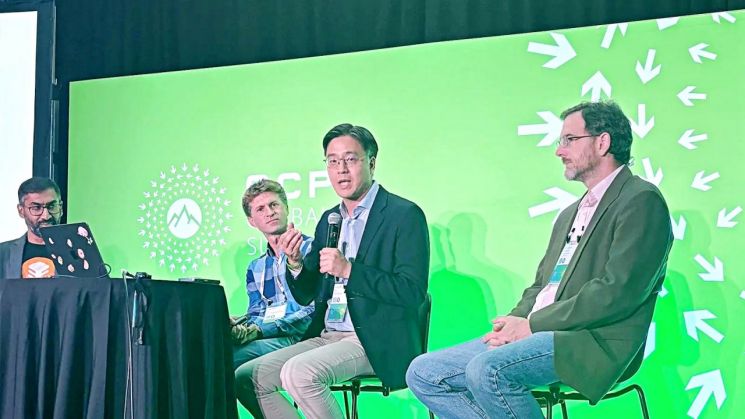 Kim Hosik, Vice President of the Memory System Research Center at SK Hynix, is presenting the vision of memory-adjacent computing technology at the 'OCP Global Summit 2024' held in October last year. SK Hynix Newsroom
Since DeepSeek was implemented with low-spec chips, some concerns about a slowdown in GPU demand have been raised. However, SK Hynix believes that while memory requirements may temporarily decrease, demand for high-spec GPUs and HBM will remain steady alongside the expansion of the AI market.
An industry insider analyzed, "Since SK Hynix does not have a foundry, it has no choice but to focus on the memory business. As long as NVIDIA continues to supply GPUs in the AI market, HBM demand will also remain robust."
Another technical leader overseeing HBM development shared the same stance. Lee Kangwook, Vice President of SK Hynix, after receiving the 'Kang Daewon Award' at the Korean Semiconductor Conference on the 13th, stated, "DeepSeek has emerged, but we just need to do better," expressing his intention to accelerate HBM technology development.
Vice President Lee contributed to SK Hynix's market advantage in HBM by introducing MR-MUF packaging technology during the development of the 3rd generation HBM2E in 2019. MR-MUF (Molded Underfill) packaging technology protects semiconductor chips while making them thinner and stronger. He is currently leading the development of the 4th generation (HBM3) and 5th generation (HBM3E).
Meanwhile, SK Hynix is preparing to break ground next month on its Yongin cluster. The company plans to invest 120 trillion won over 10 years to build four memory semiconductor fabs at this site. This aligns with its strategy to stake its future on the memory semiconductor business, including HBM. The company has recently accelerated securing production bases by starting to hire personnel responsible for infrastructure construction.
© The Asia Business Daily(www.asiae.co.kr). All rights reserved.