Kim Geonwoo of Jeonbuk National University:
"Heating and Cooling Energy Consumption Can Be Reduced"
A method to save heating and cooling energy consumption using smart polymer composites has been proposed.
The National Research Foundation of Korea announced on the 17th that Professor Kim Geon-woo's research team at Jeonbuk National University has developed a polymer composite that autonomously adjusts its thermal emissivity according to the surrounding temperature.
Heating and cooling energy consumption in Korea accounts for 40% of total energy consumption, but a fundamental solution to reduce energy consumption has not yet been established.
The research team succeeded in developing a smart polymer composite that autonomously controls thermal emissivity by utilizing phase change materials to increase thermal emissivity at high temperatures and decrease it at low temperatures.
Phase change materials exhibit metallic properties at high temperatures, resulting in low thermal emissivity, and ceramic properties at low temperatures, resulting in high thermal emissivity. Since these characteristics are opposite to the research goal, a method to inversely utilize them was necessary.
The research team nanoparticulated the phase change material and dispersed it within a polymer with specific thermal emissivity. They devised a method where the polymer absorbs far-infrared rays scattered when the phase change particles exhibit metallic properties, thereby increasing thermal emissivity.
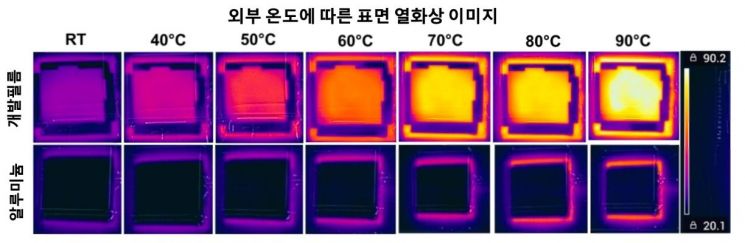
The thermal emissivity of the polymer composite produced in this way showed a 15% change rate at 70℃. Additionally, the heat radiator covered with the developed polymer composite maintained an internal temperature of 70℃ regardless of the external temperature.
Professor Kim Geon-woo explained, "If the surface is composed of such a polymer composite, it can maintain a constant internal temperature regardless of the external temperature, thereby reducing heating and cooling energy consumption. When applied to temperature-sensitive products like batteries, it can maintain a stable temperature and maximize performance."
This research was conducted with support from the Nano and Materials Technology Development Project Nano Future Materials Source Project promoted by the Ministry of Science and ICT and the National Research Foundation of Korea, and the Local Government-University Cooperation-Based Regional Innovation Project promoted by the Ministry of Education and the National Research Foundation of Korea. Pal Sudip Kumar, a professor at Jeonbuk National University, participated as the first author, and Professor Kim as the corresponding author. The research paper was published online on the 31st of last month in the international journal in the field of materials engineering, Composite Part B Engineering.
© The Asia Business Daily(www.asiae.co.kr). All rights reserved.

















