Domestic researchers have uncovered the mechanism by which the helicase protein, a key enzyme of the COVID-19 virus, promotes replication (infection and spread). This is expected to present new possibilities for developing vaccines and treatments for variant viruses in the future.
According to KAIST on the 17th, Professor Kwangrok Lee's research team in the Department of Life Sciences identified the mechanism by which two activities of the nsp13 protein (helicase activity and RNA chaperone activity) promote the replication of RNA, the genetic material of the severe acute respiratory syndrome (SARS) COVID-19 virus.
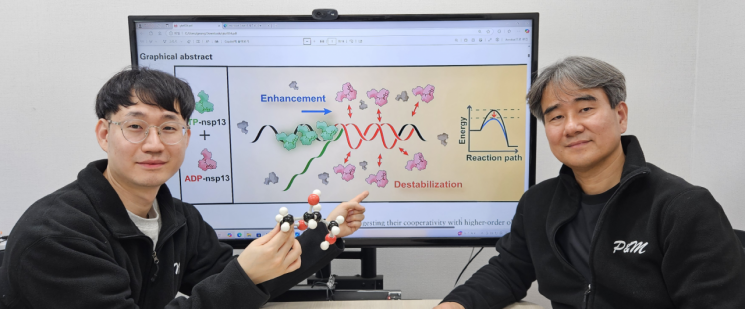 (From left) Dr. Jungmin Yoo, Department of Biological Sciences, KAIST, Professor Kwangrok Lee. Provided by KAIST
The nsp13 protein is the helicase of the SARS COVID-19 virus and acts as an essential enzyme in the gene replication and transcription processes necessary for viral proliferation.
Helicase unwinds the twisted structure of DNA or RNA, much like opening and closing a zipper. ‘Helicase activity’ refers to the enzymatic function of unwinding double-stranded nucleic acids such as DNA or RNA into single strands, thereby promoting replication or transcription processes.
Additionally, the ‘RNA chaperone activity’ of the nsp13 protein assists in the correct folding and unfolding of nucleic acid structures, correcting erroneous RNA or enhancing stability, thus supporting intracellular RNA metabolism.
The research team confirmed that the nsp13 protein promotes gene replication through both its known helicase activity and the previously unknown chaperone activity.
In conclusion, the team elucidated a new mode of action in which helicase activity and chaperone activity cooperate spatiotemporally to promote RNA replication, thereby explaining the infection and spread mechanism of COVID-19.
Professor Kwangrok Lee stated, “This study is a novel discovery confirming that the nucleic acid-enzyme protein helicase exhibits chaperone-like activity, which broadens our understanding of the functional diversity of helicases. We hope that these findings will provide clues for developing effective treatments and vaccines against SARS COVID-19 virus variants.”
Meanwhile, this research was conducted with support from the Ministry of Science and ICT and the National Research Foundation of Korea through the Mid-career Research Support, Leading Research Center Support Project, Global Basic Research Support Project, and Core Technology Development Project for Synthetic Biology.
© The Asia Business Daily(www.asiae.co.kr). All rights reserved.

















