Still Dependent on Imported Parts and Raw Materials
"Uncertainty and Cost Increases Remain for the U.S."
U.S. President Donald Trump announced that he would impose 'reciprocal tariffs' on trading partners, increasing uncertainty in the U.S. economy while also raising inflation risks, the New York Times (NYT) reported on the 16th (local time).
According to the report, President Trump has long claimed that the U.S. has been a victim of the multilateral global trading system centered on the World Trade Organization (WTO), which has been maintained for 30 years, citing the trade deficits the U.S. has incurred in trade with major partners such as China, Mexico, and Germany.
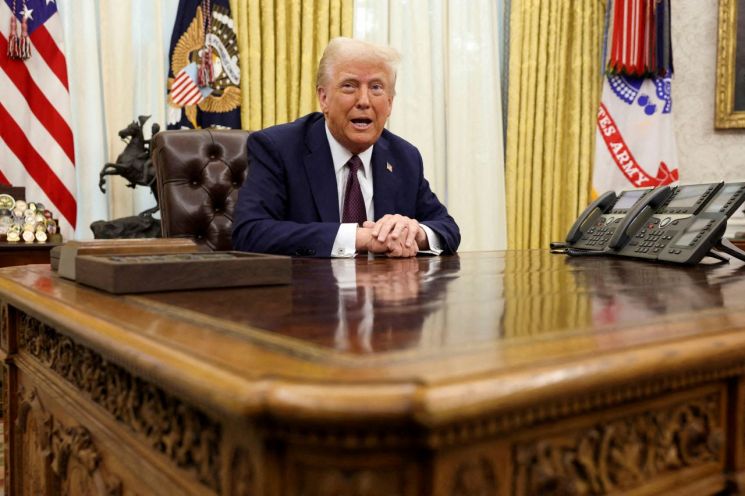
On the 13th, President Trump signed a presidential memorandum containing the decision to impose reciprocal tariffs, announcing that, considering the tariffs and non-tariff barriers of trade partners, customized reciprocal tariffs would be imposed on countries around the world as early as early April. At a press conference after signing, President Trump emphasized, "We have decided to impose reciprocal tariffs for fairness," adding, "The U.S. policy aims to reduce the persistent trade deficit and address other unfair and unbalanced aspects arising from trade with partners."
The basic premise of reciprocal tariffs is that the same level of tariffs faced by U.S. companies when exporting goods abroad should be applied to imports from those countries. However, the NYT pointed out that calculating individual tariff rates for thousands of products imported from more than 150 countries could cause significant enforcement problems for U.S. companies that need to import intermediate or final goods from abroad.
Ted Murphy, an international trade attorney at the law firm Sidley Austin, expressed concern that "there could be 150 different tariff rates for each tariff classification," noting that such complexity could make tariff enforcement a 'Herculean' task in practice.
The NYT noted that reciprocal tariffs could heighten inflation concerns, further delaying potential interest rate cuts by the Federal Reserve, and contradict President Trump's pledge to lower prices of everyday goods.
The timing of President Trump's announcement of reciprocal tariffs on the day Indian Prime Minister Narendra Modi visited the White House also drew attention. The U.S. recorded a $45 billion trade deficit with India last year. According to World Bank data, the U.S. imposes tariffs below 6% on Indian plastics and chemical products, while similar U.S. products face tariffs of 10-30% in India.
The NYT pointed out, "If the Trump administration raises tariffs on Indian imports to the same level, U.S. factories will have to pay higher costs for chemicals and plastics," adding, "This applies broadly to products such as Vietnamese shoes, Brazilian machinery and agricultural products, Indonesian textiles, and rubber."
There is also a view that President Trump's tariff threats may be a negotiation tactic to force other countries to lower their tariffs. Christine McDaniel, a senior fellow at George Mason University's Mercatus Center, said, "There are many possibilities where tariffs could go very badly for the U.S.," but added, "However, if President Trump can get other countries to open their markets, there is at least some potential to promote trade."
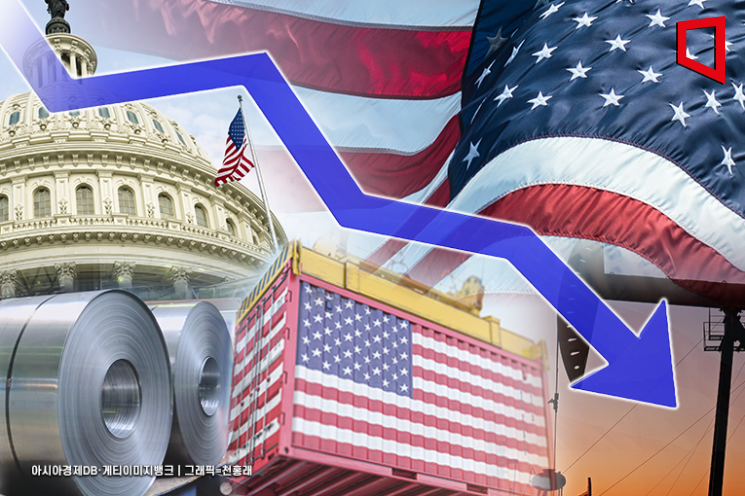
Even if companies move their factories to the U.S. as President Trump desires, the reliance on imports for parts and raw materials remains a problem. The NYT pointed out, "More than a quarter of U.S. imports consist of parts and raw materials," warning that "if their import prices rise, the competitiveness of U.S. companies will decline, putting jobs in the U.S. at risk."
The difficulty for companies is also deepened by the challenge of discerning which of President Trump's statements are truthful and which are negotiation tactics. Attorney Ted Murphy said, "We take President Trump's statements seriously but not at face value," adding, "He speaks as if painting a big picture, but we need to watch what actually happens."
© The Asia Business Daily(www.asiae.co.kr). All rights reserved.


















