First Investor Relations Session with Global Investors Since Government Martial Law Incident
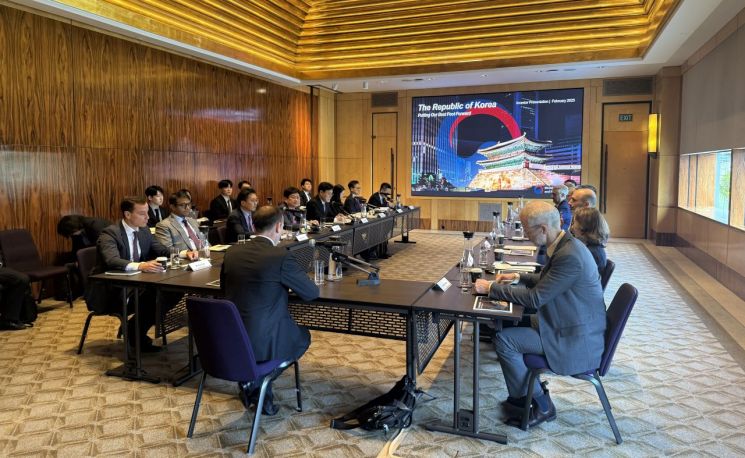 Ambassador Choi Jong-ku, Special Representative for International Financial Cooperation, is delivering a greeting at the "Singapore Korea Economic Briefing" held on the 14th (local time) at the Ritz-Carlton Millenia Hotel in Singapore.
The three major global credit rating agencies expressed the view that it is difficult to consider the new U.S. administration's policies, such as tariff imposition and increased defense cost-sharing demands, as factors affecting South Korea's sovereign credit rating.
According to the Ministry of Economy and Finance, Ambassador Choi Jong-gu, Director-General for International Financial Cooperation, and government officials met with senior executives from global credit rating agencies including S&P, Moody's, and Fitch in Hong Kong and Singapore from the 11th to the 14th. This was the first face-to-face meeting following last month's video conference between Acting Prime Minister and Minister of Economy and Finance Choi Sang-mok and the heads of the three major global rating agencies, arranged to explain recent changes in South Korea's political and economic situation and the government's response direction.
At the meeting, the three major global rating agencies evaluated that "South Korea is handling the recent situation well based on its constitution and democratic norms," and noted that "unlike other countries where political deadlock has been linked to worsening fiscal conditions leading to downgrades or negative outlooks, South Korea's case is different."
Regarding the new U.S. administration's policies such as tariff imposition and increased defense cost-sharing demands, they expressed the opinion that "while these may have some impact on the Korean economy, it is still difficult to view them as factors for credit rating changes."
Attendees at the meeting included Jin Fang, Head of Moody's Sovereign Ratings for Asia-Pacific; Kim Eng Tan, Head of S&P Sovereign Ratings for Asia-Pacific; and Jeremy Zuk, Director in charge of Fitch's Korean Sovereign Ratings.
Ambassador Choi and others also held an investor relations (IR) session explaining the Korean economy to global investors. This IR was attended by senior executives from major global asset management firms such as BlackRock, the world's largest asset manager, and PIMCO, the world's largest bond manager, and was composed of a small group of about ten people to facilitate substantive discussions. This briefing, the first held by the Korean government since the December 3 martial law incident, included participation from key institutions such as the Ministry of Economy and Finance, the Financial Services Commission, Korea Investment Corporation, and the International Financial Center.
Ambassador Choi emphasized regarding value-up initiatives, which attracted significant investor interest, that "since there is a social consensus, these will be steadily pursued over the long term regardless of political changes." He also stated, "Along with follow-up measures to existing policies such as awarding excellent companies and publishing white papers, structural institutional improvements in the stock market, including enhancing the rationality of IPO pricing and strengthening delisting requirements and procedures, will continue."
Regarding the U.S. administration's tariff imposition response, he maintained the position that "specific details such as target items and rates have yet to be decided," but added, "the Korean government is already fully prepared with various feasible scenarios centered on relevant ministries."
On the medium- to long-term demographic issues, he explained, "Since these are not problems that can be solved quickly, we will focus on highly effective policy tasks based on an analysis of the effectiveness of past birth rate promotion policies, while simultaneously adopting a multidimensional approach including securing economically active populations such as women and foreigners and structural reforms to improve productivity."
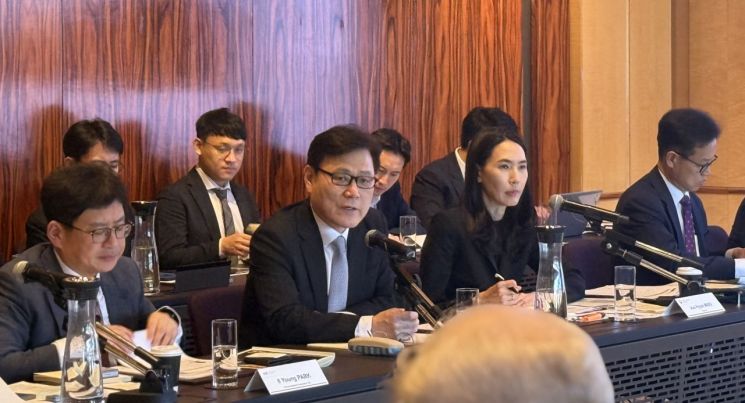
At the IR session, the government also provided a detailed diagnosis of the Korean economy. First, Fitch, one of the three major global credit rating agencies, maintained South Korea's credit rating and outlook at 'AA-, stable' as before, and the credit default swap (CDS) premium indicating sovereign default risk has recovered to pre-martial law incident levels, reflecting continued international confidence in the Korean economy.
Regarding external soundness, the government assessed that South Korea's stable foreign exchange reserves ranked ninth globally, the largest-ever net external financial assets amounting to 1 trillion dollars, and a government debt ratio significantly lower than major countries demonstrate the robust fundamentals of the Korean economy.
To improve stock market investment conditions, the government announced improvements to the short-selling system in June last year and has been implementing related follow-up measures. The improved system is planned to be smoothly implemented by the end of next month, with the completion of IT system construction to allow the resumption of short selling. The 'Corporate Value-Up Program' announced in February last year has shown gradual results such as increased corporate disclosure participation, and the government will continue to promote tax support measures and corporate governance improvements.
© The Asia Business Daily(www.asiae.co.kr). All rights reserved.


















