Pothole Damage on Industrial Roads in Jingok and Hanam Especially Severe
Gwangju Sees 265 Claims for Public Facilities Liability Insurance This Year
Thousands of Claims Filed Annually, with Complicated Procedures
Late-Night Tire Shops Charging Two to Three Times the Usual Price
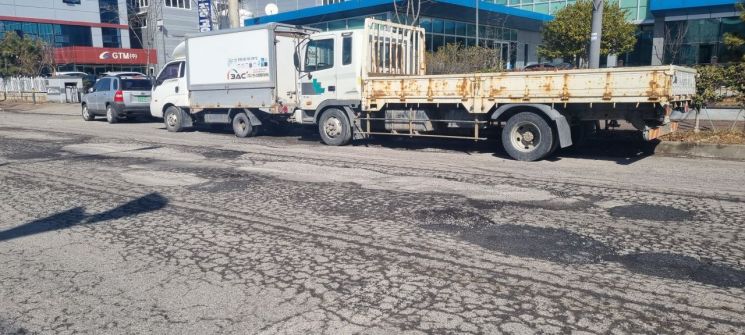 On the morning of the 15th, potholes appeared in various places around Jingok Industrial Complex in Jingok-dong, Gwangsan-gu, Gwangju, due to heavy snowfall that lasted for a week since the 3rd. Photo by Min Chanki
There are growing concerns that the safety of drivers is being threatened by the appearance of potholes (road surface depressions) in various parts of Gwangju, following a week-long heavy snowfall earlier this month. In particular, drivers are complaining that the problem is especially severe in areas like Hanam and Jingok Industrial Complexes, where large cargo trucks frequently travel and repeated snowfall has weakened the roadbed, leading to more severe pothole occurrences.
As a result, tire damage has become common, forcing drivers to replace even undamaged tires out of necessity, which has led to increasing dissatisfaction with the authorities' slow response to repairing potholes. Although local governments are alleviating some of the financial burden through liability insurance for public facilities, the process is complicated and compensation can take two to three months, highlighting the urgent need for improvements to the system.
Furthermore, drivers who have had to use late-night repair shops to replace tires damaged by pothole accidents often find themselves forced to purchase expensive tires they did not want, making it urgent to come up with countermeasures.
◇ Potholes Springing Up Across Gwangju, Including Jingok and Hanam Industrial Complexes
On the morning of the 15th, around the Jingok Industrial Complex in Jingok-dong, Gwangsan-gu, Gwangju.
Due to the heavy snowfall that began on the 3rd and lasted about a week, potholes (road surface depressions) appeared in several places along the roads in this area. Potholes with diameters estimated at 25?30 cm were found in clusters of five to ten, with pieces of stone scattered around them.
Because cargo trucks frequently travel through this area, the potholes were not only larger but also deeper than those on other roads.
Drivers of cargo trucks and other vehicles, upon seeing the potholes, abruptly changed lanes, resulting in near-collisions with vehicles in adjacent lanes.
One cargo truck, unable to spot the pothole in advance, drove over it with a loud thud, while another driver, apparently shocked by the impact, stopped and got out to inspect their vehicle for damage.
Around the same time, in the Hanam Industrial Complex area of Gwangsan-gu.
In this area, including Hanam Industrial Complex and Hanam-daero, 16 potholes had been repaired by the city of Gwangju as of the previous day, but large and small potholes still remained, posing a threat to vehicles.
Some of the repaired potholes had become damaged again, leaving new holes, and drivers were seen swerving to avoid them, performing what looked like acrobatic maneuvers.
The city of Gwangju announced that, from the 3rd (when the snow began) to the previous day, it had repaired 2,339 potholes across the Gwangju area.
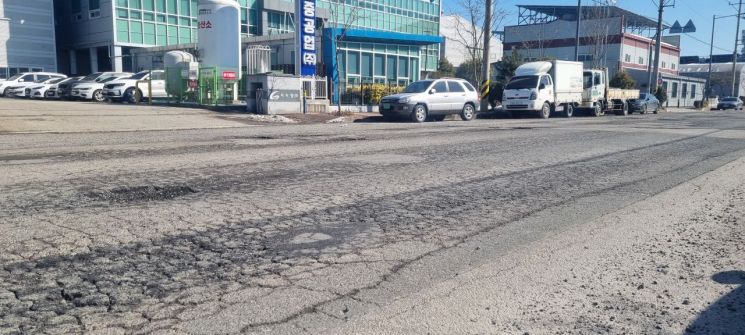 On the morning of the 15th, potholes appeared in various places around Jingok Industrial Complex in Jingok-dong, Gwangsan-gu, Gwangju, due to heavy snowfall that lasted for a week since the 3rd. Photo by Min Chanki
◇ Increasing Number of Claims Filed for Liability Insurance for Public Facilities Every Year
According to the city of Gwangju, the number of claims filed with the Gwangju Comprehensive Construction Headquarters for liability insurance for public facilities due to potholes has been rising sharply each year: 1,343 cases in 2021, 328 in 2022, 1,374 in 2023, and 3,008 in 2024.
As of the 13th of this year, 265 people had applied, with 120 cases currently being processed.
These figures only account for claims related to damages on the 378 routes (covering 597 km) managed by the city of Gwangju. If damages on roads managed by the five districts of Gwangju, such as side streets, are included, the number of claims is expected to be even higher.
Liability insurance for public facilities is a system in which damage caused by management defects in facilities such as roads, parks, government buildings, and sports facilities managed by local governments is handled by an insurance company, allowing citizens to receive compensation.
However, there has been a growing number of cases where this national insurance system is being abused.
For example, Mr. A drove over a pothole in the Jingok Industrial Complex area of Gwangsan-gu at around 7 p.m. on the 12th, causing his tire to be torn. He called a towing company and headed to a nearby repair shop.
Most repair shops were closed at the time, so Mr. A had no choice but to go to Repair Shop B in Suwan-dong, Gwangsan-gu.
However, Repair Shop B explained that only foreign tires from brands like 'D' and 'M' were in stock. The price of these tires ranged from 400,000 to 600,000 KRW, two to three times the price of regular tires.
Due to the high price, Mr. A gave up on the repair, called the towing company again to return home, and replaced his tire at another shop the next day for about 200,000 KRW.
Mr. A said, "I couldn't bring myself to replace the tire at a price two to three times higher than usual," and added, "I couldn't understand how such a well-known repair shop only had foreign tires in stock."
◇ Increasing Cases of Abuse of the Liability Insurance System for Public Facilities
Local towing companies unanimously reported that it is common for repair shops to exploit the liability insurance system for public facilities to make excessive profits.
Kim, who operates a towing company in Gwangju, said, "It's rare to find a repair shop open late at night, and as pothole-related accidents have increased, many shops are taking advantage of this situation for profit. Some inflate the cost of tire replacement to two or three times the usual price and entice customers by mentioning the liability insurance system for public facilities."
He added, "In the case of Repair Shop B, if a customer needs to travel to a distant area, the shop insists on replacing the tire and first asks where the customer is headed. Over the past week, the number of towing requests has tripled, but it's the repair shops that are making excessive profits."
There have also been calls for improvements to the system, as some ordinary citizens are also abusing it.
Park, who runs another towing company, said, "For imported cars, tire replacement is expensive, so some people deliberately lower the tire pressure to half and intentionally damage the tire. Since it's not possible to replace just one tire, some repair shops even intentionally damage the rear part of the already damaged tire and tell customers that they can replace it with the opposite front tire after the repair."
He continued, "At the same location, there have been dozens of towing requests in a single day. We asked the local government to provide sandbags for temporary measures, but they refused, saying that professional repairs were necessary. Pothole repairs need to be carried out more quickly, and the insurance system also urgently needs improvement."
Regarding this, a Gwangju city official stated, "For liability insurance for public facilities, the loss adjuster investigates documents such as repair estimates related to the accident, while the local government is only responsible for receiving the claims. Sometimes, if there is a surge in applications or disputes arise, compensation can take a long time. The level of compensation is determined by the loss adjuster, so it's difficult for the local government to intervene."
© The Asia Business Daily(www.asiae.co.kr). All rights reserved.













