Ministry of Land, Infrastructure and Transport Implements Enhanced Safety Standards
Auxiliary Batteries and Electronic Cigarettes Prohibited from Overhead Storage
Must Be Carried in Plastic Bags or with Insulating Tape
Limit of Five Units Under 100Wh, Two Units Under 160Wh
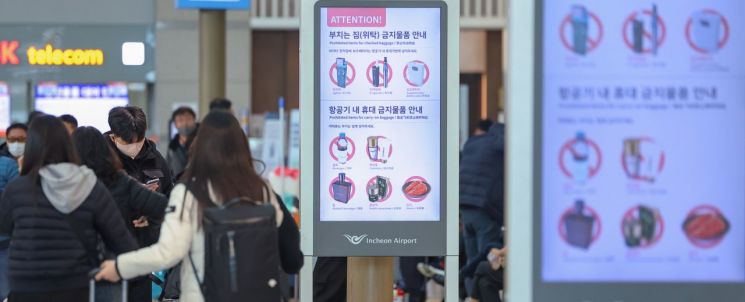 On the afternoon of the 3rd, a notice about prohibited checked baggage items is displayed on a screen near the check-in counters at the Departure Hall of Terminal 1, Incheon International Airport. Photo by Yonhap News
Starting from the 1st of next month, it will be prohibited to store auxiliary batteries and electronic cigarettes in the overhead luggage compartments on domestic airline passenger planes, and their capacity and quantity will also be restricted.
On the 13th, the Ministry of Land, Infrastructure and Transport announced that from March 1st, a strengthened safety management system standard for lithium-ion auxiliary batteries and electronic cigarettes will be implemented on domestic airline passenger planes. The standard was established following the Air Busan passenger plane fire incident at Gimhae International Airport on the 28th of last month. Although the cause of the fire has not yet been clearly identified, considering public concerns about the fire risks of auxiliary batteries, a common standard applicable to domestic airlines has been set as a preemptive measure.
According to this policy, new safety regulations will require that auxiliary batteries and electronic cigarettes be placed in visible locations or carried on the body rather than stored in overhead compartments during flights. Additionally, charging other auxiliary batteries or electronic cigarettes using USB ports installed at the seats or auxiliary batteries is also prohibited. Passengers must immediately report to the flight attendants if they notice any abnormal signs such as auxiliary batteries getting stuck between seats or overheating. Electronic devices with built-in batteries such as mobile phones and laptops, excluding auxiliary batteries and electronic cigarettes, are equipped with built-in short-circuit prevention devices and are not subject to the strengthened regulations.
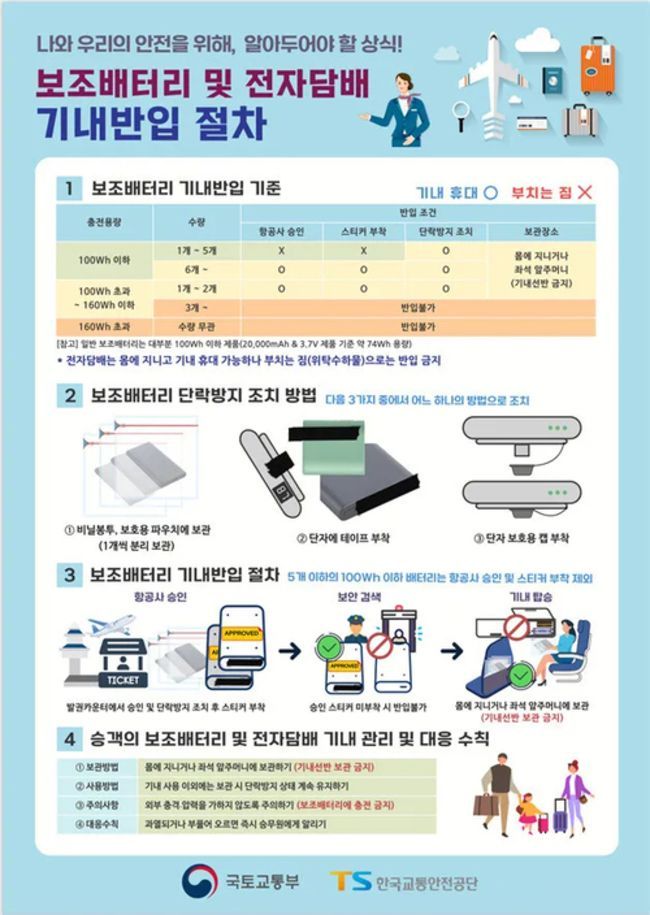 Procedures for Carrying Portable Chargers and Electronic Cigarettes on Board. Provided by the Ministry of Land, Infrastructure and Transport
Furthermore, the Ministry of Land, Infrastructure and Transport is strengthening regulations allowing up to five auxiliary batteries or electronic cigarettes with a capacity of 100Wh or less to be carried on board. If there are more than five, passengers must obtain separate approval from the airline at the check-in counter and have a sticker attached. Approval is granted only for special reasons such as charging medical devices like artificial pacemakers. Auxiliary batteries with a capacity between 100Wh and 160Wh are allowed up to two units with airline approval. Batteries exceeding 160Wh capacity are not allowed on board at all.
As with current policies, auxiliary batteries cannot be sent as checked baggage regardless of capacity and are only allowed as carry-on items. Regulations to prevent battery short circuits by ensuring that charging terminals (recessed or protruding) do not come into contact with metal will also be practically enforced on board. Passengers will be advised to cover exposed battery terminals with insulating tape before boarding or, if not possible, to store them in zipper bags. The Ministry plans to provide short-circuit prevention plastic bags at check-in counters and on board. Even when placed in plastic bags, auxiliary batteries must be kept in the seat storage space or carried directly on board.
The Ministry also plans to open and conduct additional inspections if unapproved auxiliary batteries are suspected in luggage at airport security checkpoints or upon airline request. Detected unapproved batteries will be handed over to the airline for verification and handling, and the number of detections will be reported to airlines once a month to request internal corrective actions.
The standard does not include direct penalties for passengers who violate the regulations on carrying batteries on board. Yu Kyung-soo, Director of Aviation Safety Policy at the Ministry, explained, "This was considered with the public burden in mind, and we will review changes to the system as needed while monitoring the implementation process." He added, "If passengers do not cooperate with the in-flight safety procedures guided by airlines, they may be reported for in-flight security violations." He also urged, "We ask all passengers to strictly comply with the auxiliary battery and electronic cigarette carriage standards and actively cooperate with airline instructions and security checks."
© The Asia Business Daily(www.asiae.co.kr). All rights reserved.


















