Kwon Ohjoon, Former POSCO Chairman, Interview with Our Publication
"Trump's Tariff Policy Unlikely to Be Fully Enforced"
Sees Possibility of Compromise Before Implementation
"If a 25% tariff is imposed on all imported steel, the United States will also suffer significant losses. (Our companies) should not be too scared and need to wait a bit longer."
Former POSCO Chairman Kwon Oh-joon urged the domestic industry to respond calmly regarding the U.S. policy on imposing tariffs on imported steel. Considering the current state of the U.S. steel industry and demand, he highly anticipated that negotiations would likely proceed to find a compromise before the tariff enforcement date (local time March 12).
After finishing a talk concert held on the 13th at the Korea Science and Technology Center in Gangnam-gu, Seoul, former Chairman Kwon told this publication in response to the question, "What should be the top priority response strategy for our steel industry regarding U.S. President Donald Trump's announcement of a 25% steel tariff?" Kwon is recognized as a steel expert who contributed to elevating POSCO to the top tier of the industry. Having served as the president of the World Steel Association, he also holds international prestige and recognition within the industry.
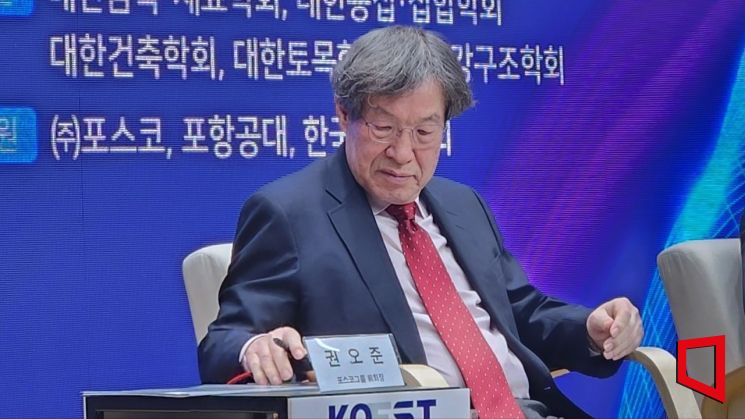 Former POSCO Chairman Kwon Oh-joon is having a conversation with Yoon Ui-jun, President of the Korean Academy of Engineering, after giving a lecture at the talk concert "Science Connecting the Era" held at the Korea Science and Technology Center in Gangnam-gu, Seoul on the 13th. (Photo by Cho Seong-pil)
Former Chairman Kwon said, "It is difficult to believe that President Trump's tariff strengthening policy will be implemented 100%," and predicted, "If a compromise is reached, it will be accepted." This implies that, as in the first Trump administration, there will be room for country-specific negotiations. President Trump also announced a 25% tariff on imported steel in 2018 based on Section 232 of the Trade Expansion Act. However, subsequent country-specific negotiations led to separate agreements, and at that time, South Korea was subject to a quota system limiting exports to the U.S. to about 2.63 million tons annually in exchange for tariff exemption.
Former Chairman Kwon stated, "President Trump is a smart person and will not ruthlessly enforce tariff strengthening policies as announced," adding, "If a 25% tariff is imposed on all imported steel, the U.S. will also suffer significant losses." If tariffs are imposed as announced, prices for items that U.S. steel companies cannot produce will rise sharply, and raw material prices are also likely to surge, inevitably causing damage to the U.S. as well.
He advised the domestic steel industry, "There is a need not to be too scared of President Trump and to wait a little longer." Since major countries such as Japan, the United Kingdom, and the European Union (EU) are actively responding, it implies that South Korea will soon seek solutions through negotiations. This can also be interpreted as a call for the domestic steel industry to actively support negotiations with the U.S. government in the future.
Earlier, on the 10th (local time), President Trump signed a proclamation imposing a 25% tariff on steel and aluminum products imported into the United States. The steel and aluminum tariff proclamation signed by President Trump reportedly includes applying a uniform 25% tariff to countries like South Korea, which had previously received some exceptions during the first term in 2018 when a 25% tariff was imposed on steel products.
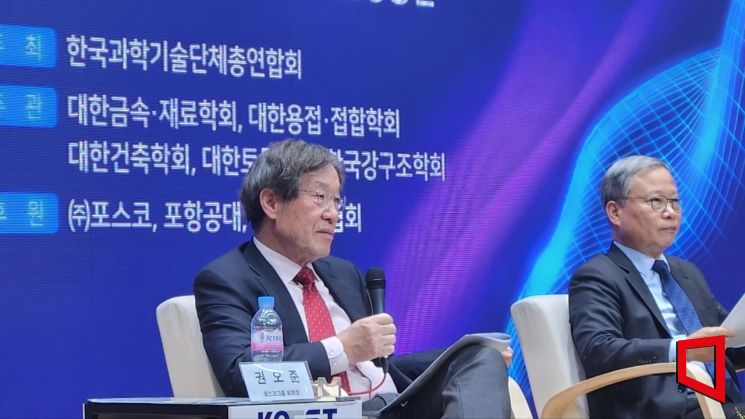 Former POSCO Chairman Kwon Oh-joon (left) is having a conversation with Yoon Ui-jun, President of the Korean Academy of Engineering, after giving a lecture at the talk concert "Science Connecting the Era" held at the Korea Science and Technology Center in Gangnam-gu, Seoul on the 13th. Photo by Cho Sung-pil
Initially, President Trump stated before signing the proclamation that there would be no tariff exceptions or exemptions, leading the industry to expect that all steel-producing countries would face the same competitive environment. However, when President Trump said at the tariff proclamation signing ceremony that he would "consider a lot" about exempting Australia, the situation was seen to have changed.
Meanwhile, former Chairman Kwon is called a "living legend" in the domestic steel industry. He graduated from Seoul National University with a degree in Metallurgical Engineering and earned a Ph.D. in Metallurgical Engineering from the University of Pittsburgh in the United States before joining POSCO in 1986. He subsequently held key positions such as head of the POSCO Technical Research Institute, President of POSCO Technology, CEO of POSCO, Chairman of Pohang University of Science and Technology, Chairman of the National Academy of Engineering of Korea, and President of the World Steel Association.
At the talk concert, he gave a lecture titled "The Journey of Humanity Through Steel," predicting that global demand for steel will increase, especially centered on India and Africa. He emphasized the need to apply innovative technologies such as the "hydrogen reduction steelmaking" method, which produces molten iron using hydrogen instead of coal, stating, "How to handle this cost is the challenge for our steel industry." POSCO, the nation's top steelmaker, is also working on converting its blast furnace facilities to hydrogen reduction steelmaking, but the cost is reportedly tens of trillions of won.
© The Asia Business Daily(www.asiae.co.kr). All rights reserved.