Special Envoy Leads Direct Negotiations Instead of Third-Country Exchange
Witkoff's Influence Extends Beyond the Middle East
Trump: "Hope This Marks the Start of an End to the Ukraine War"
American teacher Mark Fogel (63) was released after being detained in Russia for three and a half years on charges of possessing medical marijuana, drawing attention to the background that made this possible. Foreign media evaluated that the U.S. negotiation method has changed from the past practice of hostage exchanges, highlighting the significant role of Steven Witkoff, the Middle East special envoy who led the negotiations with full authority.
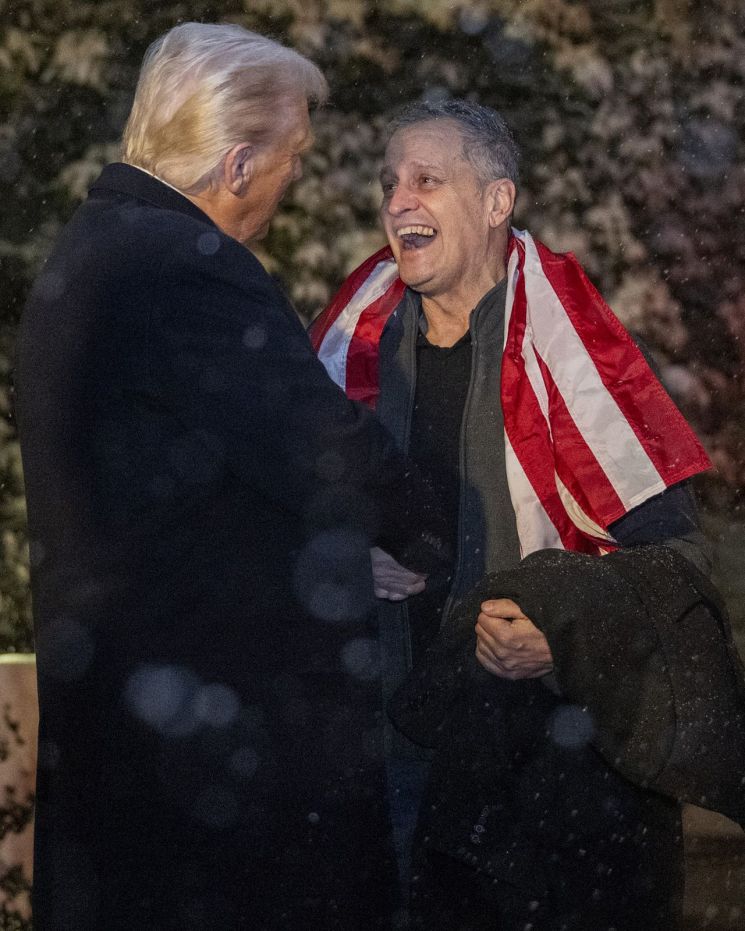 Donald Trump, President of the United States, is talking with Mark Fogel, who was released from Russia, at the White House on the 11th (local time). Photo by UPI Yonhap News
According to AP News and The Wall Street Journal (WSJ), Fogel arrived at the White House on the 11th (local time) with an American flag draped around his neck. He expressed gratitude to the president and staff, saying, "I feel like the luckiest person in the world right now. I am forever indebted to President Trump and Witkoff."
In response, President Trump said, "I am glad you are back," and added, "I am very grateful that Russia sent Fogel home." Although President Trump avoided specific comments about the negotiations with Russia for Fogel’s release, he predicted that additional detainees would be released on the 12th. However, he did not disclose whether those detainees were American or Russian.
Fogel was working as a staff member at the U.S. Embassy in Russia and as a teacher at the American School in Moscow when he was arrested in 2021 after drugs were found in his luggage while returning from the U.S. to Russia. Fogel claimed the drugs were prescribed by a doctor for medical use, but he was convicted and served time in a Russian prison.
Foreign media focused on the fact that the U.S. negotiation style revealed in Fogel’s release differs from the past. Previously, hostage exchanges with Russia took place in third countries such as Turkey, but this time, Witkoff, the Trump administration’s Middle East special envoy, directly led the negotiations in Moscow, resulting in the release. WSJ analyzed, "President Trump avoided official diplomatic channels and instead engaged in negotiations through the personal envoy Witkoff." WSJ also reported that this release demonstrates Witkoff’s influence expanding beyond the Middle East.
There is also an interpretation that the diplomatic strategy toward Russia may change. The New York Times (NYT) analyzed, "This suggests the possibility of a new negotiation method with Russia," adding, "Since a trusted close aide of President Trump directly conducted the negotiations, the U.S. diplomatic strategy toward Russia may change in the future."
Before meeting Fogel, President Trump emphasized during a press meeting at the White House that he hopes Fogel’s release marks the beginning of a relationship aimed at an early end to the Ukraine war. President Trump said, "I hope this is the start of a relationship to end the Ukraine war and prevent millions of people from dying."
He reiterated his determination for an early end to the Ukraine war. President Trump said, "They (Russia and Ukraine) have lost millions. About 1.5 million soldiers have been lost in a short period," adding, "I think we need to end that war."
© The Asia Business Daily(www.asiae.co.kr). All rights reserved.












