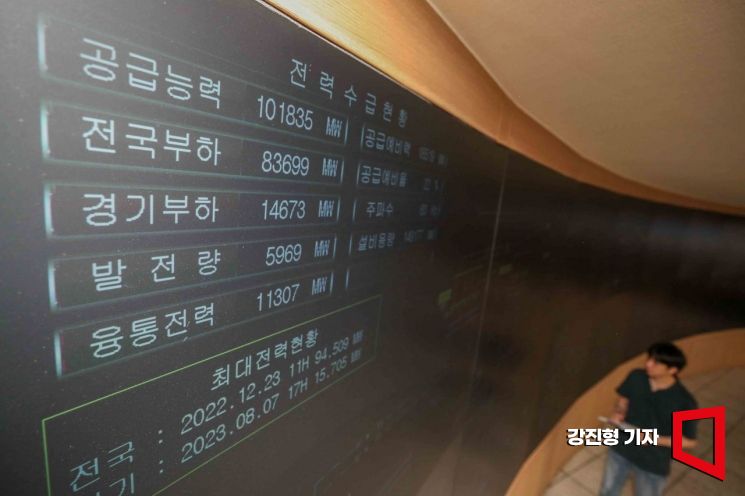
 On the 7th, as heatwaves and tropical nights continue across most regions nationwide, officials are checking the power supply situation at the System Operation Center of the Power Management Department, Korea Electric Power Corporation Gyeonggi Headquarters in Suwon, Gyeonggi Province. Photo by Jinhyung Kang aymsdream@
The government conducted an inspection last year on so-called 'power grid squatting,' where operators secure the power grid but do not engage in actual power generation projects, and it was found that the amount recovered reached 1.7GW.
According to the results of the power grid squatting inspection announced by the Ministry of Trade, Industry and Energy on the 12th, the recovered capacity by region last year was 533MW in the Gangwon area, 507MW in the Yeongnam area, 357MW in the Honam area, 325MW in the Seoul metropolitan area, and 49MW in the Chungcheong area, totaling 1.7GW nationwide.
The inspection targeted operators who had signed grid usage contracts more than two years ago. Capacity was recovered from operators who had taken no project advancement measures such as land acquisition or project permit applications, and those who delayed grid usage without special reasons.
The power authorities plan to use the secured spare capacity to advance the connection timing of power generation operators waiting to connect to the grid, and if there is remaining capacity, to allocate it to operators wishing to start new power generation projects. First, the spare capacity of 336MW (Honam area) will be disclosed on the Korea Electric Power Corporation website starting from the 13th. The rest will be allocated by the end of next month.
So far, the power authorities have been significantly expanding power grid investment plans to implement the power mix (a system composed of power sources such as nuclear, thermal, and hydro) including the expansion of carbon-free power sources.
However, the standard construction period required for power grid construction is nine years (based on 345kV), which limits short-term expansion, and considering recent low local acceptance of power grids and delays in local government permits, timely power grid construction is becoming increasingly difficult. In some areas, concerns are rising over the regular occurrence of output control due to insufficient grid capacity as power generation facilities exceeding local demand enter before grid reinforcement.
To prevent this, the power authorities have been strengthening management of phantom operators who secure the grid but do not engage in power generation projects. Since the end of May last year, they have been guiding 'system management substations to minimize output control,' and power generation facilities wishing to connect to these substations can only be permitted to operate conditionally after the grid reinforcement timing. The early connection substations and capacity (336MW) in the Honam region to be disclosed this time reflect the recovered capacity from phantom operators.
Lee Ho-hyun, Director of the Energy Policy Office at the Ministry of Trade, Industry and Energy, said, "Even under the current limited power grid conditions, we will actively expand the use of NWAs (Non-Wire Alternatives) such as improving the efficiency of existing grid usage to ensure the smooth spread of renewable energy," adding, "We will also steadily establish institutional foundations for power grid expansion, including the enactment of the 'Special Act on Expansion of National Power Grid'."
© The Asia Business Daily(www.asiae.co.kr). All rights reserved.

![Clutching a Stolen Dior Bag, Saying "I Hate Being Poor but Real"... The Grotesque Con of a "Human Knockoff" [Slate]](https://cwcontent.asiae.co.kr/asiaresize/183/2026021902243444107_1771435474.jpg)















