Shilla University Graduate School of Social Welfare (President Heo Nam-sik) held a policy seminar and winter academic conference on the theme of "Challenges and Tasks Following the Enforcement of the Regional Care Integrated Support Act."
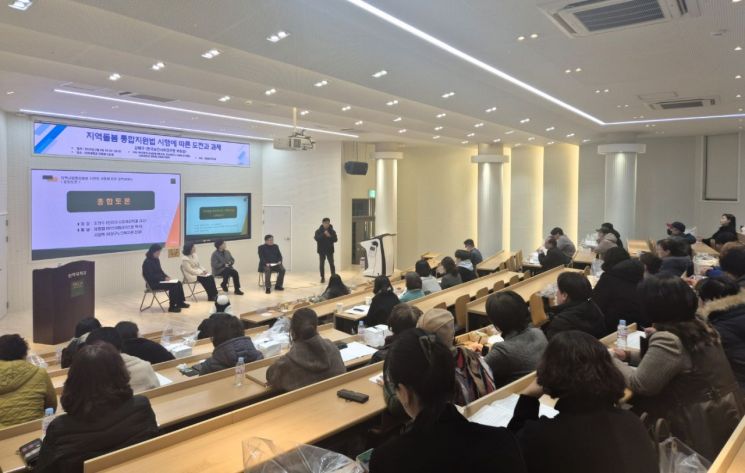 Shilla University Graduate School of Social Welfare held the Winter Academic Conference on "Challenges and Tasks Following the Implementation of the Regional Care Integrated Support Act." Photo by Shilla University
On the 6th, at Shilla University's Humanities Building, a policy seminar and winter academic conference on the theme of "Challenges and Tasks Following the Enforcement of the Regional Care Integrated Support Act" was jointly hosted by the Shilla University Social Welfare Research Association, Busan Social Welfare Council, and Busan Social Workers Association. The event shared various opinions on responding to the era of a super-aged society with an elderly population of ten million and an aging rate of 20%, and on strengthening the regional care system.
On that day, Kang Hye-gyu, Vice President of the Korea Institute for Health and Social Affairs, delivered a presentation titled "Challenges and Tasks Following the Enforcement of the Care Integrated Support Act," diagnosing that the core pillar of Korea's social security and welfare system at this stage is "care," and argued that multidimensional preparations are necessary to improve the quality and expand the quantity of care, as well as to enhance safety.
In particular, the "Act on Integrated Support for Regional Care including Medical and Nursing Care" was enacted in March last year and is scheduled to be enforced in March next year. The expansion of neighborhood care and the establishment of an extended welfare network have emerged as important policy tasks. The "Care Integrated Support Act" is expected to bring many changes, such as systematizing care within the community, integrated operation of beneficiary selection and benefit provision, and playing a central role in welfare administration led by basic local governments.
Vice President Kang forecasted that although the current care paradigm demands the expansion of service universality, public responsibility, and community leadership, considerable time will be required to prepare administrative and institutional frameworks, necessitating a long-term approach.
In the subsequent discussion, Dr. Choi Young-hwa of the Busan Social Service Center pointed out that for integrated operation of care, clear role division among central information, metropolitan local governments, and basic local governments is essential. She emphasized the importance of participation by regional branches related to long-term care of the National Health Insurance Corporation and suggested that detailed supplements to future government plans, such as considering the introduction of a neighborhood primary care physician system, are necessary.
Seo Jeong-hee, Director of Sasang-gu Senior Welfare Center, stressed the need to refer to the care system built around the Community Comprehensive Support Center within the population range of 10,000 to 20,000 in Japanese municipalities (市町村), which corresponds to a middle school district area accessible within a 30-minute walk.
Professor Cho Eui-su of Shilla University's Department of Social Welfare argued that in the United States, the United Kingdom, and Japan, care operations are all striving to strengthen capabilities centered on neighborhoods, emphasizing comprehensive integration of health, medical, welfare, and care services, and proceeding in a manner that respects regional characteristics to satisfy residents' quality of life.
Professor Cho predicted that when establishing dedicated organizations for integrated support at the city/county/district and town/village/neighborhood levels, unlike Japan’s system where 30% of Community Comprehensive Support Centers are directly operated, Korea is likely to have a 100% direct operation system. Accordingly, while public responsibility will be strengthened during operation, significant financial resources will be required, making funding procurement important.
The attendees agreed that ahead of the enforcement of the Care Integrated Support Act, Busan, which has the highest aging rate among metropolitan cities nationwide, needs to proactively develop and operate a Busan-type integrated care model, striving to provide the highest quality of care services in the country.
© The Asia Business Daily(www.asiae.co.kr). All rights reserved.












