4,330 Positions, 105,111 Applicants
Competition Rate Rebounds for First Time in 9 Years
"Economic Downturn and Improved Civil Servant Benefits Cited as Factors"
The competition rate for the Grade 9 civil service open recruitment exam rebounded for the first time in nine years, recording an average competition rate of 24.3 to 1.
The Ministry of Personnel Management announced on the 8th that a total of 105,111 applicants applied for the Grade 9 national civil service open recruitment exam this year, with 4,330 planned positions to be filled (an average competition rate of 24.3 to 1). The competition rate for the Grade 9 open recruitment increased compared to last year (21.8 to 1), which recorded the lowest rate in 32 years. After recording a competition rate of 53.8 to 1 in 2016, the Grade 9 open recruitment competition rate had been declining for eight consecutive years before rebounding for the first time in nine years. The competition rates over the past five years were ▲2021: 35 to 1 ▲2022: 29.2 to 1 ▲2023: 22.8 to 1 ▲2024: 21.8 to 1.
Although the number of planned recruits for Grade 9 civil servants decreased compared to last year, the number of applicants submitting exam applications increased by 1,514 from the previous year. By job category, the competition rate was 22.1 to 1 for the Science and Technology category and 24.7 to 1 for the Administrative category.
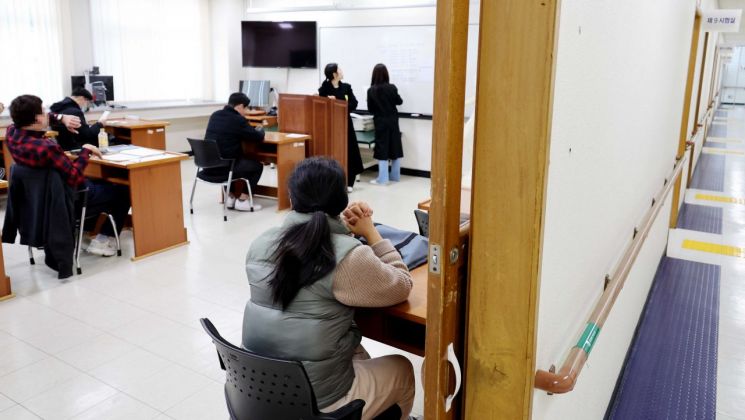 On March 23 last year, examinees were waiting for the start of the written exam for the Level 9 National Public Officials Open Competitive Recruitment Test at a test center in Yongsan-gu, Seoul. Provided by the Ministry of Personnel Management, Yonhap News Agency.
By detailed recruitment units, the highest competition rate in the Science and Technology category was for the Facilities position (Facilities Landscaping), which recorded 100 to 1. In the Administrative category, the Education Administration administrative position recorded the highest competition rate at 363.8 to 1.
The average age of applicants was 30.8 years, slightly higher than last year (30.4 years). Applicants aged 20 to 29 accounted for 53,859 (51.2%), making up more than half, followed by those aged 30 to 39 with 38,638 (36.8%), 40 to 49 with 10,679 (10.2%), and those aged 50 and above with 1,422 (1.4%). By gender, the proportion of female applicants was 55.6%, which is 1.6 percentage points lower than last year (57.2%).
An official from the Ministry of Personnel Management stated, "While the recent economic downturn may have had some impact, it appears that interest in public service has increased again due to the government's continued efforts to improve civil servant treatment." The first exam will be held on April 5. Exam locations will be announced on March 28 through the Cyber National Examination Center. The announcement of the written exam passers will be on May 9.
Meanwhile, the Ministry of Personnel Management recently announced plans to gradually raise the starting salary for Grade 9 civil servants to 3 million KRW per month by 2027 to improve the treatment of practical and low-experience civil servants.
On the 23rd of last month, the Ministry explained that the starting salary for civil servants entering public service for the first time as Grade 9 this year is about 2.69 million KRW, but it will be gradually increased to 2.84 million KRW next year and 3 million KRW by 2027. They also plan to improve treatment mainly for low-experience, practical, and field civil servants, promote a virtuous cycle structure of disaster prevention, compensation, and rehabilitation, and create a "working environment where civil servants work diligently" by boosting morale.
Additionally, to alleviate housing burdens for civil servants without homes, the supply of rental housing will be significantly expanded, focusing on areas with supply shortages relative to demand such as Seoul and Sejong, aiming to supply more than 5,800 rental housing units by 2030. Priority allocation will be given to low-experience and newlywed civil servants. Furthermore, the risk duty allowance for police and fire service civil servants will be increased, and disaster response civil servants will be able to receive both disaster safety allowances and important duty pay simultaneously. To reduce work avoidance caused by an increase in malicious civil complaints, a civil complaint work allowance will be newly established. Also, to strengthen compensation for demanding and busy tasks such as national audits and special holiday duties, the overtime work limit will be expanded from 57 hours per month to 100 hours per month.
© The Asia Business Daily(www.asiae.co.kr). All rights reserved.












