Handmade Data Centers Built with Low-Cost GPUs
Gaming Computers and Crypto Mining Rigs Repurposed
China Maintains an Innovative Ecosystem Despite Full U.S. Pressure
Following the Biden administration's restrictions on the export of high-end graphics processing units (GPUs) to China, the re-elected Trump administration is also considering strengthening semiconductor export regulations. Despite not being able to procure advanced American semiconductors, China demonstrated its capability by creating makeshift 'GPU farms' and launching the low-cost, high-efficiency AI model DeepSeek R1, drawing attention to whether China can continue its AI rise.
The GPU export restrictions introduced by the U.S. Department of Commerce in 2022 are known as 'precision' regulations aimed at blocking China's advanced computer engineering research. AI performance depends on the number of parameters and data size, and the U.S. has pressured China by refusing to supply semiconductors with high memory bandwidth (the speed at which memory moves), which can improve AI training efficiency. While China could import GPUs from Nvidia, it was unable to obtain high-bandwidth chips necessary for AI or advanced computing.
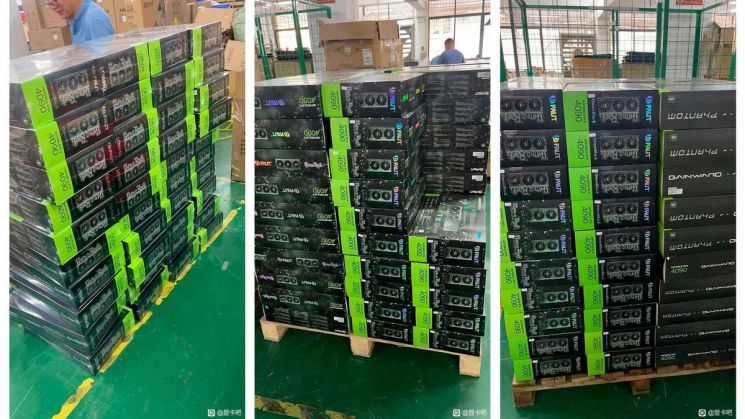 At the end of 2023, when mass semiconductor sanctions began, a logistics center in China was filled with gaming GPUs. Photo by Baidu capture.
To respond to this crisis, Chinese AI researchers and big tech companies devised the idea of 'GPU farms.' When the export restrictions were first introduced, a shortage of Nvidia GPUs emerged in China, largely because big tech companies like Tencent and Baidu bought up many gaming GPUs. Gaming GPUs, unlike data center GPUs, are not used for AI or advanced computing and thus were outside the scope of U.S. surveillance.
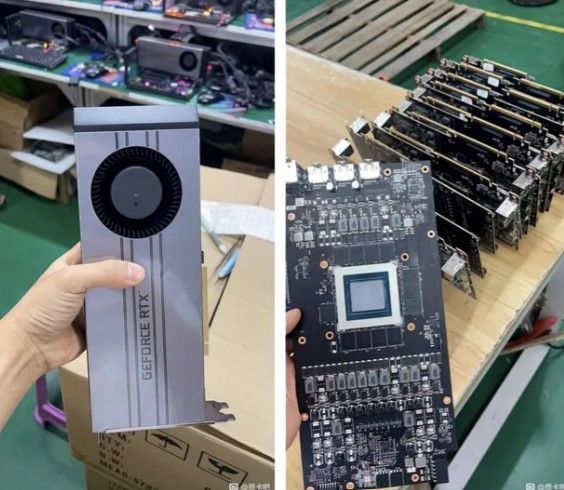
Gaming GPUs are still fully functional GPUs and are useful assets for small-scale AI research. Chinese AI researchers removed chips from gaming GPU cards, soldered them onto custom-made circuit boards, and connected them with high-bandwidth cables to create homemade GPU clusters.
Videos of clusters built directly by Chinese AI engineers during the export restrictions remain on local social networking services (SNS) such as Bilibili and TikTok. The roughly soldered makeshift GPU boards lined up on shelves or in warehouses resemble a farm. Beyond just filming, they actively discussed how to configure GPU farms for more efficient operation.
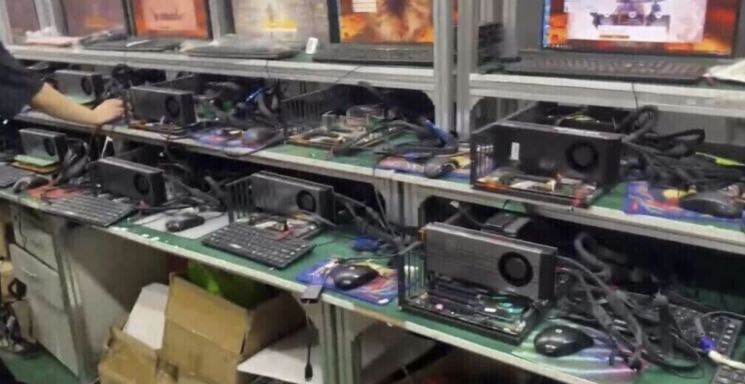 A so-called 'GPU farm' created by connecting general GPUs that are not subject to mass export restrictions. Photo by Baidu Capture
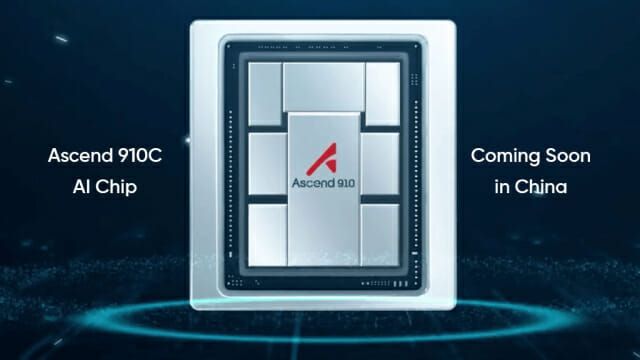
Chinese companies roamed the global black market, indiscriminately buying used GPUs. GPUs used for cryptocurrency mining such as Bitcoin in Russia were also major import targets. Around the same time, GPU manufacturers appeared within China. Huawei released a GPU called 'Ascend 910' in 2023. This GPU is known to rival Nvidia's A100 data center GPU, though it lagged about 1.5 generations behind Nvidia's technology at the time. The equipment presumed to have been used by the AI startup DeepSeek, which emerged like a comet, also employed Huawei's Ascend 910 GPU.
Ironically, the strict U.S. export regulations are credited with enhancing China's ability to build AI data centers. Today, Chinese researchers build clusters mixing low-cost Nvidia GPUs with Chinese-made GPUs. While the computing performance is not outstanding, a self-sufficient ecosystem capable of providing usable AI infrastructure has been established.
The U.S. government's announcement in January this year of new restrictions banning semiconductor companies like Nvidia from exporting advanced AI chips to 20 hostile countries including China and Russia is interpreted as a measure taken with this situation in mind. The U.S. has divided the world into three regions and decided to fully control the export of advanced computer chips to areas classified as 'Tier 3.'
Tier 3 includes China, Macau, Iran, Russia, Belarus, Cuba, and 20 other countries.However, there are concerns that the U.S.'s intense pressure may only strengthen China's competitiveness in the semiconductor and AI industries. Ned Finkel, vice president in charge of government affairs at Nvidia, criticized, "Extreme restriction policies will affect the main computing performance of countries worldwide." Jensen Huang, CEO, also warned, "U.S. regulations against China will rather stimulate China's independent GPU semiconductor development."
© The Asia Business Daily(www.asiae.co.kr). All rights reserved.
![Clutching a Stolen Dior Bag, Saying "I Hate Being Poor but Real"... The Grotesque Con of a "Human Knockoff" [Slate]](https://cwcontent.asiae.co.kr/asiaresize/183/2026021902243444107_1771435474.jpg)


















