Analysis of National Health Insurance Hospitalization and Death Data by Rep. Kim Yoon's Office
Majority of Excess Deaths Occurred in Long-Term Care and Tertiary General Hospitals
An analysis revealed that more than 3,000 patients died over six months from February last year, when residents collectively resigned in protest against the increase in medical school admissions, due to not receiving timely treatment.

On the 5th, the office of Kim Yoon, a member of the Health and Welfare Committee of the National Assembly from the Democratic Party of Korea, analyzed hospitalization and death statistics over 10 years from 2015 to last year and estimated that 3,136 excess deaths occurred nationwide from February to July 2024, a period marked by a medical service gap.
Excess deaths refer to the number of deaths exceeding the normally expected level. According to the National Health Insurance Service, 4.67 million patients were hospitalized from February to July 2024, of whom 1.01%, or 47,270, died. This rate is about 0.2 percentage points higher than the 0.81% mortality rate during the same period from 2015 to 2023. When calculating excess deaths by AADRG adjusted for severity, the office claims approximately 3,136 excess deaths occurred.
By type of medical institution, the mortality rate in long-term care hospitals increased the most, from 1.14% to 1.7%, a rise of 0.56 percentage points, resulting in 4,098 excess deaths. Additionally, excess deaths in tertiary general hospitals numbered 110, and in general hospitals, 76.
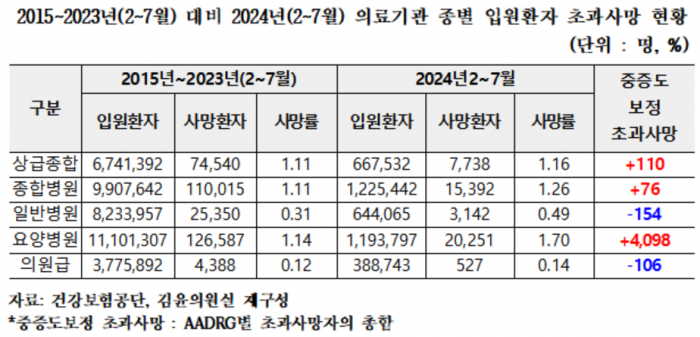
Monthly, excess deaths started at 513 in February, when resident departures began, slightly decreased to 357 by April, then surged to 627 in June. Among the top 20 AADRG disease groups with the highest excess deaths, 'Delirium including cognitive impairment (other organic disorders in those aged 65 and over)' accounted for 2,479 deaths, followed by heart failure and shock with 300 deaths, and nervous system neoplasms in those aged 18 and over with 293 deaths.
Rep. Kim said, "After analyzing inpatient death data considering factors affecting mortality such as disease group severity over the past 10 years, we confirmed that more than 3,000 excess deaths occurred during the six months following the medical policy conflict due to patients not receiving appropriate treatment." He added, "It appears that not only emergency patients visiting university and general hospitals but also patients in long-term care hospitals whose conditions worsened were unable to receive proper treatment and died due to the medical crisis."
He continued, "Although the emergency medical system seems to be functioning well on the surface, in reality, many citizens are suffering serious harm due to the medical crisis," and emphasized, "The government must systematically analyze the extent of patient harm and prepare realistic measures to resolve the medical crisis."
© The Asia Business Daily(www.asiae.co.kr). All rights reserved.













