Only 20 Out of 30 Libraries in Gwangju Operate Study Rooms
Fewer Study Spaces as Libraries Become Complex Cultural Centers
High Study Cafe Fees Draw Complaints
Most Lecture and Club Rooms Remain Unused for Long Periods
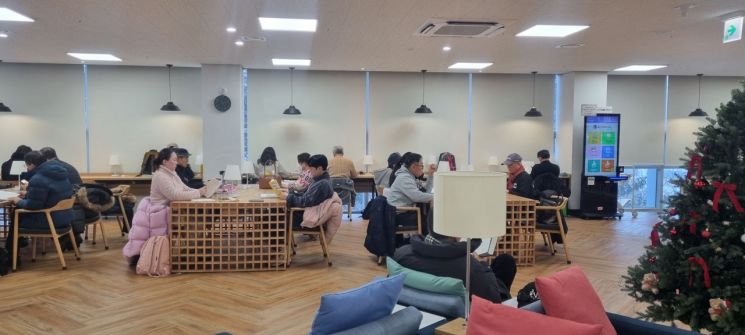 On the morning of the 4th, citizens are reading books in seats prepared in the general reference room of Seobitmaru Library in Pungam-dong, Seo-gu, Gwangju. Photo by Min Chanki
"There is no space to study, no friends my age, and it's more comfortable to study at a study cafe than at the library."
On the morning of the 4th, at Seobitmaru Library in Pungam-dong, Seo-gu, Gwangju.
The general reference room of this library, located on the 4th floor of the Seobitmaru Culture and Arts Center, had about 30 seats. Most of the seats were occupied by elderly people reading books, and only about three or four students were studying.
Since there is no separate reading room (study room) in this library, citizens were reading or studying in the space next to the bookshelves. One elderly person was passing the time surfing the internet, while another was alternating between reading newspapers and books.
The seats filled up quickly from early in the morning, leaving no available spots. A student, who appeared to be a middle schooler, was seen opening the library door, looking around for a seat, and leaving immediately after finding none available.
Kim Gihyun (71), who lives in Pungam-dong, said, "I'm still too young to go to the senior center, and there's a sense of exclusivity there, so I often use the library," adding, "I come often because I can enjoy not only books but also the internet, newspapers, and various cultural activities."
Around the same time, at Pureungil Library in Juwol-dong, Nam-gu.
Similarly, there was no separate reading room here either, and the only spaces for reading were about 20 seats inside the general reference room and a lecture room. This library is being used as a complex cultural space, consisting of club rooms, cultural classrooms, and audiovisual rooms instead of a reading room.
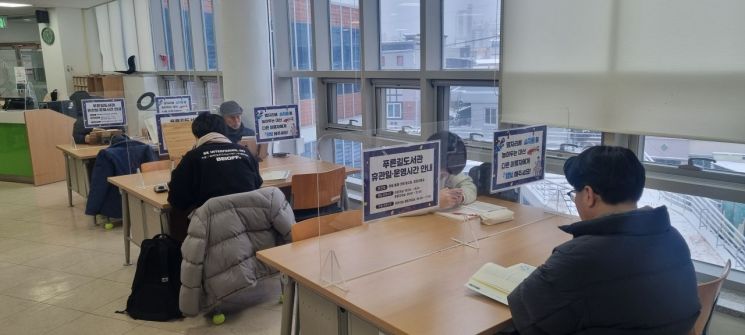 On the morning of the 4th, elderly people were reading books in seats set up in the general reference room of the Pureungil Library in Juwol-dong, Nam-gu. The Pureungil Library had about 30 seats available, but there was no separate dedicated reading room. Photo by Min Chanki
At the seats, elderly people had books open on reading stands, and it was difficult to find young people in their 20s or 30s.
Some citizens were studying in empty lecture rooms, which were relatively quieter compared to the general reference room, but even there, only three people were present.
The few students seen in the library were using it because of the advantage of being able to study for free.
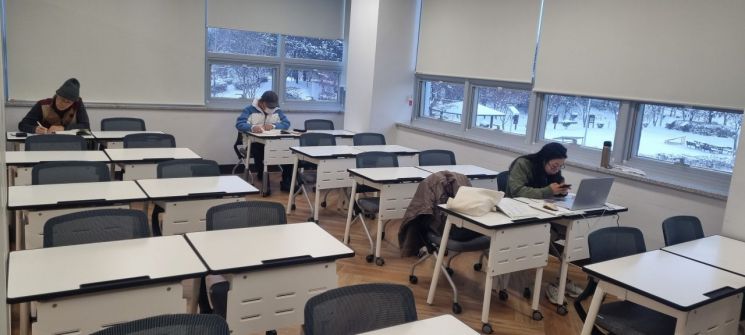 On the morning of the 4th, three people including elderly and young adults are studying in an empty lecture room at Pureungil Library in Juwol-dong, Nam-gu. Photo by Min Chanki
Jeong (23), a university student studying for a major-related certification, said, "The library is attractive because it's free, so I come often, but sometimes I come to save on living expenses," adding, "Looking at my friends, they used to use the library often, but now they mostly study in cafes."
On the other hand, a nearby study cafe had more than 70% of its seats filled, even though users have to pay a certain amount per hour.
In particular, students who appeared to be in their teens mainly used the study cafe, and there were no elderly people at all.
Jang (15, female) said, "There is a library near my house, but there is no separate space for studying and the seats are small and uncomfortable," adding, "Even though the study cafe is expensive, there is no alternative. I use it just because I can freely use the seats."
According to Gwangju City and others, out of 30 public libraries in the Gwangju area, 20 operate reading rooms (study rooms).
In the case of Gwangju City Libraries, all have reading rooms, but out of one library operated by the City Office of Education and 21 district libraries, 9do not have separate study rooms.
The reason for the decrease in reading rooms is that libraries are transforming from simple spaces for studying and reading books into complex cultural spaces. Libraries, which used to be places for entrance exam students and job seekers to study, are now changing to offer various foreign cultures, online lectures, and cultural or club activities.
Because of this, teenage students and job seekers in their 20s and 30s are flocking to study cafes, but they have to pay 2,000 to 3,000 won per hour, or about 100,000 won for a monthly pass. As a result, reading room spaces have been reduced and lecture and seminar rooms have been created, but most of them are left unused for long periods, raising questions about their practicality.
In fact, at a recent library in Gwangju, a complaint was filed asking for a separate reading room, and as a result, a reading room that did not previously exist was opened.
Regarding this, a Gwangju City official said, "Reading room spaces can always be created again, but since teenagers and job seekers in their 20s mainly use cafes, it seems study room spaces have been reduced to create complex cultural spaces," adding, "Nevertheless, most libraries are operating reading rooms. If there are complaints, we will operate them at any time."
© The Asia Business Daily(www.asiae.co.kr). All rights reserved.














