Overseas Demand Declines, Domestic Demand in China Rises
Chinese Companies Cautious Amid Trump’s Adverse Policies... Employment Growth Slows
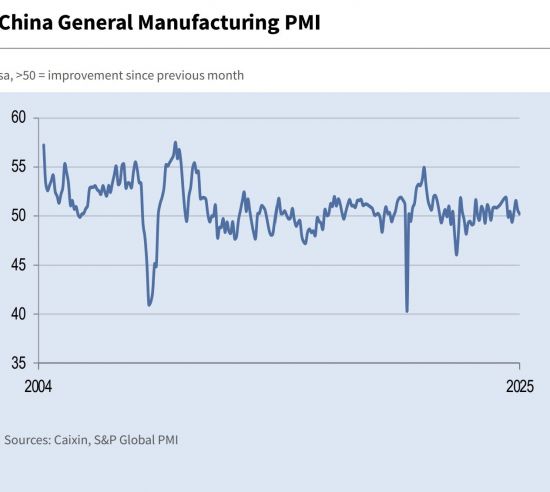 Chinese financial information provider Caixin announced on the 6th that the Caixin Services Purchasing Managers' Index (PMI) recorded 50.1 last month, falling to its lowest level in four months. Data from Caixin
Chinese financial information provider Caixin announced on the 6th that the Caixin Services Purchasing Managers' Index (PMI) recorded 50.1 last month, falling to its lowest level in four months.
According to Caixin foreign reports on the 3rd, the manufacturing PMI for January was 50.1, barely surpassing the baseline to maintain an expansion phase in the economy. This is a 0.4-point decrease from 50.5 in December last year.
The PMI statistics, based on surveys of corporate purchasing managers, indicate economic trends. A value above 50 signifies economic expansion, while below 50 indicates contraction.
However, this was higher than the manufacturing PMI of 49.1 announced by China's National Bureau of Statistics on the 27th of last month. The relatively smaller-scale Caixin survey focuses more on export-oriented companies.
According to the Caixin survey, new overseas orders declined for the second consecutive month last month, and the average selling price of factories recorded the largest drop since July 2023.
With U.S. President Donald Trump imposing an additional 10% tariff on Chinese products and 25% tariffs on imports from Canada and Mexico, the risk of a new trade war has become a reality. Conversely, expectations that domestic demand in China will improve and the government will expand economic stimulus measures supported the downside.
Wang Zhe, a Caixin analyst, noted, "Although growth in the manufacturing sector is limited, it has continued for four consecutive months," adding, "Downward pressure on exports persisted, and overseas demand for consumer goods and investment products declined together."
Meanwhile, companies prioritized cost management by reducing new hires, resulting in a slowdown in employment. The employment index fell for five consecutive months, reaching its lowest level since February 2020.
Analyst Wang Zhe also stated, "If international policy uncertainty increases, China's export environment will weaken, potentially causing significant economic difficulties," and added, "Policies to increase disposable income are necessary because demand weakness and consumer spending stagnation may continue."
© The Asia Business Daily(www.asiae.co.kr). All rights reserved.

![Clutching a Stolen Dior Bag, Saying "I Hate Being Poor but Real"... The Grotesque Con of a "Human Knockoff" [Slate]](https://cwcontent.asiae.co.kr/asiaresize/183/2026021902243444107_1771435474.jpg)















