Trump's Tariff Bomb to Cause 3 Trillion Won Loss for Korean Companies
Kia, Samsung Face Production Disruptions in Mexico
POSCO, LG Energy Solution Hit Hard in Canada
Price Hikes to Lead to Decreased Demand and Inevitable Supply Chain Restructuring
Need for Expanded U.S. Production and Strategic Overhaul
As the universal tariffs promised by U.S. President Donald Trump become a reality, Korean companies operating in Canada and Mexico are facing tariff bombs worth trillions of won. It is expected that the supply chains of Korean companies will inevitably be reorganized in the future.
According to the business community on the 3rd, based on the new U.S. tariff policy (25% tariff imposition), calculations using the annual production volume and average selling price of seven major companies?Kia, Samsung Electronics, LG Electronics, POSCO, LG Energy Solution, POSCO Future M, and EcoPro BM?operating in Mexico and Canada show that they will have to bear additional costs exceeding 2 trillion won annually.
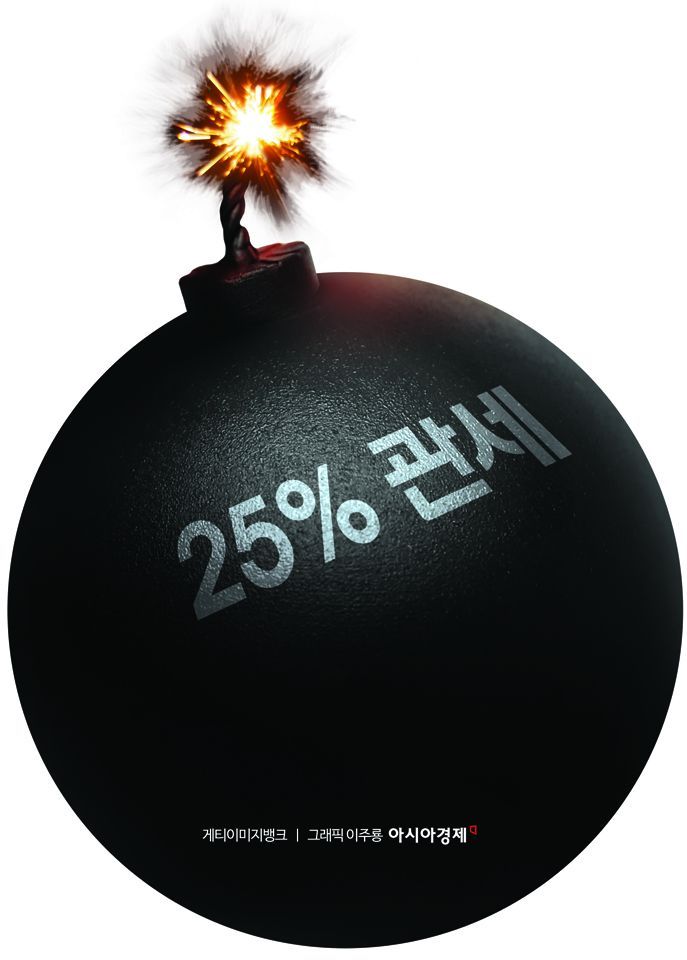
Considering indirect damages such as demand reduction due to product price increases and market share decline, the total damage is expected to exceed 3 trillion won.
The estimated losses for the Mexico subsidiaries of Kia, Samsung Electronics, LG Electronics, and POSCO amount to about 1.2 billion dollars (approximately 1.56 trillion won). Kia’s Mexico plant has an annual maximum production capacity of about 400,000 units, exporting about 120,000 units of the compact sedan K4 annually to the U.S.
With an average vehicle price of about 25,000 dollars, applying a 25% tariff results in an additional cost of 6,250 dollars per vehicle, totaling 750 million dollars (approximately 975 billion won) annually. Hyundai Motor is also producing 16,000 Tucson units on consignment at Kia’s Mexico plant.
The expected operating loss for Kia due to this measure by the Trump administration is about 1 trillion won (about 8% of this year’s estimated operating profit), and for Hyundai Motor, it reaches 120 billion won. Kia is considering shifting some of its North American export volume to Canada, South America, or Europe to avoid tariffs.
Samsung Electronics, which operates a plant in Mexico, is in a similar situation. Approximately 2 million TVs are exported from Mexico, and assuming an average TV price of about 500 dollars, the tariff would result in an additional annual cost of 250 million dollars (approximately 325 billion won).
For LG Electronics’ refrigerators produced in Mexico, with an annual production of about 500,000 units and an average price of 1,000 dollars, additional costs of about 125 million dollars (approximately 162.5 billion won) per year are expected. POSCO, producing 400,000 tons of automotive steel sheets annually, would incur about 80 million dollars (approximately 104 billion won) in additional tariff costs, assuming an average price of 800 dollars per ton.
Korean companies maintaining production facilities in Canada have also fallen under the impact of the 25% tariff bomb. About 50 companies are known to have entered the market, with LG Energy Solution, POSCO Future M, and SK On currently building or operating large-scale production facilities.
LG Energy Solution is constructing a battery plant in Ontario, Canada, through a joint venture called NextEnergy with Stellantis. This plant has an annual battery production capacity of 49.5 GWh, and the additional cost due to tariffs is predicted to reach 105 million dollars (approximately 136.5 billion won).
POSCO Future M, building a high-nickel cathode material plant with an annual capacity of 30,000 tons in Quebec, Canada, is expected to incur additional costs of 180 million dollars (approximately 234 billion won) annually if tariffs are applied. EcoPro BM, exporting about 70% of its 45,000 tons of cathode materials produced annually in Canada to the U.S., would have to pay about 315 million dollars (approximately 409.5 billion won) in tariffs.
As a result, the total additional costs borne by the seven major companies in Mexico and Canada due to tariff imposition amount to 1.805 billion dollars (approximately 2.3465 trillion won).
Considering indirect damages such as demand reduction due to product price increases, market share decline, and supply chain reorganization costs (10?20%), the total losses for Korean companies are expected to exceed 3 trillion won.
Experts view this universal tariff imposition as causing significant changes to Korean companies’ global supply chain strategies. Some companies are considering expanding local production in the U.S., while others are exploring diversification of export routes to Asian and European markets. In addition to improving production process efficiency to reduce costs, there is also a possibility of strengthening lobbying activities within the U.S. to urge tariff withdrawal.
Lee Taegyu, Senior Research Fellow at the Korea Economic Research Institute, said, "From the companies’ perspective, there is little they can do except taking measures such as exporting in advance. President Trump is using tariffs as leverage for negotiations on immigration and drugs, but if negotiations drag on, domestic companies will definitely be affected."
Kang Seokgu, Head of the Survey Department at the Korea Chamber of Commerce and Industry, also expressed concern, saying, "A blow of 2 to 3 trillion won is a considerable scale. Ultimately, if the structure forces continued imports through tariffs, it will lead to consumer price increases."
© The Asia Business Daily(www.asiae.co.kr). All rights reserved.