"Tariff Announcement Not a Negotiation Tactic...
Purely an Economic Issue"
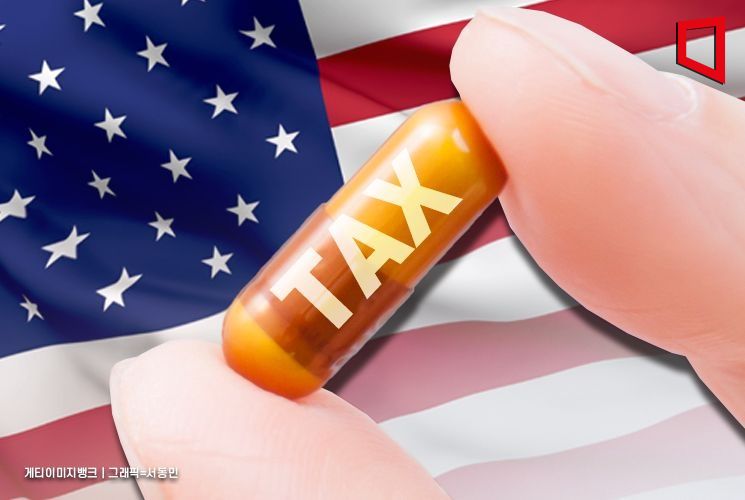
U.S. President Donald Trump reaffirmed his determination to impose tariffs on Canada and Mexico on February 1, signaling the beginning of a full-scale global tariff war. In particular, he also announced plans to impose tariffs on steel, aluminum, oil, gas, pharmaceuticals, and semiconductors, which is expected to further escalate global trade conflicts.
On the 31st (local time), after signing an executive order at the White House, President Trump responded to a question about his meeting with Jensen Huang, CEO of Nvidia, saying, "It was a good meeting," and added, "We will eventually impose tariffs on semiconductors."
He continued, "We will also impose tariffs on oil and gas, and that will happen soon. Probably around February 18."
President Trump stated, "We will impose tariffs on steel as well," explaining, "We are currently imposing tariffs on steel, but those are relatively small compared to what is coming."
Regarding the European Union (EU), he said, "They have treated us very badly," reaffirming his intention to impose tariffs in the future.
The most imminent action is the tariff increase on Canada and Mexico. When asked if Canada and others could do anything to forestall the tariff imposition tonight or tomorrow, Trump replied, "No. Not now."
When asked if the tariff announcement was a negotiating tactic, he said, "No. It is not," adding, "It is purely economic."
He went on to say, "We have large deficits with all three countries," and "We have big deficits, and that is what we are addressing now."
When asked if Canadian crude oil would be included in the tariffs starting February 1, Trump responded, "We will lower the tariff on that. We are considering reducing the tariff on oil from 25% to 10%."
With President Trump's firm stance, global trade conflicts are expected to intensify. According to the U.S. Trade Representative (USTR), based on 2022 import data, China ranked first with $536.3 billion (14.6% of the total), followed by Mexico ($454.8 billion) and Canada ($436.6 billion). The Wall Street Journal (WSJ) reported that if comprehensive tariffs on Canada, Mexico, and China materialize, the tariff targets would exceed $1.3 trillion (approximately 1,894 trillion KRW) as of 2023.
Canada, Mexico, and China have declared that they will immediately implement retaliatory tariffs if the U.S. raises tariffs. U.S. companies are also expected to suffer damage from the tariff imposition. Karl Weinberg, founder of the American economic research institute High Frequency Economics, estimated that imposing a 25% tariff on Canada and Mexico would reduce the U.S. first-quarter GDP growth rate by 0.6%, with an additional 0.1% hit in the second quarter.
© The Asia Business Daily(www.asiae.co.kr). All rights reserved.
![User Who Sold Erroneously Deposited Bitcoins to Repay Debt and Fund Entertainment... What Did the Supreme Court Decide in 2021? [Legal Issue Check]](https://cwcontent.asiae.co.kr/asiaresize/183/2026020910431234020_1770601391.png)















