Trump to Enforce 25% Tariffs on Mexico and Canada Starting February 1
All Three Major New York Stock Indices Close Lower
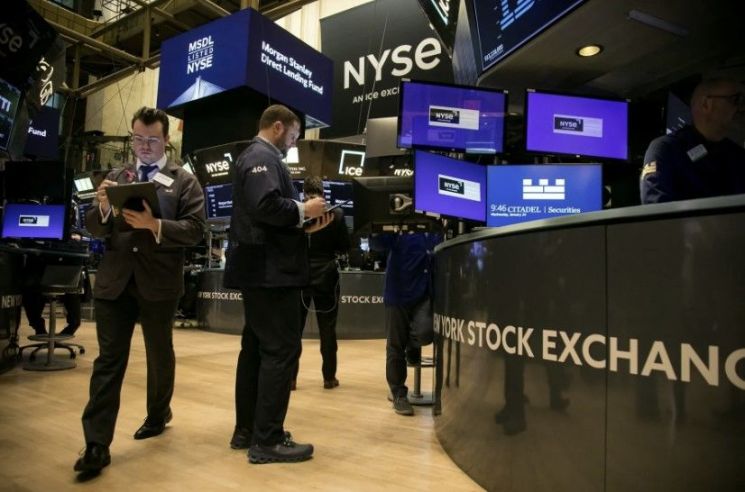
U.S. President Donald Trump reaffirmed his intention to impose tariffs on Canada, Mexico, and China, leading to a broad decline in the New York stock market.
On January 31 (local time), the Dow Jones Industrial Average closed at 44,544.66, down 337.47 points (-0.75%) from the previous session.
The Standard & Poor's (S&P) 500 index fell 30.64 points (-0.50%) to 6,040.53, while the tech-heavy Nasdaq index dropped 54.31 points (-0.28%) to 19,627.44.
All three major New York indices gave up earlier gains and turned negative in the afternoon. Energy majors ExxonMobil and Chevron fell 2.5% and 4.6%, respectively, following disappointing earnings reports. Nvidia also declined 5.9% amid increased volatility after the shock from Chinese AI startup DeepSeek.
The Nasdaq, which had plunged 3.1% on the 27th, recovered some losses to close the week down 1.9% overall.
The personal consumption expenditures (PCE) inflation rate for December last year was announced at 2.6%, marking a rebound for the third consecutive month. However, as it met expert expectations, its impact on the market was limited.
President Trump's determination to raise tariffs was seen as a major influence on the stock market. White House spokeswoman Caroline Levitt stated at a briefing, "President Trump confirms that tomorrow (February 1), 25% tariffs on Mexico and Canada and 10% tariffs on China will begin," reaffirming the tariff imposition plans on Canada, Mexico, and China.
Later that day, after signing an executive order in the White House Oval Office, President Trump responded to reporters' questions about whether China, Canada, and Mexico could do anything tonight to prevent the tariffs from taking effect tomorrow (the 1st) by saying, "No. Not right now. There is no negotiation tool."
International oil prices initially weakened but rebounded following President Trump's remarks about imposing tariffs on crude oil. On the New York Mercantile Exchange, March delivery West Texas Intermediate (WTI) crude futures closed at $72.53 per barrel, down 20 cents (-0.3%) from the previous session.
However, after the closing price was calculated, President Trump mentioned that tariffs on oil and gas would likely be imposed around February 18, causing prices to rebound to $73.81 per barrel, up $1.08 (1.5%) as of 4:59 p.m. Eastern Time compared to the previous closing price.
Nonetheless, President Trump said he would impose a 10% tariff on Canadian crude oil, lowering the tariff rate. While reaffirming the tariff application policy, he indicated that the rate would be applied at a reduced level.
© The Asia Business Daily(www.asiae.co.kr). All rights reserved.

















