Constitution Transcription Certification Photos Flood SNS
Sales of Constitution-Related Books Surge Amid Martial Law and Impeachment Turmoil
Since the 12·3 emergency martial law incident, sales of books related to the constitution have surged. Initially, constitutional books were unpopular titles sought mainly by law students and legal professionals. However, as the domestic political situation became chaotic with the declaration of emergency martial law for the first time in 45 years since 1979, and the unprecedented indictment and detention of a sitting president in constitutional history, more general readers have started seeking out constitutional books.
Constitution-related books storm bookstores after emergency martial law... Constitution transcription also popular
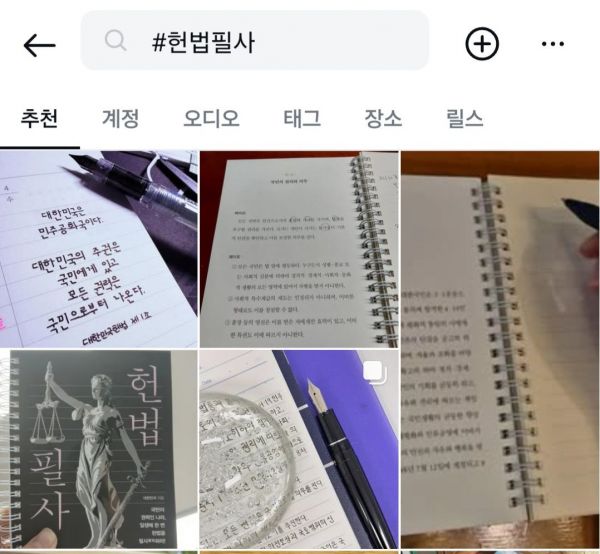 Recently, posts related to handwritten copies of the Constitution have been continuously appearing on social networking services (SNS) such as Instagram. Instagram
Recently, photos certifying the transcription of the constitution have been continuously posted on social networking services (SNS). Users on X (formerly Twitter) commented, "I've been transcribing the constitution these days, and maybe because of the current situation, it really sticks in my head," "I've completed one-third of the constitution transcription. I realized again that everything on the land we stand on is not something given for granted," and "Transcribing the constitution helps you understand it and also improves concentration. I want to recommend constitution transcription to my acquaintances."
The surge in interest in the constitution began after the 12·3 emergency martial law. According to Yes24, sales of constitution-related books in December last year, when emergency martial law was declared, increased by 219% compared to November. Sales in the first half of January this year also surged by 79% compared to December of last year.
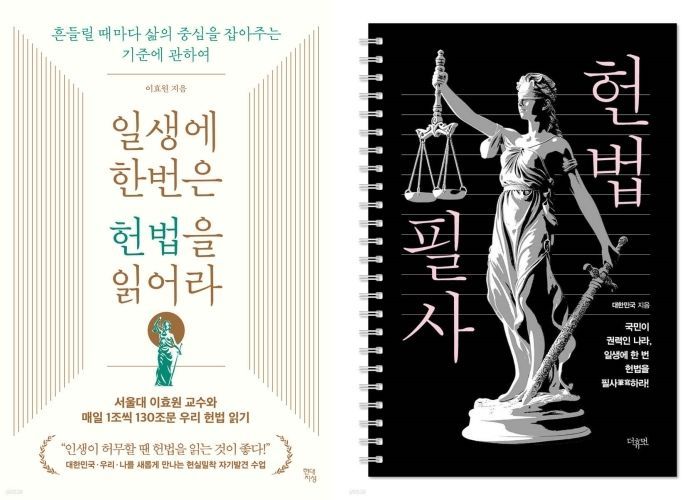
Among constitution-related books, popular titles are those aimed at the general public. “Read the Constitution at Least Once in Your Lifetime,” published in August last year by constitutional scholar Professor Lee Hyowon, ranked in the top 100 humanities books on Yes24 for 19 consecutive weeks. This book explains the meanings embedded in the wording and terms of all 130 articles of the Constitution of the Republic of Korea. The book’s purchasers were predominantly in their 40s and 50s, accounting for 65.9% of sales.
Meanwhile, the book “Constitution Transcription,” which allows readers to copy the entire constitution in order of articles, saw sales increase by 1036.0% in January compared to the same period last month. Notably, more than half (53.3%) of the buyers were in their 20s and 30s, showing its popularity among younger generations. Reviews of the constitution transcription book included comments such as, "I bought it to focus my mind in these chaotic times," "It made me think more about protecting our basic rights," and "When I think about how much blood and tears of many citizens are embedded in Article 1 of our constitution stating that the Republic of Korea is a democratic republic, I feel deeply moved and solemn."
Why has interest in the constitution increased? ... Influence of a turbulent political situation
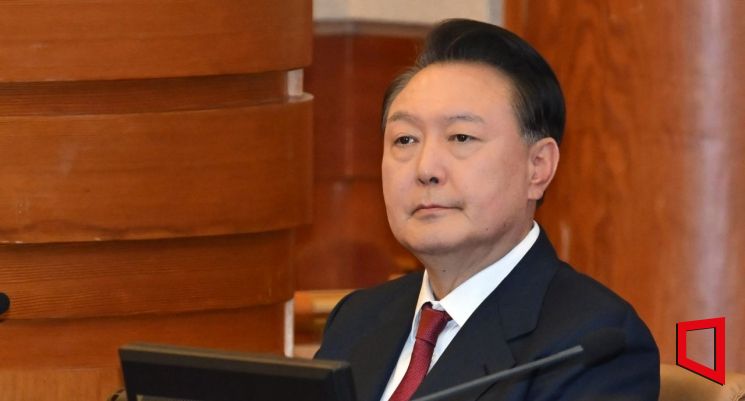 President Yoon Suk-yeol is seated after attending the 4th impeachment trial hearing held at the Constitutional Court in Jongno-gu, Seoul on January 23. Photo by Joint Press Corps
The background for the increased interest in the constitution is interpreted as a result of unprecedented incidents in constitutional history, prompting more people to directly check and understand the constitution. In particular, the unprecedented situation where a sitting president is simultaneously undergoing impeachment and criminal trials after the declaration of emergency martial law has had an impact.
President Yoon Seok-yeol declared emergency martial law on December 3 last year based on Article 77 of the constitution. Article 77, Paragraph 1 of the constitution stipulates that "The President may declare martial law in accordance with the law when it is necessary to respond to military needs or maintain public peace and order by military force in times of war, armed rebellion, or a similar national emergency." The power to declare martial law is one of the national emergency powers granted to the president under the constitution, along with the emergency decree power (Article 76, Paragraph 2) and emergency financial and economic disposition and decree power (Article 76, Paragraph 1).
However, controversy arose over the legitimacy and fulfillment of legal requirements for the martial law declaration. The opposition parties and some civic groups criticized it as unconstitutional, arguing that martial law was declared forcibly in a situation that did not qualify as a national emergency. However, President Yoon’s side claimed it was a legitimate measure within the president’s constitutional authority.
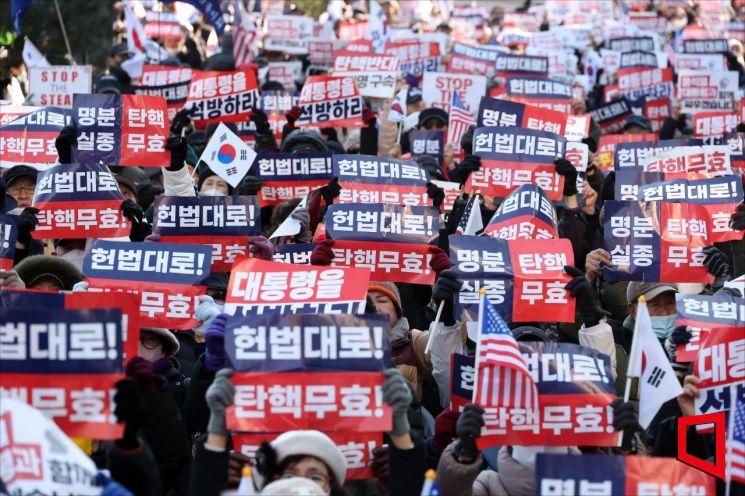 On the afternoon of January 23, the fourth hearing date for the impeachment trial of President Yoon Seok-yeol, a rally by conservative groups supporting President Yoon was held near the Constitutional Court in Jongno-gu, Seoul, as President Yoon appeared at the court. Photo by Joint Press Corps
Ultimately, President Yoon became the first sitting president in constitutional history to be indicted and detained on charges of leading a rebellion, facing impeachment and criminal trials simultaneously. The key issue in the impeachment trial is whether the martial law declaration met constitutional requirements and procedures, while the criminal trial will focus on whether the president declared martial law with the intent to disrupt the constitutional order.
Meanwhile, after being detained at Seoul Detention Center, President Yoon reportedly argued that the declaration of emergency martial law cannot be considered rebellion. According to lawyer Seok Dong-hyun, who met with President Yoon on the 28th of last month, the president claimed, "I judged, as president, that the country was in crisis due to the dictatorship of the National Assembly dominated by a huge opposition party, and declared martial law under constitutional authority to inform and appeal to the sovereign people about this crisis." He also stated, "I immediately lifted the martial law upon the National Assembly’s request for repeal in accordance with the constitution. Everything was done within the framework of the constitution."
© The Asia Business Daily(www.asiae.co.kr). All rights reserved.



















