"Yoon's Indictment and Detention Mark a Significant Change in Circumstances... No Need for a Special Investigation"
"Acting President Choi Should Not Make a Wrong Decision"... Democratic Party Refrains from Strong Responses Such as Impeachment
Choi Sang-mok, Acting President and Deputy Prime Minister as well as Minister of Strategy and Finance, is considering exercising the right to request reconsideration (veto) on the 'Special Investigation Act on Treason' passed by the National Assembly led by the opposition party, while the ruling and opposition parties show stark differences in their positions.
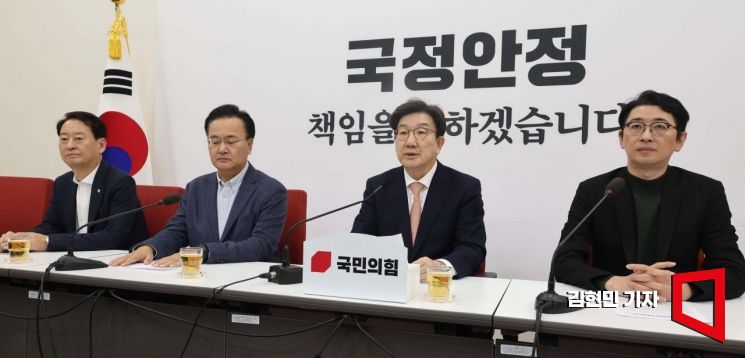 Kwon Seong-dong, floor leader of the People Power Party, Joo Jin-woo, chairman of the legal advisory committee, and Yoo Sang-beom, secretary of the Legislation and Judiciary Committee, are holding a press briefing at the National Assembly on the 14th regarding the proposal of the "Emergency Martial Law Special Prosecutor Act" (tentative name). Photo by Kim Hyun-min
The People Power Party holds the position that the veto is appropriate since the Special Investigation Act was passed solely by the Democratic Party without bipartisan agreement, whereas the Democratic Party strongly opposes this, stating, "Those who reject the Special Investigation Act on Treason are collaborators with the treasonous forces."
Kwon Seong-dong, floor leader of the People Power Party, said at a National Assembly press briefing on the 30th, "Our party has already requested Acting President Choi to demand reconsideration of the Special Investigation Act, and we believe Acting President Choi is likely to accept this."
He emphasized, "Since the Democratic Party forcibly passed the bill without bipartisan agreement, it does not meet the requirements, and with the president already indicted and detained, there is no longer a need for a special investigation."
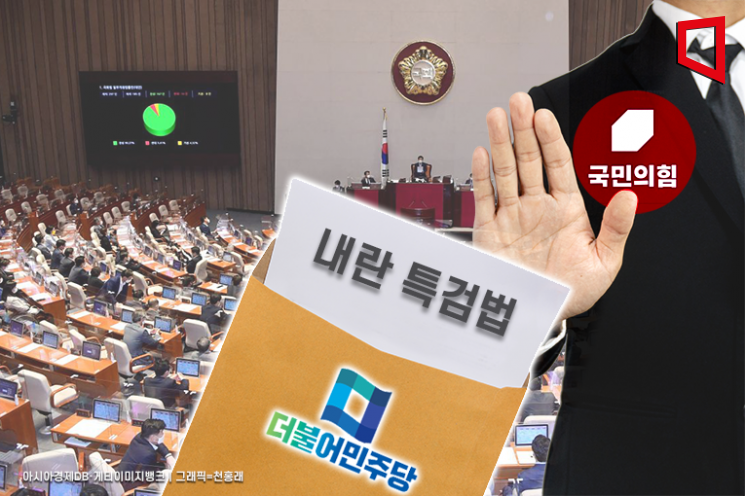
Shin Dong-wook, chief spokesperson for the People Power Party, also added, "The Special Investigation Act still contains unconstitutional elements and issues we have pointed out," and "Exercising the veto is a reasonable decision."
On the other hand, the Democratic Party claims that the current Special Investigation Act has removed the unconstitutional elements raised by the government and the ruling party, and that the demands of the People Power Party have also been reflected.
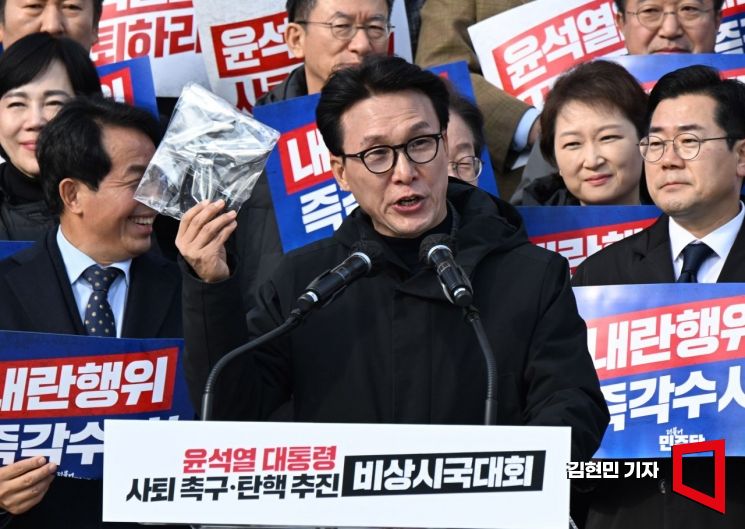 Kim Min-seok, Supreme Council Member of the Democratic Party of Korea, is holding up handcuffs left by martial law troops at the "Emergency National Rally to Urge President Yoon Seok-yeol's Resignation and Impeachment Promotion" held on the stairs in front of the National Assembly Main Building on the 4th. Photo by Kim Hyun-min
Kim Min-seok, Supreme Council member of the Democratic Party, said at a National Assembly press briefing, "The currently passed Special Investigation Act has eliminated legal controversies, and it includes a significant portion of the demands made by the People Power Party," adding, "From a rational perspective, there is absolutely no reason for Acting President Choi to exercise the veto."
The Democratic Party is urging Acting President Choi to accept the Special Investigation Act while refraining from strong responses such as impeachment motions. This appears to be in consideration of the fact that one reason the Democratic Party has recently failed to overwhelmingly surpass the People Power Party in public opinion polls is due to repeated impeachment attempts.
Kim emphasized, "There is no need to discuss responses based on the assumption that Acting President Choi will make a wrong decision," maintaining a cautious stance.
However, Roh Jong-myeon, floor spokesperson for the Democratic Party, strongly warned in a briefing, "If Acting President Choi rejects the Special Investigation Act, it will be impossible to avoid suspicion of collusion with the People Power Party, and it will be difficult to escape the evaluation of being collaborators with the treasonous forces."
The Democratic Party is carefully considering an appropriate date for the vote reconsideration, taking into account the members' travel schedules, as the result of the re-vote cannot be guaranteed even if only 3 to 4 members are absent.
Additionally, in preparation for the possibility that the veto is exercised and the bill returns to the National Assembly, they are expected to devise strategies to increase the likelihood of passing the re-vote.
© The Asia Business Daily(www.asiae.co.kr). All rights reserved.



















