Captain and First Officer Flew 186 and 164 Hours Respectively in 90 Days Before Accident
Preliminary Report Submitted to United States, France, and Thailand
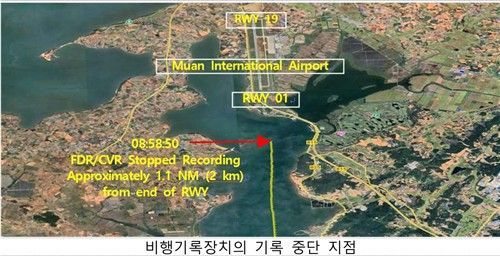
The black box record of the Jeju Air accident aircraft was found to have stopped when it was about 2 km away from the runway of Muan International Airport. Additionally, the wreckage of the front part of the aircraft was found to have been thrown up to 200 meters away from the hill of the localizer facility beyond the runway due to the impact of the collision.
The Aviation and Railway Accident Investigation Board (ARAIB) of the Ministry of Land, Infrastructure and Transport, which is investigating the cause of the accident, published a preliminary report of five A4 pages including the accident overview on the 27th. This report is the first official investigation report released since the accident on December 29 last year.
According to the international civil aviation agreement, the initial investigation information must be shared within 30 days of the accident by sending a preliminary report to the International Civil Aviation Organization (ICAO) and the countries involved in the accident. Accordingly, the ARAIB submitted the preliminary report to the United States and France, the manufacturers of the aircraft body and engines, and Thailand, where fatalities occurred.
The report revealed the approximate flight position when the black box, including the Flight Data Recorder (FDR) and Cockpit Voice Recorder (CVR), stopped simultaneously. The black box record was no longer available from 8:58:50 a.m. on the 29th of last month, 4 minutes and 7 seconds before the aircraft collided with the localizer hill at Muan Airport.
According to the ARAIB investigation, the aircraft was flying over the sea about 1.1 NM (nautical miles) south of the starting point of Runway 01 (the southernmost end of the runway), which was the intended landing direction. This distance converts to approximately 2,037 meters.
As the landing was imminent, the speed had decreased to 161 knots (about 298 km/h), and the altitude was lowered to 498 feet (about 151 meters). At this time, it is estimated that greater white-fronted geese, a representative winter migratory bird, were sucked into both engines. The investigation found feathers and bloodstains of the greater white-fronted geese in both engines. The ARAIB stated that the exact timing of the bird strike, the number of birds involved, and whether other birds were included have not yet been confirmed.
At the time of the accident (9 a.m.), the wind was blowing from 110 degrees at 2 knots (about 3.7 km/h). Visibility was 9,000 meters, and clouds were present at 4,500 feet (about 1.37 km), which was not significant enough to affect aircraft operation. The temperature was 2 degrees Celsius, the dew point was 0 degrees, and sea-level pressure was 1028 hectopascals (hPa). The ARAIB explained that there were no special weather changes.
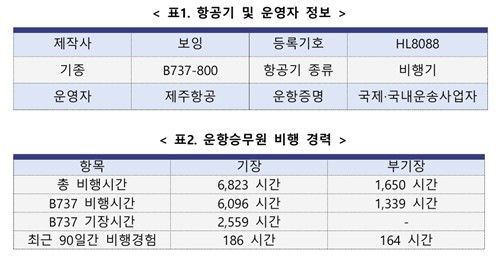
The report also included the accident overview, aircraft history, pilot experience, and site conditions. The aircraft was a B737-800 model (registration number HL8088), manufactured by Boeing in the United States. It was first delivered to the European low-cost carrier Ryanair on September 4, 2009, and operated there before being leased and introduced by Jeju Air on February 3, 2017.
The captain (45 years old) had a total flight time of 6,823 hours, of which 6,096 hours were on the accident aircraft type (2,559 hours as captain). The flight time in the 90 days before the accident was 186 hours. The first officer (35 years old) had a total of 1,650 flight hours, with 1,339 hours on the accident aircraft type. In the 90 days before the accident, the first officer flew 164 hours.
Flight 7C2216, the accident flight, took off from Suvarnabhumi Airport in Bangkok, Thailand, at 2:30 a.m. local time (4:30 a.m. Korean time) on the 29th, carrying 6 crew members and 175 passengers, totaling 181 people. At 8:54:43 a.m. Korean time, the aircraft made initial contact with Muan Airport control tower for landing, and the tower granted permission to land on Runway 01.
While approaching Runway 01 after receiving landing clearance, at 8:57:50 a.m., the control tower warned the aircraft to be cautious of bird activity (collision). One minute later, the black box records stopped simultaneously. Immediately after, at 8:58:56 a.m., the aircraft declared Mayday three times due to bird strike and initiated a go-around by increasing altitude.
The aircraft then flew over the left side of Runway 01, turned right to land on the opposite Runway 19, and approached accordingly. The aircraft landed on Runway 19 with the landing gear not deployed, touching down on the fuselage, and during the rollout, it overshot the runway and collided with the localizer hill.
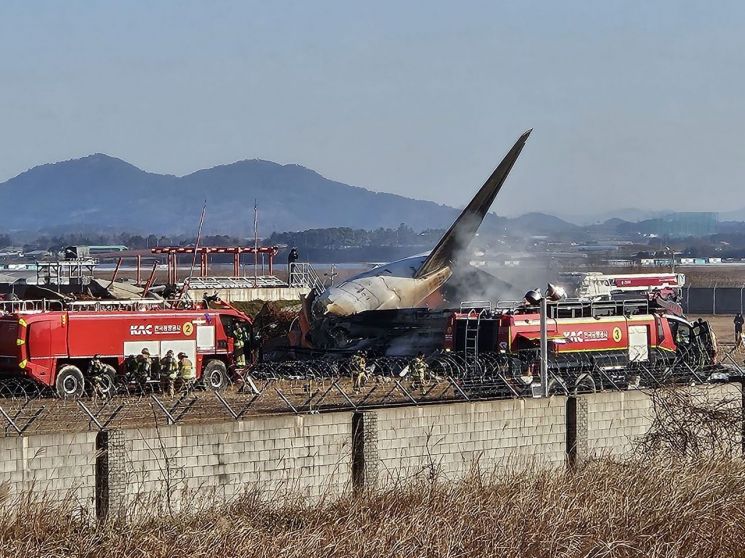
After colliding with the hill, a fire and some explosions occurred. Both engines were buried in the soil mound of the hill, and the forward part of the aircraft was scattered about 30 to 200 meters from the hill. The tail section of the rear fuselage was partially burned just beyond the hill. The accident resulted in 179 fatalities, including 4 flight and cabin crew members and 175 passengers. Two cabin crew members were seriously injured.
The sequence leading from the bird strike to the malfunction of aircraft systems including the black box, the background of the go-around and runway change, and the impact of the localizer hill on the extent of damage are expected to be revealed later. The report also contains photos of the accident site and the engines buried in the soil mound.
According to the accident investigation manual, the ARAIB can record any issues found during the investigation in the preliminary report if necessary, but no significant problems were pointed out. The ARAIB stated, "If any matters are deemed necessary for safety and improvement during the investigation, we will review the content and issue urgent safety recommendations."
Regarding future investigation plans, the ARAIB said, "We will comprehensively investigate the bird strike, engine disassembly inspection, FDR and CVR data analysis, control tower data, detailed parts inspection, and localizer facilities to clearly identify the cause." They added, "We are cooperating with the U.S. National Transportation Safety Board (NTSB) and the French Bureau of Enquiry and Analysis for Civil Aviation Safety (BEA) on the investigation and plan to continue joint investigations as needed."
The ARAIB previously held a briefing for the bereaved families on the 25th to share the investigation status and future plans included in the report.
An ARAIB official said, "There may be errors in the information contained in the preliminary report, and the final report will include corrected information. We will conduct all processes fairly and make every effort to clearly identify the cause of the accident."
© The Asia Business Daily(www.asiae.co.kr). All rights reserved.
![User Who Sold Erroneously Deposited Bitcoins to Repay Debt and Fund Entertainment... What Did the Supreme Court Decide in 2021? [Legal Issue Check]](https://cwcontent.asiae.co.kr/asiaresize/183/2026020910431234020_1770601391.png)