Experts: "Forecasting Standards for Volcanic Ash Should Be Revised"
Concerns about the possibility of an eruption of Mount Fuji in Japan have emerged, and if an eruption actually occurs, it is expected that many areas, including the metropolitan area, could experience significant inconvenience due to volcanic ash.
According to public broadcaster NHK on the 24th, the Japan Meteorological Agency recently held a meeting involving experts for the first time to establish a new forecasting system for volcanic eruptions.
At the meeting, it was pointed out that the information on the amount of volcanic ash expected to accumulate on the ground should be detailed further, and the areas subject to warnings should be expanded compared to the current system. Currently, the Japan Meteorological Agency’s forecast for ash fall (volcanic ash falling to the ground due to an eruption) sets the maximum ash amount at "1 mm or more," making it impossible to specify details such as when ash accumulates to several tens of centimeters.
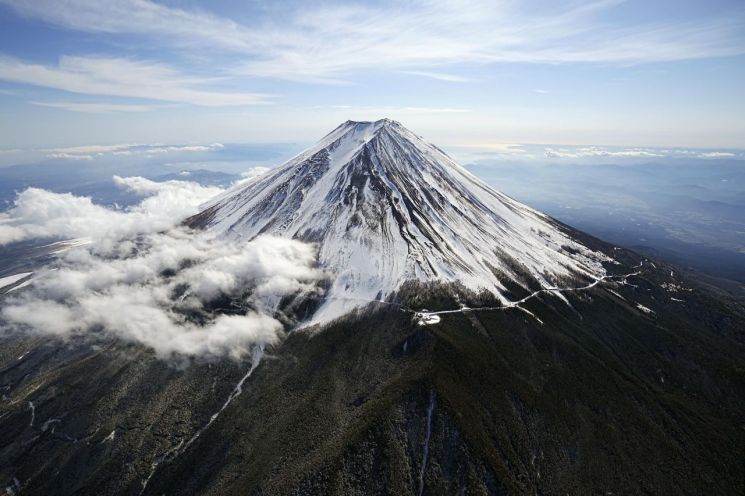
Mount Fuji, which stands 3,776 meters tall, has erupted about 180 times over the past 5,600 years. The last historically confirmed eruption was the 1707 "Hoei eruption." Research has also estimated that the economic damage caused by that eruption reached 2.5 trillion yen (approximately 23 trillion won).
According to a prediction of damage from a Mount Fuji eruption released by the Japanese government in 2020, assuming an eruption similar in scale to that of 1707 and a northeast wind blowing, in the worst-case scenario, volcanic ash could reach Tokyo and the metropolitan area within about three hours, potentially halting railway operations. It could also adversely affect power transmission facilities, causing widespread blackouts.
If volcanic ash emission continues for two hours, more than 30 cm of ash would accumulate in Kanagawa Prefecture, Yamanashi, and other areas, and about 10 cm or more would accumulate in urban centers. The amount of ash that would need to be removed is estimated to be 490 million cubic meters, which is ten times the volume of disaster waste from the Great East Japan Earthquake.
Accumulated volcanic ash paralyzes transportation. For vehicles, if ash accumulates more than 1 mm, speeds are limited to about 30 km/h, and if ash accumulates more than 10 cm, passage becomes impossible. Railways stop operating with just 0.5 mm of ash accumulation, causing disruptions in the transportation system. Aircraft engines can stop if they ingest volcanic ash, and runways can be closed due to ash coverage.
Basic daily life for citizens is also adversely affected. If roads become unusable, logistics halt, making it impossible to obtain medical supplies and other necessities.
If it rains after a volcanic eruption, volcanic ash can stick to electrical equipment, causing power outages, and it can affect water supply and communication facilities. Additionally, volcanic ash becomes heavier when wet, including from rain, raising concerns that wooden houses could be crushed if ash accumulates more than 30 cm.
The impact on people’s health is also significant. It can cause pain in the eyes and throat and worsen respiratory diseases.
© The Asia Business Daily(www.asiae.co.kr). All rights reserved.

















