Public Opinion Becomes Deeply Polarized After Emergency Martial Law
Seek Dialogue Through Empathy, but Avoid Forcing It When Differences Are Too Great
"Don't Stumble Over Words; Try to Understand Why Such Words Are Being Spoken"
After President Yoon Suk-yeol sent armed soldiers to the National Assembly and the National Election Commission in the so-called emergency martial law incident, the entire country turned into a battlefield. Through phases such as impeachment and arrest, the situation became more polarized rather than resolved. The country was fragmented along political lines, generations, and regions. Although the Lunar New Year, a time when families meet after a long time to ask about each other's well-being and spend cozy moments together, has arrived, the risk of conflicts erupting in every household, similar to those that occurred at Gwanghwamun Square or in front of the Hannam-dong residence, has increased.
On the 27th, despite the unprecedented crisis, the political sphere appeared to be fueling conflicts while looking ahead to an early presidential election rather than managing the situation. The ruling party, at a crossroads of survival, stirred its support base by pointing out issues such as acknowledging responsibility in the special investigation into President Yoon's arrest and charges of rebellion, as well as the overall investigation, thereby escalating conflicts. President Yoon himself, who caused the crisis, is not showing remorse but rather provoking conflict by rallying his supporters. The opposition party, which claimed to suppress the rebellion, ignored national unity amid unilateral dominance of power instead of seeking common ground to overcome the crisis. Meanwhile, some politicians voiced calls for national unity, but they lost influence when faced with the question, "Which side are you on?"
Even daily life is threatened by political conflicts after the emergency martial law
As a result, as revealed in public opinion polls, social conflicts are intensifying. According to a recent nationwide indicator survey, regarding President Yoon, who is undergoing impeachment proceedings at the Constitutional Court, 57% of the public believe that the National Assembly should approve impeachment and dismiss him, while 38% believe the impeachment should be dismissed and he should return to office. (NBS by Embrain Public, K-stat Research, Korea Research, and Hankook Research; conducted from the 20th to 22nd via mobile phone interviews with 1,000 men and women aged 18 and over nationwide; sampling error ±3.1 percentage points at a 95% confidence level; response rate 22.2%)
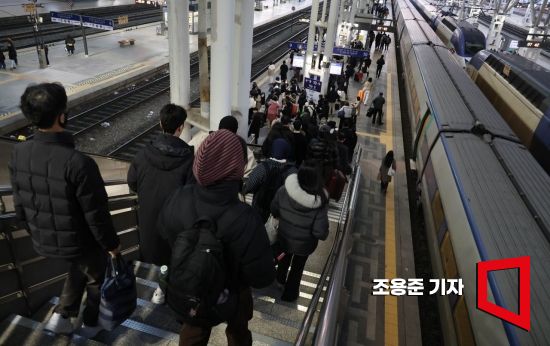 On the morning of the 24th, one day before the major national holiday Seollal, travelers are moving to board trains heading to their hometowns at Seoul Station in Yongsan-gu, Seoul. Photo by Jo Yong-jun
Notably, responses varied significantly by generation, region, and political orientation. Among those in their 20s to 50s, the opinion to dismiss President Yoon far outpaced the opinion for his return. In contrast, among those in their 60s, dismissal and return opinions were similar at 49% and 47%, respectively, while among those aged 70 and above, 36% favored dismissal and 59% favored return. Although there have always been generational differences in political leanings, the crisis phase, which overwhelmed daily life due to President Yoon's emergency martial law and subsequent political turmoil, amplified hostility due to these differences in thought.
Looking at regional differences, public opinion in the Yeongnam region and other areas diverged. In the metropolitan area, Honam, and Chungcheong regions, dismissal opinions were dominant, whereas in Daegu·Gyeongbuk (TK), dismissal opinions were 30%, while dismissal rejection opinions were significantly higher at 58%. In Busan·Ulsan·Gyeongnam (PK), dismissal and rejection opinions were similar at 50% and 45%, respectively. Even ideologically, among respondents identifying as progressive, 91% favored dismissal (5% favored return). Conversely, among conservatives, only 21% favored dismissal (75% favored return). Among moderates, 71% favored dismissal and 25% favored return.
According to a survey by the Korea Center for Social Conflict Resolution and Korea Research, 92.6% of respondents said that conflicts in our society are severe. In particular, the overall level of conflict was the highest in the past 11 years according to last year's survey results. The most severe conflict was identified as the conflict between progressive and conservative forces (91.3%).
How to narrow differences in thought and engage in dialogue: empathy
In this situation, meetings among relatives with different generational and ideological backgrounds during the Lunar New Year carry a heightened risk of escalating into political disputes.
How can one engage in dialogue with those holding different political views?
Im Mi-ae, a member of the Democratic Party of Korea who has lived and been politically active in Daegu·Gyeongbuk (TK)?the region with the strongest opposition to the Democratic Party nationwide?has lived at the heart of intense conflicts since entering politics. Introducing the entire TK region as her constituency, could she claim to represent those with differing political views?
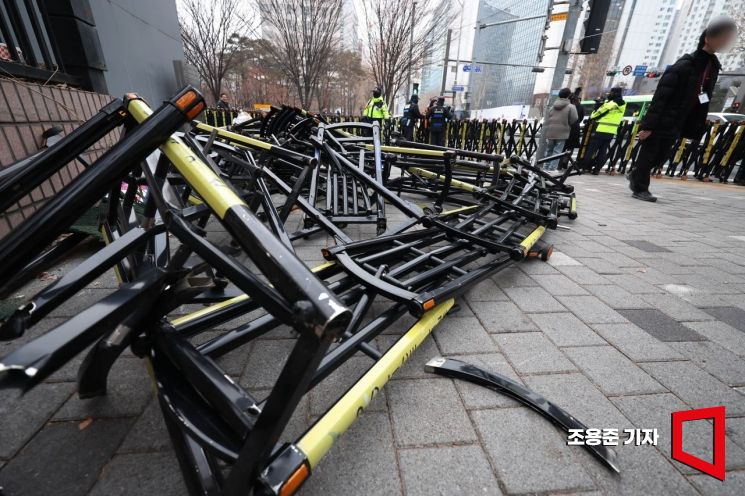 President Yoon Suk-yeol was arrested on charges of leading an insurrection, and a day after some supporters stormed the Seoul Western District Court, causing an illegal violent incident, police barricades remain damaged in front of the Western District Court in Mapo-gu, Seoul, on the morning of the 20th. Photo by Jo Yong-jun
Member Im's secret was 'empathy.' She said, "When I visit people in the region, I sometimes hear, 'You must have impeached so much that it had to be like this,' but even the same words differ depending on the person," adding, "Some people approach with hostility, while others are open to dialogue." She introduced her conversation method: "If the person does not show hostility, I start the conversation with empathetic words. Then I share my thoughts." This approach involves finding at least a minimal common ground where opinions may not differ before opening the conversation.
Member Im said, "Although there is strong backlash due to emergency martial law and impeachment, when I engage in dialogue with local residents, I can see their hearts soften," adding, "Through such conversations, we can find ways to reduce conflicts." She plans to continue dialogues with local residents during the holiday period to seek an exit from this conflict. However, she advised against forcing conversations. She said, "If there is no prospect of improvement and you judge that conflicts will rather intensify, maintaining some distance is also a method."
Don't stumble over words; look into why such words are spoken
Lee Jin-hee, a KBS PD and author of the book on 'Nonviolent Communication' titled Actually, This Is What I Wanted to Say, advised ahead of this year's Lunar New Year, when conflicts due to political differences are feared, "Don't stumble over words; try to find out why such words are being said."
Lee PD said, "In conversations, you need to see what the other person wants," adding, "Although they speak aggressively and sharply, instead of thinking 'Why can they only speak like that,' focus on what they want, and you can connect to that desire."
He gave an example: "For instance, if you get out of a taxi and close the door, accidentally making a loud bang, the driver might say, 'Does the door break like that?' You might think, 'Why do I have to hear this?'" Lee PD explained, "(Actually) the taxi driver wants to say, 'This car is my precious property, so please treat it carefully.'" He introduced a possible response: "Instead of reacting with 'What did you say?' you could say, 'Driver, you were startled by the loud door sound, right? I was startled too. You are asking me to treat the taxi carefully.'" By understanding the message the other person wants to convey instead of responding with harsh words, the conversation can change.
Lee PD viewed the hostility people show amid recent political situations as stemming from 'fear' and 'anxiety.' He analyzed, "Watching various YouTube videos, it seems that supporters of President Yoon are afraid of his arrest but also fear what might happen if Lee Jae-myung, the Democratic Party leader, becomes president." Conversely, those advocating for President Yoon's dismissal worry, "Is President Yoon going to start a war with North Korea to maintain power?" Lee PD said, "Ultimately, both sides harbor fears that their peaceful daily lives will be destroyed and a desire to keep their lives comfortable and safe," adding, "If you engage in dialogue by connecting with the other person's needs such as 'You are worried' or 'You are anxious,' better conversations can be had."
However, he cautioned, "The conversation should not proceed in a way that argues who is right or wrong," and said, "Rather than debating by presenting articles or videos you have seen, the conversation should focus on understanding what feelings arise and what needs are held."
© The Asia Business Daily(www.asiae.co.kr). All rights reserved.


















