The police have applied for a second arrest warrant for Kim Seong-hoon, Deputy Director of the Presidential Security Service, who led the prevention of President Yoon Seok-yeol's arrest, while Kim's side urged the prosecution to dismiss it, calling it an "illegal reapplication due to a separate investigation."
Kim's lawyer stated in a press release on the 25th, "According to the police investigation, the reasons for reapplying for the warrant are that evidence was destroyed by ordering the deletion of communication records on a burner phone and that abuse of authority under the Presidential Security Act was recognized."
He added, "These matters are completely unrelated to the main case of obstruction of official duties," and argued, "It is a widely accepted view that separate arrests are illegal, and the prosecution should dismiss the illegal warrant reapplication resulting from the police's separate investigation to uphold the rule of law."
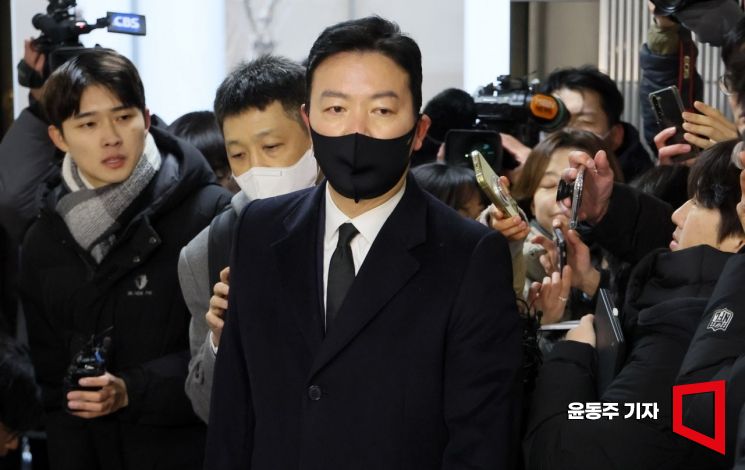 Kim Seong-hoon, Deputy Chief of the Presidential Security Service (Acting Chief), who is accused of obstructing the execution of an arrest warrant against President Yoon Seok-yeol, is appearing on the 17th for investigation by the National Police Agency's Criminal Investigation Headquarters. Photo by Yoon Dong-ju
Claims were also made that the reasons for reapplying for the warrant differ from the facts. The lawyer emphasized, regarding the suspension of two Presidential Security Service employees from their duties being considered abuse of authority, "There is no 'suspension from duty' in the personnel measures of the Security Service, so abuse of authority cannot be established," and "It was to prevent them from performing the relevant tasks, not a personnel measure that caused disadvantage, which is completely untrue." He also claimed, "The burner phone automatically deletes records periodically, so there was no order to delete communication records."
Regarding the court's decision the previous day to deny the extension of President Yoon's detention period, the lawyer argued, "If the Public Officials Corruption Investigation Act is applied strictly like this, the court may rule that the Corruption Investigation Office does not have the authority to investigate treason, and thus the process of arresting the president is also unlawful," and "In that case, the Deputy Director of Security and others lawfully exercised their security rights against the illegal execution of the warrant, so obstruction of official duties cannot be established."
Earlier, the Seoul Central District Court denied the prosecution's request to extend President Yoon's detention period, citing as grounds the absence of explicit provisions in the Public Officials Corruption Investigation Act regarding whether prosecutors affiliated with the prosecution office have supplementary investigation rights or their scope. In response, the prosecution reapplied to the court for an extension of the detention period.
© The Asia Business Daily(www.asiae.co.kr). All rights reserved.
![Clutching a Stolen Dior Bag, Saying "I Hate Being Poor but Real"... The Grotesque Con of a "Human Knockoff" [Slate]](https://cwcontent.asiae.co.kr/asiaresize/183/2026021902243444107_1771435474.jpg)











