"Putin Also Supported Denuclearization... China Would Have Joined"
"Will Demand Oil Price Cuts from OPEC"... Reaffirms Tariff Increase Policy
U.S. President Donald Trump said on the 23rd (local time) regarding nuclear arms reduction negotiations with Russia and China, "We want to know if we can denuclearize, and I think it is possible." He also pressured Middle Eastern oil-producing countries to lower oil prices, stating, "If oil prices fall, the war between Russia and Ukraine will end immediately."
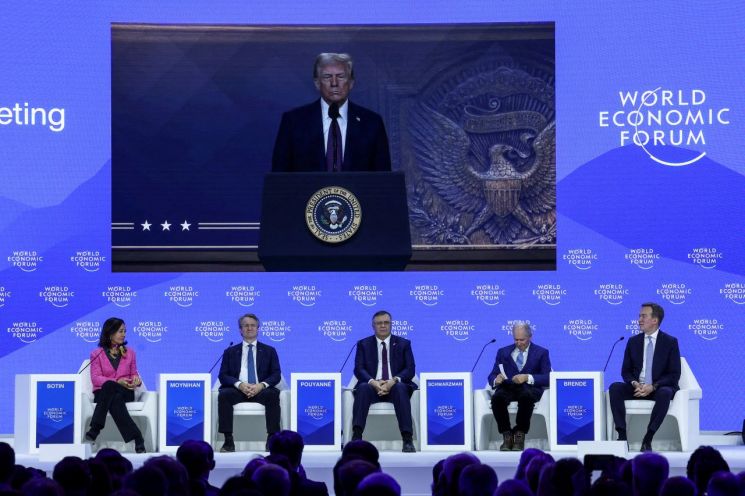 Donald Trump, President of the United States, is delivering a special speech at the World Economic Forum (WEF) held in Davos, Switzerland, on the 23rd (local time). Photo by Reuters-Yonhap News
President Trump made these remarks during a live video speech at the World Economic Forum (WEF, Davos Forum) held in Davos, Switzerland, mentioning the destructive power of nuclear weapons.
He said, "Before the 2020 presidential election, I talked with Russian President Vladimir Putin about denuclearization between the two countries," adding, "President Putin and I wanted that. We also had good talks with China, and if denuclearization had proceeded, they would have participated as well." He emphasized, "This would have been an incredible thing for the planet."
The United States currently has the New Strategic Arms Reduction Treaty (New START) with Russia, which limits strategic nuclear warheads, but with Russia's announcement to suspend participation, the treaty is set to expire in February 2026. China has not signed any separate nuclear arms reduction agreements with the U.S.
During his first term in office, in October 2018, President Trump withdrew from the Intermediate-Range Nuclear Forces Treaty (INF), which had been upheld since 1987 between the U.S. and the former Soviet Union, citing Russia's development and deployment of cruise missiles capable of carrying nuclear warheads in violation of the treaty, and also pointing out the unfairness that China was not a party to the agreement.
In his remarks about nuclear weapons on this day, President Trump did not mention North Korea. Earlier, on his inauguration day, the 20th, he referred to North Korea as a "nuclear-armed country." During last year's presidential campaign, he mentioned North Korea's nuclear arsenal and said, "It is a good thing to get along well with Kim Jong-un, the Chairman of North Korea, who has nuclear weapons."
Regarding the Ukraine war and China's role, President Trump said, "I want China to help us end the war," adding, "China has great power. We will cooperate with China." He further stated, "I mentioned this in a call with Chinese President Xi Jinping, and I hope we can work together to stop the war."
He referred to the Ukraine battlefield as a "killing field," saying, "I want to end the war from the perspective that millions of lives are being wasted, not for economic or any other reasons," emphasizing, "We have not seen anything like this since World War II. It is time to end it now."
"Demanding Oil Price Cuts from Saudi Arabia and OPEC to End Ukraine War... Reaffirming Tariff Increase Policy"
In his speech at the Davos Forum, President Trump expressed his determination to end the Ukraine war by requesting Middle Eastern oil-producing countries to lower oil prices.
He said, "If oil prices fall, the war between Russia and Ukraine will end immediately," adding, "Right now, prices are high enough that the war will continue. I will ask Saudi Arabia and the Organization of the Petroleum Exporting Countries (OPEC) to lower oil prices." This is intended to pressure Russia, which depends on energy exports for half of its fiscal revenue, by urging Middle Eastern oil producers to increase production and thus lower oil prices. The policy of cooperating with China for a ceasefire in Ukraine is also interpreted as an effort to prevent the continuation of the war by blocking Russia's military industry, which relies on China. Earlier, on the 21st, President Trump said he would impose additional sanctions if Russia did not come to the negotiating table, and the day before, he said, "If we do not negotiate soon, we will have no choice but to impose high-level taxes, tariffs, and sanctions on Russia and other countries."
President Trump also reaffirmed his stance on raising tariffs. He said, "If you do not make products in the U.S., that is your privilege," adding, "Then, simply put, you have to pay tariffs. The amount will vary, but hundreds of billions, even trillions of dollars will come into our treasury as tariff revenue." He reiterated this at a meeting with reporters at the White House, stating that tariffs would be imposed starting February 1 on China, Mexico, and Canada as previously announced.
Regarding the prospects for ending the Ukraine war, President Trump said, "You have to ask Russia," and answered, "Ukraine is ready."
© The Asia Business Daily(www.asiae.co.kr). All rights reserved.

















