"If Retaliatory Tariffs Are Imposed, It Will Be a Disaster... We Must Remain Calm"
Donald Trump, the President of the United States, fired the opening salvo on tariffs, prompting Ngozi Okonjo-Iweala, the Director-General of the World Trade Organization (WTO), to urge calm in response.
On the 23rd (local time) at the World Economic Forum Annual Meeting (WEF, Davos Forum) held in Davos, Switzerland, Director-General Okonjo-Iweala said during the 'Tariff Debate' session that the Trump administration's tariff policy should "not be overreacted to." She strongly advised member countries to remain calm, saying, "Even if tariffs are imposed, there are other ways."
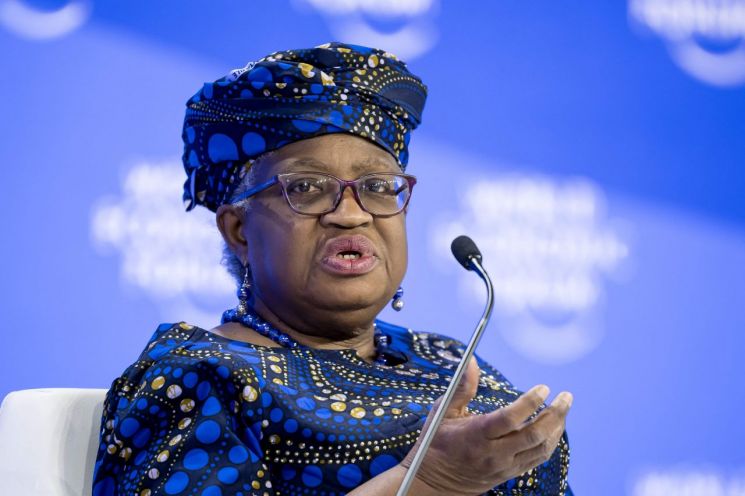 Ngozi Okonjo-Iweala, Director-General of the World Trade Organization (WTO), is speaking at the World Economic Forum (WEF, Davos Forum) held in Davos, Switzerland, on the 21st (local time). Photo by AFP Yonhap News
However, Director-General Okonjo-Iweala pointed out the negative effects of tariffs. "Tariffs cause price increases, raise exchange rates, reduce export competitiveness, and increase deficits," she said. "If we retaliate with 25% or 60% tariffs and return to the 1930s, we will see double-digit losses in global Gross Domestic Product (GDP). That would be a disaster."
She also said, "Tariffs are often used as a tool to solve problems unrelated to trade, which is why trade is sometimes blamed," adding, "If there is a trade deficit country, the cause is often not trade but domestic macroeconomic imbalances." This statement directly contradicts President Trump's claim that tariffs are imposed to solve trade imbalance issues.
Valdis Dombrovskis, the European Union (EU) First Vice-President, who participated as a panelist in the same discussion, stated that numerous studies have proven that free trade across the 27 EU countries has greatly benefited the economy, and said, "Protectionism is not seen as the answer to economic problems."
The market is also watching President Trump's words carefully and moving cautiously. Typically, when the U.S. imposes tariffs, the value of the dollar rises, but the dollar was evaluated to have remained flat during President Trump's first week in office. Offshore yuan showed a slight increase against the dollar. Bloomberg News analyzed this as a result of imposing a 10% tariff, lower than the previously announced 60%, on Chinese exports.
However, at the same time, preparations are being made for increased volatility in the future. Bloomberg reported that Wall Street is incorporating tariff hikes into its base scenario. Michael Strain, Director of Economic Policy Studies at the American Enterprise Institute, a U.S. think tank, said, "The fact that President Trump showed no movement on tariffs during the first few days of his administration should not be interpreted as a sign that he has changed his mind."
The industry is also on edge. William Oplinger, CEO of Alcoa Corporation, the largest aluminum company in the U.S., told Bloomberg, "Imposing a 25% tariff on aluminum products imported from Canada would have a negative impact of $1.5 billion to $2 billion on consumers." Volkswagen, which has Mexico as a major production base, stated the day before, "We are concerned about the harmful economic impact that the tariffs proposed by the U.S. government would have on American consumers and the global automotive industry."
© The Asia Business Daily(www.asiae.co.kr). All rights reserved.
![Clutching a Stolen Dior Bag, Saying "I Hate Being Poor but Real"... The Grotesque Con of a "Human Knockoff" [Slate]](https://cwcontent.asiae.co.kr/asiaresize/183/2026021902243444107_1771435474.jpg)
















