Increase in Users and Loan Amounts at Savings Banks with Their Own Apps
Steep Growth Compared to Banks Without Apps
Both Deposit Growth and Decline Rates Rise Sharply During External Crises Such as the Saemaeul Geumgo Insolvency
"Digitalization May Heighten the Risk of Bank Runs"
Savings banks, which have a high dependence on loans to medium- and low-credit borrowers and on deposits, may face worsening asset soundness and an increased risk of bank runs (massive deposit withdrawals) as financial digitalization progresses, according to a recent study. This suggests that digitalization could become a critical variable in financial institutions' risk management.
Associate Professor Shin Hye-jung of the Business School at Pusan National University, Professor Park So-ra of the Business School at Ewha Womans University, and others recently published these findings in the external research support competition paper collection of the Korea Deposit Insurance Corporation. This paper is the first academic study on the digitalization of savings banks. The authors empirically analyzed how mobile application (app) users of savings banks respond sensitively to the characteristics of individual savings banks or the overall industry's risks through trend and correlation analyses related to the use of savings bank mobile apps. They employed multiple regression analysis including control variables.
The analysis showed a marked increase in the number of users and loan amounts for savings banks with their own apps and those affiliated with financial holding companies. The number of active users of savings banks with their own apps rose about threefold from approximately 40,000 in the first half of 2020 to 120,000 in the first half of 2023. Financial holding company-affiliated savings banks also recorded a fivefold increase from about 20,000 to 100,000 during the same period. Mobile banking loan amounts for financial holding company-affiliated savings banks increased rapidly from 150 billion KRW to about 500 billion KRW, compared to the overall savings bank average remaining in the 100 billion KRW range. Savings banks with their own apps saw an increase from about 100 billion KRW to 350 billion KRW.
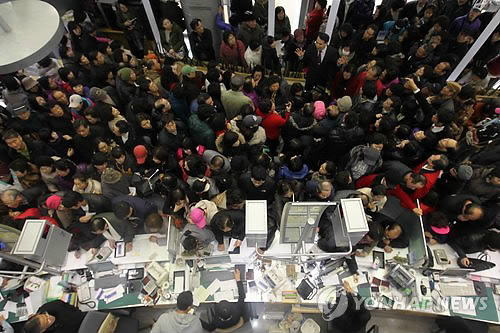
However, in the case of large savings banks with their own apps and financial holding company-affiliated savings banks, both deposit growth rates and decline rates were higher than those of other savings banks when external shocks occurred. In particular, financial holding company-affiliated savings banks with their own apps experienced greater deposit fluctuations compared to non-financial holding company-affiliated banks. During the third quarter of 2022, when Gangwon Jungdo Development Corporation filed for rehabilitation (the Legoland incident), the mobile deposit growth rate of financial holding company-affiliated savings banks with their own apps was about 72%, which was 40 percentage points higher than the 32% of non-financial holding company-affiliated savings banks without their own apps. The decline rates were 27% and 16%, respectively, showing an 11 percentage point difference. In the second quarter of 2023, when the Saemaeul Geumgo insolvency incident occurred, financial holding company-affiliated banks showed a 132% increase rate, while non-financial holding company-affiliated banks recorded only 13%. The decline rates were 24% and 12%, showing a 12 percentage point difference.
The authors explained that savings banks with their own apps and financial holding company-affiliated savings banks have strong capital and offer various financial products, providing convenience that leads to higher deposit growth rates. They added, “In times of external crises, there is a tendency for mobile app users to react sensitively to large-scale deposit inflows and outflows, quickly withdrawing deposits,” and warned that “this could increase the risk of digital bank runs.”
Additionally, as the proportion of loans made through mobile channels increased, the loan loss provision ratio also rose significantly. Specifically, with the expansion of mobile loans leading to an increase in vulnerable borrowers, savings banks appear to be preparing for rising delinquency rates and increased uncertainty in loan recovery. The authors noted that this case demonstrates the need for stricter risk management measures, such as raising loan loss provision ratios, to maintain asset soundness alongside the expansion of digital finance.
© The Asia Business Daily(www.asiae.co.kr). All rights reserved.
![Clutching a Stolen Dior Bag, Saying "I Hate Being Poor but Real"... The Grotesque Con of a "Human Knockoff" [Slate]](https://cwcontent.asiae.co.kr/asiaresize/183/2026021902243444107_1771435474.jpg)











