Hitler Gained Popularity Through Riots and Extremist Rhetoric
Focused on Agitation
Public Opinion Driven Toward Hate and Violence
Citizens Already Living in Fear
Is Korean Democracy at a Crossroads?
"Violence led to the rise of dictators like Hitler." (Kwon Youngse, Emergency Committee Chair of the People Power Party)
"Such acts are reminiscent of historical mobs like the Nazi Sturmabteilung." (Kim Sunmin, Acting Leader of the Innovation Party for the Fatherland)
Adolf Hitler, the Nazi leader responsible for World War II and the Holocaust, is being repeatedly mentioned in political circles. Concerns are growing that President Yoon Sukyeol's December 3 Martial Law declaration and the violent incident at the Seoul Western District Court evoke memories of Hitler, who was released from trial for attempted insurrection through the mobilization of his supporters. Just over a hundred years ago, how much did Germany resemble today's Korea?
Hitler Gained Popularity Through Riots and Extremist Rhetoric... Focused on Agitation
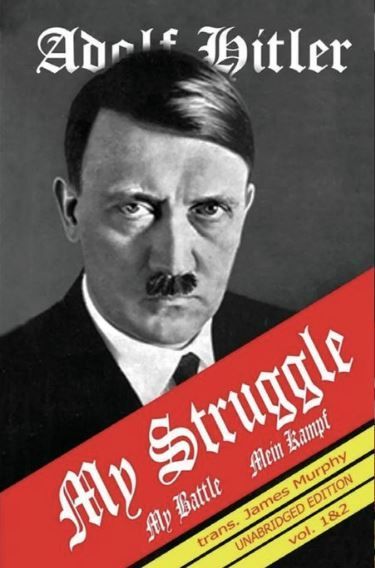
In 1923, Hitler, along with armed Nazi Sturmabteilung, staged a riot at the B?rgerbr?ukeller beer hall in Munich. They locked German political leaders inside the beer hall and declared the launch of a new government with Hitler as the head of the cabinet.
The poorly organized coup was suppressed within a day. Hitler was brought to court on charges of attempted insurrection. However, he used the trial as a stage for propaganda. In the courtroom, he criticized the German economy, which was faltering after World War I, as well as the political establishment for neglecting the situation and engaging in endless strife. He also incited that occupying the beer hall was an act of national resistance. As his remarks were publicized, his extremist supporters rallied around him. The Munich court was packed with spectators supporting Hitler. Buoyed by public opinion, Hitler, who had instigated insurrection, was paroled after just one year and one month.
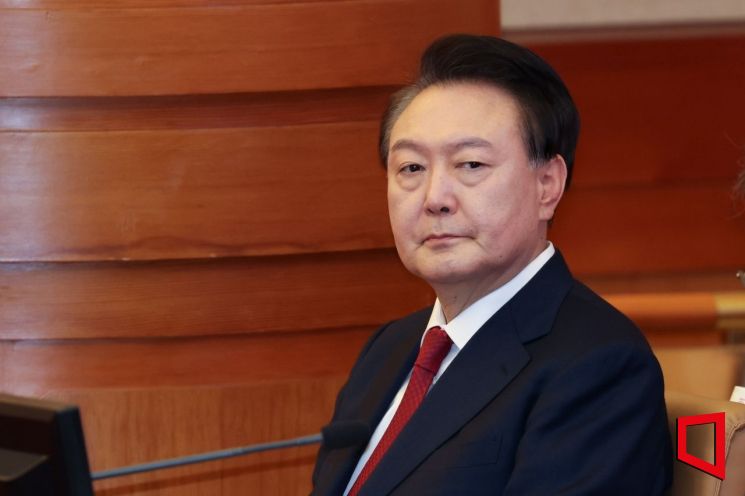 President Yoon Sukyeol is seated as the respondent at the third impeachment trial hearing held at the Constitutional Court in Jongno-gu, Seoul on the afternoon of the 21st. 2025.1.21. Photo by Joint Press Corps
There are now assessments that the domestic situation following the December 3 Martial Law incident is similar. President Yoon's attempt at martial law was nullified within about two hours by a National Assembly resolution demanding its termination. Nevertheless, his rhetoric hinting at continued struggle is rallying his supporters. What ignited extreme actions among his supporters was a letter from President Yoon. At the start of the new year, he told supporters protesting against impeachment, "The Republic of Korea is in danger due to forces infringing on our sovereignty both inside and outside the country, as well as anti-state forces," and declared, "I will fight to the end to protect you and this country."
President Yoon has avoided investigations by agencies such as the Corruption Investigation Office for High-ranking Officials, but has participated in hearings for his arrest warrant and the Constitutional Court's impeachment trial. This has led to interpretations that he is essentially engaging in propaganda and agitation directed at his supporters by only appearing in venues where his remarks can be publicized. At the Constitutional Court impeachment trial on the 21st, he stated, "Throughout my public service, I have lived with a steadfast belief in liberal democracy," and added, "Even before the martial law declaration, there were many doubts about the fairness of the election process." He further expressed distrust of the legislative and media branches, saying, "The National Assembly and the media wield far more power in Korea."
Public Opinion Driven Toward Hate and Violence... Citizens Already Living in Fear
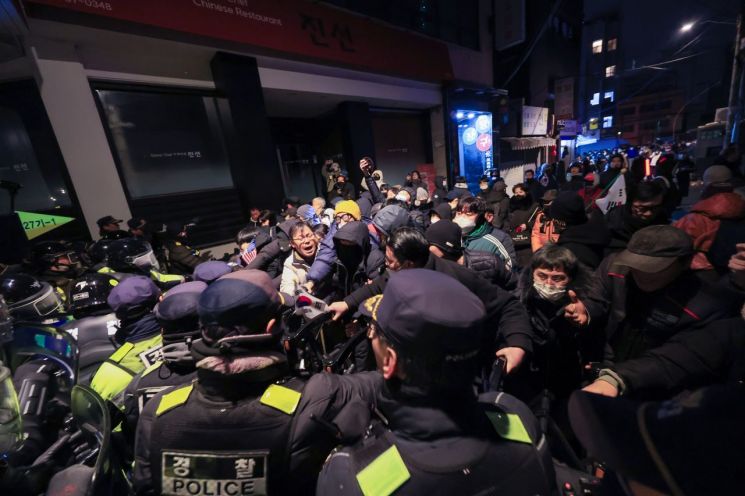 On the morning of the 19th, when President Yoon Seokyeol was arrested on charges of leading a rebellion, some supporters stormed the Seoul Western District Court in Mapo-gu, Seoul. Near the back gate of the Western District Court, police attempted to disperse the protesting supporters of President Yoon, but the supporters blocked them. Photo by Yonhap News
Hitler's ideology was completed during his time in prison. During his one year and one month of incarceration, he wrote his autobiography Mein Kampf. The book foreshadowed, in detail, the crimes he would later commit, including racial discrimination. He described Germans as "always sparking the divine flame of genius in any era," while referring to Jews as "parasites," claiming, "If only Jews existed, they would deceive each other in a struggle filled with hatred." He also argued for the necessity of dictatorship, stating, "The modern Western European concept of democracy only interferes with individuals," and "The ones who create greatness are the leading politicians."
Hitler's ideology began to gain mass popularity after the Great Depression of 1929. In the 1928 general election, the Nazi Party received only 2.6% of the vote, but in the 1932 election, their share soared to 37.4%, making them the largest party in parliament. As centrist politics failed to deliver results, weary Germans turned to extremist political forces. The moderate conservative party, seeking popularity, allied with Hitler and gave him the position of Chancellor. In 1933, when the Reichstag in Berlin was set on fire by communists, Hitler declared a national emergency. He then passed the Enabling Act, which marked the beginning of his dictatorship. The Enabling Act effectively transferred legislative power from parliament to the executive branch.
Far-right supporters of President Yoon, under the banner of "defending liberal democracy," are now engaging in hate and violence. A clear example is the violent incident at the Seoul Western District Court on the 19th. Protesters stormed the courthouse and destroyed property, shouting slogans such as "Arrest Lee Jaemyung," "Eradicate spies," and "You are not police, but Chinese public security." They openly directed hate toward the opposition, China, and North Korea. President Yoon himself effectively identified these targets of hate. In a public address on December 12, he said, "A Chinese national in his 40s was caught filming the National Intelligence Service with a drone," and claimed, "The martial law declaration was to alert the public to the anti-national atrocities of the opposition and to prevent the collapse of the liberal democratic constitutional order."
Is Korean Democracy at a Crossroads?
Domestic public opinion is being overtaken by an atmosphere of extremism. According to a public opinion poll conducted by the Korea Public Opinion Reputation Analysis (KOPRA) at the request of Asia Today on January 3-4, surveying 1,000 men and women aged 18 and over nationwide via wireless RDD, President Yoon's approval rating was recorded at 40%. In this poll, 31% responded that they "strongly support" President Yoon, while 56% said they "do not support him at all." In another KOPRA poll conducted on January 17-18, the rates for "strongly support" and "do not support at all" were both 42%. This means that over 80% of respondents gave extreme answers in the survey.
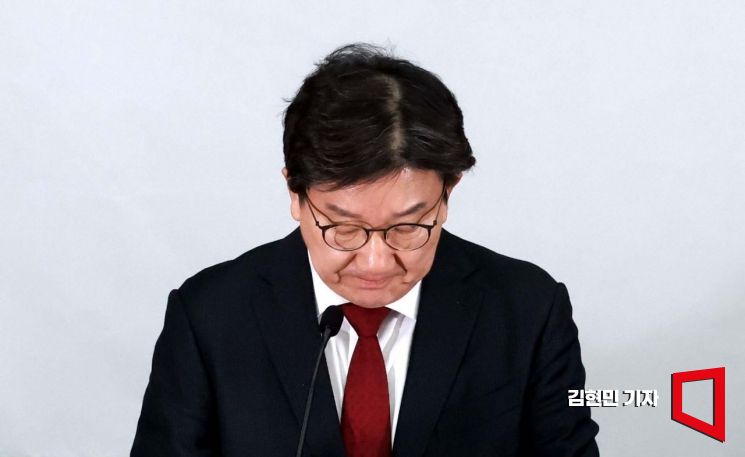 Kwon Seongdong, floor leader of the People Power Party, is speaking at the members' meeting held at the National Assembly on the 16th. Photo by Kim Hyunmin
Support for the conservative bloc is also rising. According to a poll conducted by Realmeter at the request of Energy Economy News on January 16-17, surveying 1,004 men and women aged 18 and over, the People Power Party's approval rating was 46.5%, up 5.7 percentage points from the previous week.
Kwon Youngse, the Emergency Committee Chair, sent Lunar New Year gifts to ten conservative YouTubers known for their extreme remarks. Although these far-right YouTubers have been identified as instigators of the violent incident at the Seoul Western District Court by encouraging blind support for President Yoon and collective action, Kwon defended them, saying, "These YouTubers were not inciting, but merely reporting the situation." Kwon Seongdong, the People Power Party floor leader, also responded to calls to distance the party from far-right groups by saying, "Our party is a party that embraces all who support us."
However, citizens are expressing fear. Mr. Na (30, male), who lives near the Seoul Western District Court, said he could not sleep and watched the scene through his window on the day of the violent incident. He said, "I sensed the commotion, but was shocked to hear that the violence was so rampant that windows and offices at the court were destroyed," adding, "I am worried that my daily life might collapse because of these extreme supporters."
There are now claims that President Yoon has brought Korean democracy to a crossroads. Political commentator Lee Jonghun said, "President Yoon's martial law declaration and the pro-Yoon faction have brought far-right forces to the center of domestic politics," and added, "It is crucial to severely punish those involved in the violent incident at the Seoul Western District Court and to proceed with the impeachment trial of President Yoon in order to restore democracy."
© The Asia Business Daily(www.asiae.co.kr). All rights reserved.



















