"Additional Faculty and Equipment Prepared for Medical School Expansion
Quota Must Not Be Reduced Below Pre-Expansion Levels"
Yang Obong, president of Jeonbuk National University, who was elected as the new chairman of the Korea Council for University Education (KCUE), stated, "The medical school quota for the 2026 academic year must be agreed upon by February to avoid public confusion."
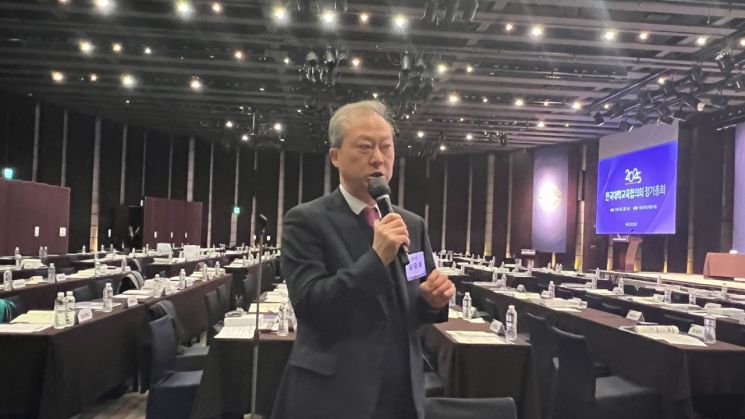 Yang Obong, the newly appointed chairman of the Korea Council for University Education, is answering reporters' questions at the '2025 Korea Council for University Education General Assembly' held on the 22nd at the Westin Chosun in Jung-gu, Seoul. Photo by Korea Council for University Education
On the 22nd, Chairman Yang made this remark during a meeting with reporters at the KCUE regular general meeting held at the Westin Chosun Hotel in Jung-gu, Seoul.
Regarding the medical school quota for the 2026 academic year, Chairman Yang said, "This issue will be decided through the medical-government consultation, and each university is striving to have students return to normal classes starting in March," adding, "It must be finalized by February at the latest." He explained, "Once the quota is decided in February and each university submits the confirmed quota to the Ministry of Education by the end of March, KCUE will finalize the admission guidelines in April," and "Only then can all universities announce their admission guidelines in May." He also mentioned, "The final revision period for the 2026 admission guidelines is until April this year," emphasizing, "To avoid confusion, the schedule must be met by February."
Regarding the scope of adjustment for the medical school quota, he said, "That is not something I can comment on," but expressed reluctance toward some opinions advocating for reducing the quota below the 2024 academic year level. Chairman Yang expressed concern, saying, "Preparations such as increasing faculty have been made according to the increased quota, so reducing it below the previous quota would cause significant difficulties."
When asked whether collective measures such as group failure or expulsion would be taken if medical students continue their collective actions, he responded, "The situation will be different from last year," urging the students on leave to return to school.
Chairman Yang stated, "Realistically, everyone must return by the start of the semester in March," adding, "If students take leave again, about 10,000 students could form one grade next year, which is absolutely impossible." He continued, "Last year, given the difficult circumstances, everything was allowed, but it will be difficult to do so this year," and stressed, "An agreement between the medical and government sides must come out quickly."
Regarding the decision by nine flagship national universities to freeze tuition fees, he explained, "Considering the national and public difficulties, it was deemed better to freeze tuition fees this year for the students' sake." He said, "After deducting personnel expenses, operating costs, utility bills, and facility expenses, only about 30 to 40 billion won remains, making it difficult to repair even leaking roofs or broken restroom doors," adding, "While national universities receive personnel expenses from the government, private universities must cover these costs through tuition fees, making their situation even more difficult." He further explained, "Even though tuition fees are frozen, the Ministry of Education is discussing with the Ministry of Economy and Finance to increase operating funds through projects such as the National University Development Project to ensure no financial difficulties for universities."
Chairman Yang's term will run from March 1 of this year to February 28, 2026.
© The Asia Business Daily(www.asiae.co.kr). All rights reserved.

















