'Foreign Seasonal Workers System Improvement Forum'
Limitations of Local Government Agreements Instead of Intergovernmental Treaties
"Need to Strengthen Legal Basis and Prepare Standard Plan"
In the National Assembly, the need to establish a legal basis to protect foreign seasonal workers has been raised. There are calls for urgent legislative improvements to protect foreign seasonal workers exposed to labor exploitation and human trafficking, and to ensure a stable supply of labor.
On the 21st, Im Mi-ae, a member of the Democratic Party of Korea, announced on the 22nd that she discussed improvements to related systems through a 'Foreign Seasonal Workers System Improvement Forum' held together with the Korean Bar Association. Park Ji-won, also from the same party, attended the meeting.
Foreign seasonal workers are a system that allows the temporary employment of foreign workers during periods requiring labor, such as farming seasons, in rural areas facing labor shortages due to aging populations and regional extinction risks. Starting as a pilot project in 2015, demand has steadily increased. The number of foreign seasonal workers, which was only 1,547 in 2017, rose to 67,778 last year.
However, the foreign seasonal worker system is criticized for its low operational stability as it is run only by guidelines without sufficient legal grounds. Although the Ministry of Justice oversees the program, overseas local governments and basic local governments each sign memorandums of understanding (MOUs) to secure labor supply.
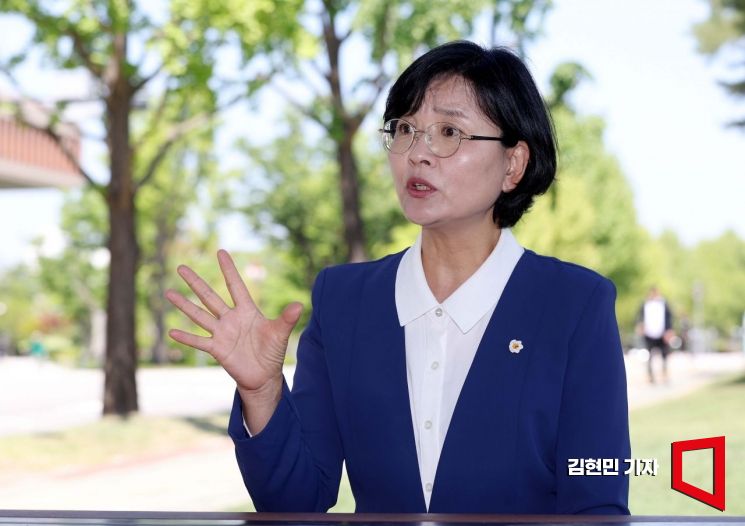 Im Mi-ae, elected member of the Democratic Party of Korea, is giving an interview to Asia Economy at the National Assembly on the 13th. Photo by Kim Hyun-min kimhyun81@
The problem is that brokers and others intervene in this process, leading to ongoing exploitation issues of seasonal workers. According to Im Mi-ae’s office, since 2023, five seasonal workers have been issued human trafficking victim certificates by the 'Central Human Trafficking Victim Rights Protection Agency.'
Attorney Lee So-a, who attended the forum, stated, "Currently, the seasonal worker system treats seasonal workers as tools," and emphasized, "There is no legal basis related to seasonal labor, so amendments to the 'Immigration Control Act' and the 'Special Act on Support for Employment of Agricultural and Fishery Workers' are necessary to add provisions on the basis of the seasonal worker system, employment management, and human rights protection."
Attorney Choi Seon-young proposed, "We need to analyze the problems of MOUs and related ordinances individually signed by each basic local government with overseas local governments and prepare a standard plan to improve them."
Im Mi-ae pointed out, "Seasonal workers have already become deeply integrated into our daily lives, but the relevant ministries, such as the Ministry of Agriculture, Food and Rural Affairs and the Ministry of Oceans and Fisheries, do not even have basic statistical data," adding, "Since the Ministry of Justice grants permission and basic local governments handle the rest of the operations, a blind spot in human rights inevitably arises."
© The Asia Business Daily(www.asiae.co.kr). All rights reserved.
![Clutching a Stolen Dior Bag, Saying "I Hate Being Poor but Real"... The Grotesque Con of a "Human Knockoff" [Slate]](https://cwcontent.asiae.co.kr/asiaresize/183/2026021902243444107_1771435474.jpg)
















