Introduction of Artificial Intelligence Techniques for Predicting Climate Disasters in East Asia
Participation of APCC Senior Researcher Jung Yooran and Others
A study that enhances AI (artificial intelligence) prediction capabilities for climate disasters that may occur in East Asia has attracted attention.
The Asia-Pacific Climate Center (APCC, Director Shin Do-sik) announced on the 22nd that a research team including Senior Researcher Jung Yoo-ran had their paper published online in the internationally renowned academic journal Heliyon.
The title of the paper is "Improving Sub-seasonal to Seasonal (S2S) Multi-model Ensemble Precipitation Forecasts in East Asia - Accuracy Enhancement through Deep Learning-based Post-processing."
Currently, APCC produces reliable long-term climate forecast information using the multi-model ensemble (MME) technique based on forecast information provided by 15 leading climate prediction institutions from 11 countries worldwide, and supplies it to the Asia-Pacific region.
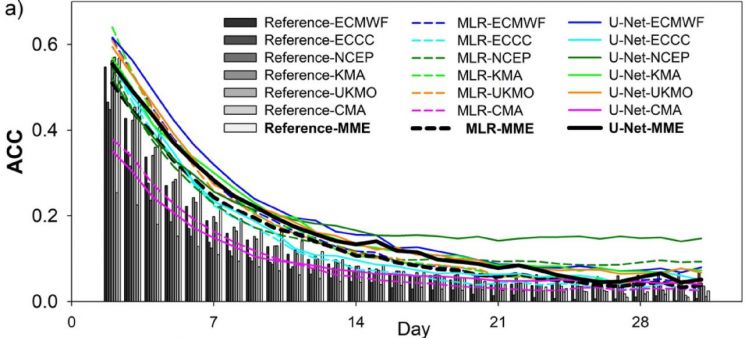
The MME technique systematically analyzes and integrates forecast information from each climate prediction model provided by climate prediction institutions to improve the accuracy of climate forecasts.
A climate prediction model is a mathematical representation that explains each component of the Earth's climate system. It simplifies the complex interactions among climate factors into a series of mathematical equations, helping to understand the progression of climate and enabling simulation and prediction of climate.
According to the research team, recent rapid climate and weather changes have broadly impacted daily life and industry. Consequently, there is an increasing need for relatively accurate weekly climate variability forecasts, such as the intensity or duration of heatwaves or heavy rainfall, one month in advance to effectively prevent and respond to damage caused by extreme climate events. For this reason, social demand for reliable S2S forecast information has recently increased.
Sub-seasonal to seasonal forecasts typically target periods of 1 to 6 weeks, predicting weekly climate variability. They fill the gap between medium-range (sub-seasonal) forecasts, which predict weather beyond 10 days, and seasonal forecasts, which usually predict several months or more.
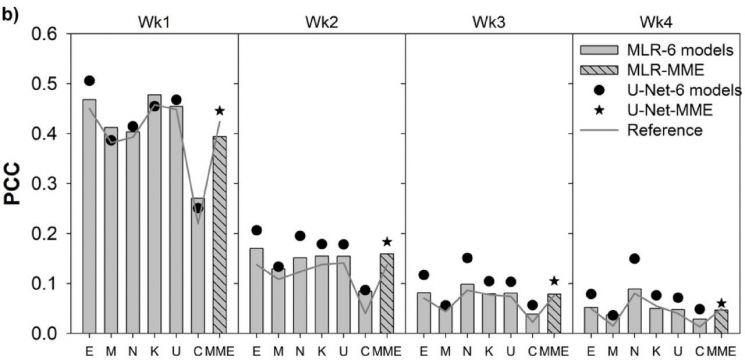
Variability in sub-seasonal climate over several tens of days is closely related across vast areas spanning thousands to tens of thousands of kilometers. It is also influenced by various components of the Earth system, which comprises the atmosphere, hydrosphere, cryosphere, lithosphere, and biosphere.
Until now, the primary focus of climate prediction models has been the atmosphere, but recently it has expanded to include various elements such as oceans, land surface, sea ice, and vegetation.
However, the reliability of forecasts beyond 1 to 2 weeks, where the influence of initial conditions input into these climate prediction models rapidly diminishes, drops sharply. As a result, it is challenging for people to practically utilize the forecast information produced by these models. In particular, accurate prediction of precipitation amount and frequency in sub-seasonal forecasts is very difficult.
The APCC research team confirmed that the reliability of sub-seasonal multi-model ensemble precipitation forecasts for East Asia from 2 to 4 weeks can be improved through post-processing based on deep learning, an artificial intelligence technology.
Deep learning-based post-processing is a technique where a deep learning model learns and predicts long-term weather patterns based on accumulated sub-seasonal forecast data and sequentially forecasts the weather conditions for the next day based on this.
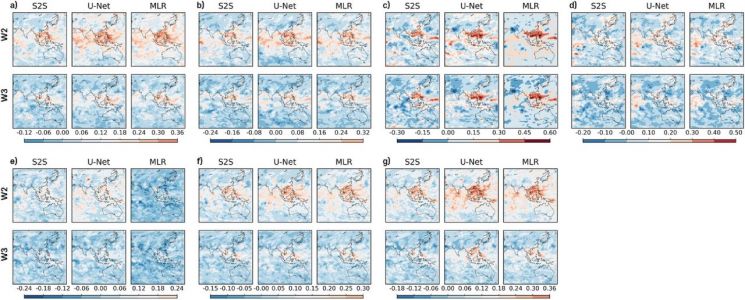
The results of this APCC research team’s paper enabled evaluation of the accuracy of precipitation amount and frequency forecasts within the prediction period of climate prediction models by comparing the forecast performance among prediction models post-processed using machine learning or deep learning techniques for precipitation forecasting in the region.
Through this, it is expected to contribute to the production of reliable climate forecast information by enabling the selection of specific climate prediction models with excellent forecast performance for each region in East Asia for precipitation forecasting.
Senior Researcher Jung Yoo-ran of APCC explained, “This research has made it possible to predict reliable precipitation amount and frequency, which are key elements in climate disaster management,” adding, “It can contribute to reducing human and material losses caused by climate disasters by supporting effective use of climate information and proper decision-making in climate-sensitive sectors such as agriculture.”
© The Asia Business Daily(www.asiae.co.kr). All rights reserved.



















