2025 Capital Market Outlook Seminar Held by Capital Market Research Institute
Macroeconomic Assessment Raises Concerns Over "Downside Risks to Domestic Economy"
The Capital Market Research Institute, a think tank for capital markets, warned that South Korea's economic growth rate could be limited to 1.6% this year. With the imposition of martial law and the impeachment crisis, coupled with the arrival of the 'Trump 2.0' era emphasizing America First, economic sentiment is expected to remain subdued and investment delayed through the first half of the year. The current benchmark interest rate of 3% per annum is forecasted to be cut by a total of 0.75 percentage points over the year.
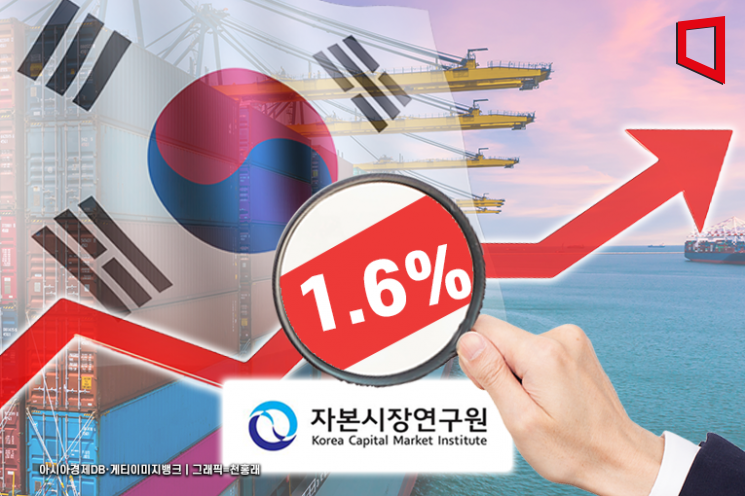
On the afternoon of the 22nd, the Capital Market Research Institute held a seminar at the Financial Investment Center in Yeouido under the theme "2025 Capital Market Outlook and Key Issues." Jang Boseong, head of the Macroeconomic and Financial Research Division, who presented the "Macroeconomic Outlook" first, stated, "The downside risks to the domestic economy are significant," and forecasted that the 2025 gross domestic product (GDP) growth rate would slow to 1.6%.
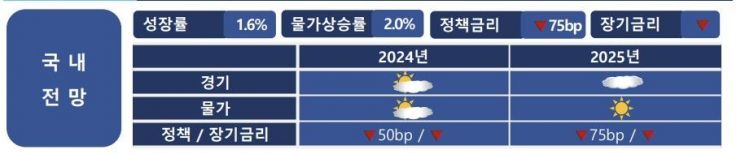
This figure is similar to the recent Bank of Korea’s downward revision of this year’s growth forecast from 1.9% to a range of 1.6?1.7%. This reflects the increased domestic political uncertainty following the martial law incident at the end of last year, and the sharp rise in political and trade policy uncertainties both domestically and internationally due to the inauguration of U.S. President Donald Trump, who emphasizes high tariffs and America First policies.
Specifically, exports are expected to show mixed performance across industries this year, with some sectors leading. Jang predicted, "The semiconductor and shipbuilding industries will perform well, but the steel and petrochemical industries will be sluggish." Domestic demand is also expected to show clear stagnation in private consumption and facility investment during the first half of the year, due to continued economic sentiment deterioration and investment delays.
The consumer price inflation rate forecast for this year was presented at 2.0%. However, if the high exchange rate persists, inflationary pressures could intensify. If the won-to-dollar exchange rate averages in the mid-1400 won range per dollar, inflation indicators are estimated to rise by an additional 0.1?0.2 percentage points. On the morning of the day, the won-dollar exchange rate was trading around 1,433 won.
Monetary policy is expected to see increased need for further easing as the inflation rate approaches the 2% target. Jang anticipated that the Bank of Korea, which decided to "hold" rates at the first Monetary Policy Committee meeting this year, will implement a total interest rate cut of 0.75 percentage points over the year. Macroprudential regulations to manage financial stability (leverage) were also cited as factors supporting additional easing. Furthermore, long-term interest rates are expected to show increased divergence due to macroeconomic desynchronization between Korea and the U.S.
In his presentation, Jang identified key macroeconomic issues for this year as ▲ Trump policy scenarios ▲ private consumption recovery ▲ exchange rate outlook. First, economic uncertainties and tariffs resulting from President Trump’s inauguration are expected to exert downward pressure on domestic economic growth, inflation, and interest rates. In particular, the trade war triggered by Trump’s tariffs is expected to intensify from 2026, having a relatively larger impact on the economy next year than this year.
He explained, "We assumed that due to trade policy impacts, the U.S. growth rate will fall by an additional 0.2 percentage points in 2025 and 0.6 percentage points in 2026 compared to the baseline forecast," adding, "The impact on the domestic economy this year is not large, but in 2026 it will reduce the growth rate by 0.25 percentage points." Market interest rates are also expected to face downward pressure, with a decline of about 12 basis points (1 bp = 0.01 percentage points) anticipated next year for the 3-year government bond benchmark.
Regarding the possibility of domestic private consumption recovery, Jang analyzed that both positive and negative factors coexist. Private consumption contraction is expected in the first half of the year, but in the second half, the effects of interest rate cuts will become more pronounced, improving consumption conditions. However, he also cautioned, "It is necessary to be aware that uncertainties in U.S. trade policy could continue to pose downward risks to private consumption through export channels."
As for the exchange rate, the combination of a strong dollar and domestic economic slowdown is expected to maintain downward rigidity this year. Jang stated, "Despite the shift in monetary policy stance, the strong dollar environment based on the U.S. economic advantage continues," and explained, "Due to the Federal Reserve’s delayed rate cuts, the widening monetary policy divergence between the U.S. and major countries, and increased global uncertainty leading to safe-haven asset preference, the global dollar is expected to remain strong throughout 2025." In the U.S., robust growth and persistently high inflation are expected to limit the Fed’s rate cut to 0.25 percentage points this year.
However, Jang noted, "The recent sharp rise in the exchange rate was largely influenced by domestic factors such as policy uncertainty, so as these effects diminish, the exchange rate is expected to gradually stabilize downward after the second half of 2025," adding, "In the second half, as policy uncertainty decreases and funds tracking the World Government Bond Index (WGBI) flow in, some offsetting of the global strong dollar impact is possible."
© The Asia Business Daily(www.asiae.co.kr). All rights reserved.

![A Woman with 50 Million Won Debt Clutches a Stolen Dior Bag and Jumps... A Monster Is Born [Slate]](https://cwcontent.asiae.co.kr/asiaresize/183/2026021902243444107_1771435474.jpg)
















