Professor Kang Sebyung's Team at UNIST Develops Self-Crosslinking Protein Hydrogel
Biocompatibility Demonstrated in Animal Experiments... Published in J. Control. Release.
A technology has been developed that incorporates drugs into a soft protein 'gel' to ensure the drug's effect spreads only to the desired area.
Professor Kang Se-byung's team from the Department of Life Sciences at UNIST announced on the 22nd that, through joint research with Professor Joo Jin-myung from the Department of Biomedical Engineering and Professor Cha Chae-nyung from the Department of Materials Science and Engineering, they have developed a self-crosslinking protein hydrogel.
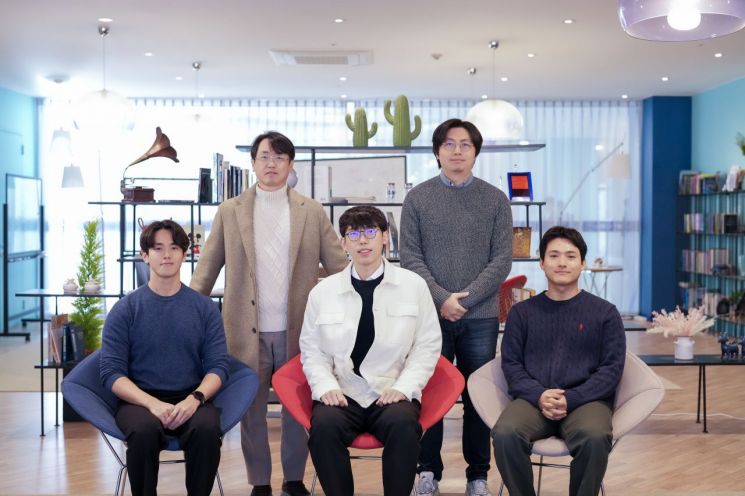 Research team (clockwise from top left): Professor Kang Se-byeong, Professor Joo Jin-myeong, Researcher Koo Yong-hoe, Researcher Eom Soo-min, Researcher Noh Young-jin. Provided by UNIST
This protein hydrogel is expected to enhance the effectiveness of cancer treatment and wound healing by delivering drugs locally over an extended period while minimizing toxicity due to additives.
Drug delivery technology using hydrogels has the advantage of slowly releasing drugs at the desired site. The principle is that the 'crosslinking' network inside the hydrogel gradually breaks down, releasing the trapped drug progressively.
The research team developed a hydrogel capable of forming crosslinking bonds between proteins within the body without adding crosslinking agents. While proteins themselves are harmless materials to the human body, this overcomes the limitation of chemical crosslinkers causing cytotoxicity.
Additionally, by using proliferating cell nuclear antigen protein as the main material of the protein hydrogel, immune inflammatory responses were suppressed. When the developed hydrogel was injected into mice, no immune inflammatory response was observed.
When anticancer drugs (doxorubicin) and wound healing growth factors (PDGF-BB) were loaded into the hydrogel to verify drug delivery performance, it suppressed the growth of breast cancer tumors and accelerated wound regeneration.
It also showed effectiveness in photothermal cancer therapy. Photothermal therapy is a treatment method that kills cancer cells by heating them, involving the administration of photosensitive particles that generate heat upon light exposure around the tumor. The developed hydrogel traps these photosensitive particles, concentrating heat at the tumor site.
Professor Kang Se-byung explained, “The newly developed self-crosslinking protein hydrogel can be utilized as an effective platform to deliver or confine various therapeutics tailored to the injection site.”
First author researcher Eom Soo-min stated, “This study presents the possibility of developing protein hydrogels suitable for biomedical applications using structurally diverse proteins.”
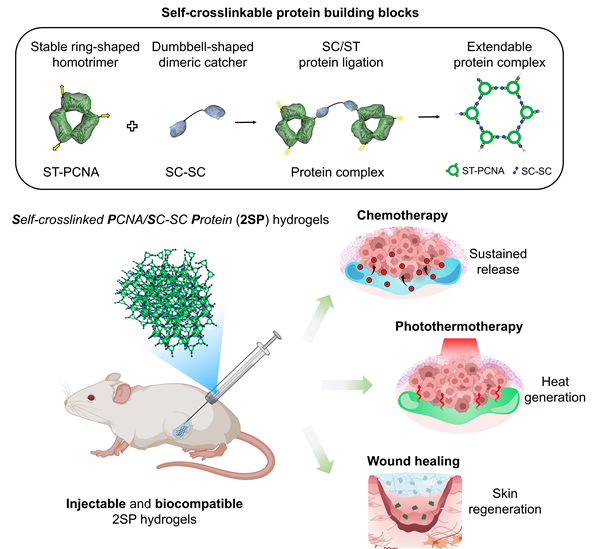 Principle of Formation and Local Therapeutic Enhancement Effect of Self-Crosslinking Protein Hydrogel. Provided by UNIST
The research results were published online on the 21st of last month in the international journal Journal of Controlled Release.
The study was supported by the National Research Foundation of Korea's Basic Research Laboratory program, Mid-career Researcher program, University Leading Research Center (Cancer Control Research Center via Intercellular Signaling), and the Ulsan Metropolitan City.
© The Asia Business Daily(www.asiae.co.kr). All rights reserved.
![Clutching a Stolen Dior Bag, Saying "I Hate Being Poor but Real"... The Grotesque Con of a "Human Knockoff" [Slate]](https://cwcontent.asiae.co.kr/asiaresize/183/2026021902243444107_1771435474.jpg)

















