On the 21st, when Donald Trump was officially inaugurated as the 47th President of the United States, the Korean stock market experienced increased volatility due to news related to the Trump administration's policies and ultimately closed lower.
On that day, the KOSPI closed at 2,518.03, down 2.02 points (0.08%) from the previous trading day. Institutions and individuals bought stocks worth 62.3 billion KRW and 54.5 billion KRW respectively, but foreigners sold stocks worth 173.2 billion KRW.
The KOSPI index started at 2,533.23, up 13.18 points (0.52%), even recording a rise of over 1%. This was because, contrary to initial concerns, President Trump did not mention immediate new tariff impositions in his inaugural speech. However, the market quickly turned bearish upon news that President Trump hinted at imposing tariffs on Canada and Mexico starting next month.
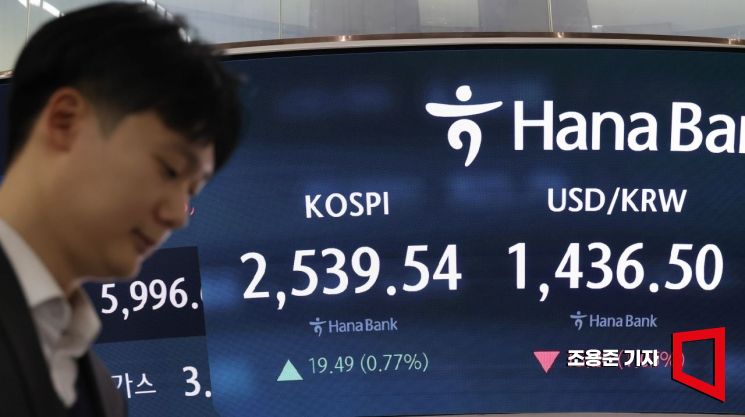 On the 21st, when the second term of the U.S. Donald Trump administration began, the status board in the dealing room of Hana Bank in Jung-gu, Seoul displayed the won/dollar exchange rate and the KOSPI index. On that day, the KOSPI opened at 2,533.23, up 13.18 points (0.52%) from the previous session, the KOSDAQ rose 0.91 points (0.13%) to 728.57, and the won/dollar exchange rate started at 1,437.0 won, down 14.7 won. Photo by Jo Yong-jun
Among the top market capitalization stocks, HD Hyundai Heavy Industries (6.00%), Hanwha Aerospace (3.18%), SK Hynix (2.83%), Hyundai Mobis (2.46%), and HD Hyundai Heavy Industries Holdings (1.84%) rose. Conversely, POSCO Holdings (-4.80%), LG Energy Solution (-4.32%), SK Innovation (-3.71%), Samsung Life Insurance (-2.61%), Samsung Biologics (-1.38%), Samsung C&T (-1.08%), and Meritz Financial Group (-1.08%) declined.
By sector, transportation equipment (2.13%), machinery equipment (1.79%), electric and gas utilities (1.47%), and non-metallic minerals (1.07%) rose. However, chemicals (-1.57%), metals (-1.34%), and insurance (-1.14%) sectors fell.
Ji-won Kim, a researcher at KB Securities, said, "The index fell as it monitored the policy direction of the Trump administration," adding, "Sector differentiation intensified amid increased volatility."
He further explained, "The domestic stock market, which started higher relieved by the postponement of U.S. tariff policies, reversed to a decline due to renewed caution following Trump's mention of tariffs on Canada and Mexico. In particular, the announcement of withdrawal from the Paris Climate Agreement and instructions to review the abolition of electric vehicle subsidies, signaling the dismantling of eco-friendly policies, intensified selling pressure on secondary battery stocks."
The KOSDAQ index recorded 726.07, down 1.59 points (0.22%) from the previous session. The index opened at 728.57, up 0.91 points (0.13%), but like the KOSPI, it turned downward following reports related to President Trump. Institutions and individuals net bought stocks worth 9.8 billion KRW and 65.7 billion KRW respectively, while foreigners alone sold stocks worth 54.8 billion KRW.
Among the top market capitalization stocks, Rino Industrial (7.11%), HLB (4.15%), Silicon Two (3.70%), Alteogen (2.04%), Peptron (1.43%), and EO Technics (1.23%) rose. EcoPro BM (-8.62%), Enchem (-8.39%), EcoPro (-5.87%), Samchundang Pharmaceutical (-4.99%), Shinseong Delta Tech (-2.92%), and Ligand Chem Bio (-1.07%) fell.
Researcher Kim added, "Major Asian stock markets overall remained flat amid caution over the Trump administration's policies," and "This week, sensitivity is expected to increase as attention focuses on U.S. political variables and domestic and international corporate earnings results."
© The Asia Business Daily(www.asiae.co.kr). All rights reserved.












