Buying and Selling Holiday Gift Sets at Bargain Prices: "Myeongjeol Tech"
High Satisfaction for Both Sellers and Buyers
Caution Needed When Trading Health Supplements Like Red Ginseng
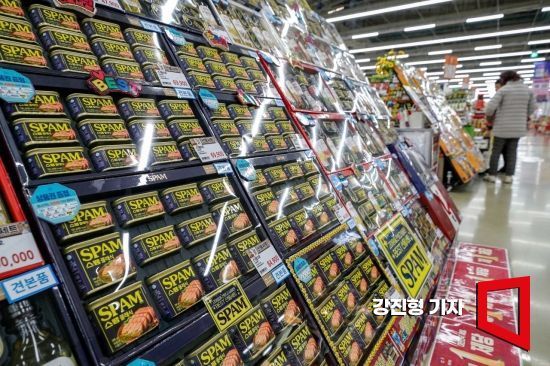
As the Lunar New Year approaches, 'Myeongjeol Tech' is continuing on secondhand trading platforms. Myeongjeol Tech is a combination of 'Myeongjeol' (holiday) and 'jaetech' (financial technology), referring to the act of reselling or purchasing gift sets received for free from companies at prices lower than the retail price to make a profit. From the seller's perspective, it allows them to gain financial benefits from items they do not need, while buyers can purchase necessary goods at a lower price, creating a mutually beneficial 'win-win' structure. However, caution is required as some items cannot be bought or sold on secondhand trading platforms.
On the 26th, various posts selling Lunar New Year gift sets were uploaded on the secondhand trading platform Danggeun Market. There were many posts selling processed foods like Spam and canned tuna, as well as daily necessities such as toothpaste and shampoo. A seller in Mok 2-dong, Yangcheon-gu, Seoul, listed a Spam gift set priced at 69,900 KRW retail for 28,000 KRW. Although it was an unopened new product, it was sold at about 60% less than the retail price and about 20% cheaper than the internet’s lowest price of 34,900 KRW. In addition, various popular Lunar New Year gifts such as seasonings, tea sets, and hand creams were posted, with most prices ranging from 20,000 to 50,000 KRW.
The spread of Myeongjeol Tech has been influenced by high inflation and the activation of secondhand trading. According to the 'Consumer Price Trends' announced by Statistics Korea, the consumer price index last year recorded 114.18 (2020=100), with an inflation rate of 2.3%. Although this is the lowest level in four years since 2020, the first year of the COVID-19 outbreak, which recorded 0.5%, it still exceeds the inflation stabilization target (2.0%). Due to prolonged economic recession amid high inflation, an environment conducive to active secondhand trading has been created, centered on those who want to purchase the same products at even slightly lower prices.
The secondhand trading market size is also rapidly growing. According to the Korea Internet & Security Agency, the secondhand trading market size, which was only 4 trillion KRW until 2008, increased sixfold to around 24 trillion KRW in 2021. Due to this steep growth, there are forecasts that the market size will expand to 43 trillion KRW this year.
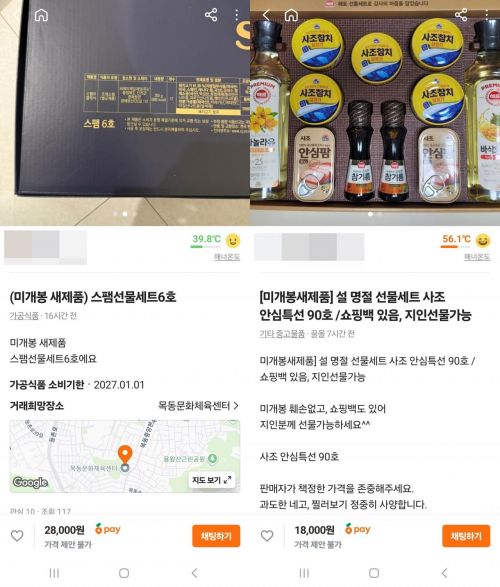 Posts related to Seol holiday gift sets are continuously being uploaded on secondhand trading platforms. Screenshot from the secondhand trading platform 'Danggeun'
However, caution is needed as there are items that cannot be sold on secondhand trading platforms.
Health functional foods (health supplements) such as red ginseng and vitamins can only be traded on Danggeun Market and Bungaejangter. Health supplements were originally among the representative items prohibited from secondhand trading along with pharmaceuticals, but from May 8 last year, a one-year pilot allowance for secondhand trading was implemented, enabling transactions on Danggeun Market and Bungaejangter. This was in response to criticism that the regulation was disconnected from the daily lives of the public, given the high demand for secondhand trading of health supplements, as posts selling red ginseng appear every holiday season.
Health supplements must be unopened, with all product names and labeling visible, and have at least six months remaining before the expiration date to be traded. Additionally, only products that are not purchased through overseas direct purchase or proxy purchase are allowed for secondhand trading. To prevent indiscriminate trading for profit, the number of transactions per individual is limited to 10 times per year, and the cumulative amount is capped at 300,000 KRW.
Sales of alcoholic beverages, including whiskey, also require caution when trading secondhand. Under current law, only those with a liquor sales license can sell alcoholic beverages. If caught selling without a license, one can be charged with 'unlicensed manufacture and sale of liquor,' punishable by up to three years in prison or a fine of up to 30 million KRW. Selling pharmaceuticals online can result in up to five years in prison or a fine of up to 50 million KRW. Even free giveaways (donations) are considered sales and subject to penalties.
© The Asia Business Daily(www.asiae.co.kr). All rights reserved.


















