Four Sites Including Chonnam National University ROTC Headquarters, Seogangsa, and Dong-gu Humanities Hall
Recognized for High Historical and Socio-Cultural Value...Partial Support for Management Costs
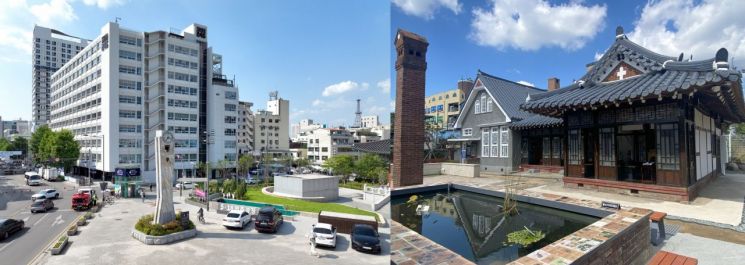 Jeonil Building 245 (left), registered as Gwangju City's first "Excellent Architectural Asset," and Donggu Humanities Hall, registered as the fourth. Provided by Gwangju City
Jeonil Building 245, located on Geumnam-ro in Gwangju, has been registered as the No. 1 Outstanding Architectural Asset.
According to the city of Gwangju on the 21st, four sites have been registered as Outstanding Architectural Assets: Jeonil Building 245, the ROTC Headquarters of Chonnam National University, Seogangsa, and Dong-gu Humanities Hall.
Unlike cultural heritage designation, ‘Outstanding Architectural Asset’ is a support system focused on the value of utilization, aimed at promoting architectural culture. If the owner applies for the promotion of architectural culture, the mayor or provincial governor registers it after a review process.
Jeonil Building 245, the first Outstanding Architectural Asset in Gwangju, was completed in 1968 as a seven-story building and was used by Jeonnam Ilbo at the time. The building holds symbolic significance for the May 18 Democratization Movement, as traces of helicopter gunfire from the 1980 uprising remain inside.
In 2011, after the city of Gwangju purchased the building and began remodeling, 245 bullet marks were discovered inside. The building was then renamed Jeonil Building 245, combining its original name with the number of bullet marks. Currently, it serves as a civic cultural complex, housing a library, a tourism center, and cultural content companies.
The second asset, the ROTC Headquarters of Chonnam National University, was constructed with unique forms and materials, showcasing the diversity of university educational facilities in the 1950s and 1960s. The third, Seogangsa, is a shrine building from the 1960s that well represents the characteristics of hanok architecture in the Gwangju area.
The fourth, Dong-gu Humanities Hall, is a complex cultural space located in Dongmyeong-dong. It blends Western, Japanese, and Korean architectural styles, demonstrating the architectural technology and diversity of Gwangju in the 1950s.
Once registered as an Outstanding Architectural Asset in Gwangju, owners can receive support for necessary technology or part of the management costs according to the ‘Gwangju City Ordinance on the Promotion of Hanok and Other Architectural Assets.’ Some regulations, such as building coverage ratio, landscaping area, open space, and parking requirements, may also be relaxed.
Park Geumhwa, head of the Architectural Landscape Division, stated, “The registration of Outstanding Architectural Assets is one of the achievements of our architectural culture preservation policy, which began with the implementation plan for promoting Gwangju’s architectural assets. Starting with this registration, we plan to further promote and strengthen the competitiveness of local architectural culture.”
© The Asia Business Daily(www.asiae.co.kr). All rights reserved.

















