"If I Had Been President, South Korea Would Have Paid $10 Billion in Defense Costs"
With the official launch of the second Trump administration, the security landscape surrounding the Korean Peninsula is shaking. On his first day in office, U.S. President Donald Trump indicated the possibility of North Korea-U.S. talks by stating that “Kim Jong-un is a nuclear power,” while toward South Korea, there is a high likelihood that he will demand a choice between a significant increase in the cost of stationing U.S. troops in South Korea (defense cost-sharing) and troop reductions, based on 'America First' principles.
The security landscape around the Korean Peninsula is expected to be greatly unsettled with the official launch of the second Trump administration. The Trump administration, based on 'America First' principles, is likely to demand South Korea to choose between a substantial increase in the cost of stationing U.S. troops (defense cost-sharing) and troop reductions.
During a discussion held in Chicago last October while he was a presidential candidate, Donald Trump stated, “If I had been in the White House, South Korea would have spent $10 billion annually (about 14.41 trillion won) on the cost of stationing U.S. troops,” adding, “They (South Korea) are a money machine.”
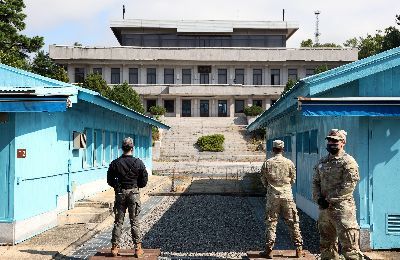 On the 4th, US Forces Korea and the Republic of Korea Armed Forces were on duty at Panmunjom, Paju-si, Gyeonggi-do. 2022.10.4.
 /Photo by Joint Press Corps
The $10 billion figure cited by Trump exceeds nine times the approximately 1.5 trillion won South Korean share for 2026 under the Special Measures Agreement (SMA) on defense cost-sharing reached between South Korea and the U.S. last October during the Biden administration. Considering the launch of the second Trump administration, the government concluded early negotiations last October on defense cost-sharing for five years starting in 2026. In 2026, South Korea will pay 1.5192 trillion won, an 8.3% increase from last year, with subsequent annual adjustments reflecting inflation.
It remains uncertain whether the newly launched Trump administration will actually demand $10 billion, but the prevailing view is that it will seek renegotiations demanding a significant increase in stationing costs. South Korea’s concern is particularly high that if this demand is not met, the U.S. may reduce troops stationed in South Korea or even consider complete withdrawal. During his first term, President Trump already mentioned $5 billion (about 7.2 trillion won) as defense cost-sharing and raised the possibility of withdrawing U.S. troops from South Korea.
In fact, this Trump administration’s ‘security free-rider theory’ is not only aimed at South Korea. During his candidacy, Trump also threatened to withdraw from the North Atlantic Treaty Organization (NATO), pressuring members to spend 5% of their Gross Domestic Product (GDP) on defense costs. For Taiwan, the proportion is even higher at 10%.
The Korea Institute for National Unification, in its report published last year titled “The Return of Trump and the Korean Peninsula: Implications and Response Directions,” stated, “The Trump administration is very likely to demand that South Korea bear a larger share of the costs for stationing U.S. troops or increase South Korea’s defense spending as a percentage of GDP from the current 2.5% to 3.0?3.5%.” It also predicted, “Based on this, the administration is likely to demand renegotiations of the defense cost-sharing agreement reached with the Biden administration, and it will also use the card of withdrawing U.S. troops from South Korea.”
© The Asia Business Daily(www.asiae.co.kr). All rights reserved.

















