Technological and Industrial Feasibility Within 5 to 10 Years
Significant Ripple Effects Expected
The Ministry of Science and ICT and the Korea Research Institute of Bioscience and Biotechnology (KRIBB) announced the 'Top 10 Future Promising Bio Technologies for 2025' on the 20th.
Future promising bio technologies are those expected to be technically or industrially feasible within the next 5 to 10 years, and are anticipated to have significant technological and industrial ripple effects not only in advanced bio fields but also across various sectors.
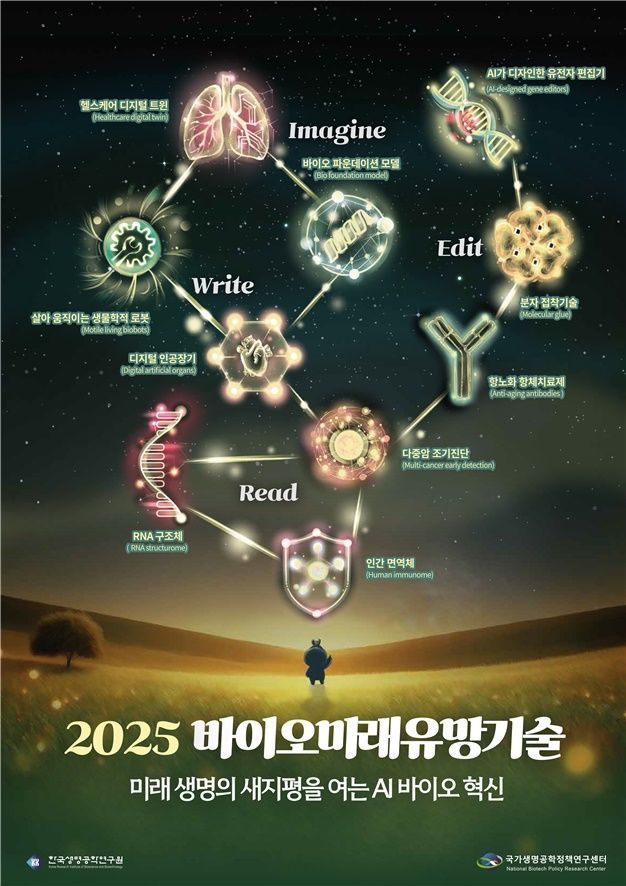 The Ministry of Science and ICT and the Korea Research Institute of Bioscience and Biotechnology (KRIBB) have selected and announced the "Top 10 Future Promising Bio Technologies for 2025." Photo by the Ministry of Science and ICT
The top 10 promising technologies include ▲Human Immune System ▲Early Diagnosis of Multiple Cancers ▲RNA Structures ▲AI-Designed Gene Editors ▲Anti-Aging Antibody Therapeutics ▲Molecular Adhesion Technology ▲Living, Moving Biological Robots ▲Digital Artificial Organs ▲Bio Foundation Models ▲Healthcare Digital Twins.
According to the technology discovery results, the future bio research paradigm is expected to shift from repetitive experiments and observation-centered approaches to data-driven prediction and inference through convergence with AI. It is anticipated that the vast amounts of data generated in each field such as 'Observation & Analysis,' 'Editing,' 'Simulation & Synthesis,' and 'Prediction & Simulation' will be interconnected through AI technology.
In the observation and analysis field, the human immune system technology is expected to build a global immune database and construct a human immune system AI model based on high-resolution measurement of the human immune system.
In the editing field, AI-based technology is expected to design gene editors with high efficiency and safety, thereby increasing their applicability.
Living, moving biological robots are technologies expected to expand applications in future biomedicine, such as autonomously moving to clean arteries or deliver drugs using various tissue progenitor cells, as well as in space exploration.
The 'Bio Foundation Model,' which predicts new principles through large-scale bio data learning, is regarded as a core technology, with semiconductor company NVIDIA launching the generative AI 'Bionemo' earlier this year.
The selected top 10 technologies can be found on the policy information portal site 'BioIN.'
Hwang Pan-sik, Director of the R&D Policy Office at the Ministry of Science and ICT, said, "With the groundbreaking advancement of bio technologies, a path has opened to reach the new continent of knowledge that was previously difficult to access due to the complexity of life phenomena."
© The Asia Business Daily(www.asiae.co.kr). All rights reserved.
![Clutching a Stolen Dior Bag, Saying "I Hate Being Poor but Real"... The Grotesque Con of a "Human Knockoff" [Slate]](https://cwcontent.asiae.co.kr/asiaresize/183/2026021902243444107_1771435474.jpg)
















