Result of Injunction to Prohibit Agenda Submission to Be Announced on 21st
If Dismissed, Introduction of Cumulative Voting System to Be Discussed at Shareholders' Meeting
National Pension Service in Favor... Outcome Remains Uncertain
The court ruling on the injunction filed by MBK Partners and Youngpoong (hereinafter the MBK alliance), opposing the proposal to introduce a cumulative voting system at the temporary shareholders' meeting of Korea Zinc scheduled for the 23rd, is expected to be announced on the 21st. The outcome of this injunction is the first critical hurdle for Chairman Choi Yoon-beom of Korea Zinc to defend his management rights, with both sides having employed up to 50 legal representatives to engage in the legal battle.

According to related industries and the legal community, the Seoul Central District Court Civil Division 50 (Presiding Judge Im Hae-ji) will decide on the acceptance of the injunction filed by the MBK alliance on the 30th of last month to prohibit the proposal submission. This injunction arose after Chairman Choi and the current management of Korea Zinc proposed the introduction of a cumulative voting system as an agenda item for the temporary shareholders' meeting on the 23rd to protect their management rights. The cumulative voting system allows shareholders to exercise one vote per share multiplied by the number of director candidates, which is significant in protecting minority shareholders' rights.
Chairman Choi and the current management of Korea Zinc have been actively pursuing the introduction of the cumulative voting system. This is related to the shareholding structure. Currently, the MBK alliance holds 40.97% of shares (46.7% of voting rights), approaching a majority, whereas Chairman Choi’s side, even including friendly shares, holds only 34.24% (39.16% of voting rights), making it difficult to control the board of directors. However, if the cumulative voting system is introduced, the situation changes. Shareholders can concentrate their votes on specific director candidates, increasing the possibility that small shareholders supporting Chairman Choi will pool their votes to block the entry of directors favored by the MBK alliance.
Accordingly, Korea Zinc has put all efforts into persuading the court by appointing 35 lawyers from multiple law firms, including Taepyungyang and KL Partners, as legal representatives for this injunction. The MBK alliance also formed a legal team of about 15 members, including Yoo Hae-yong, a former senior research judge at the Supreme Court (Kim & Chang law firm), to counter Korea Zinc’s side.
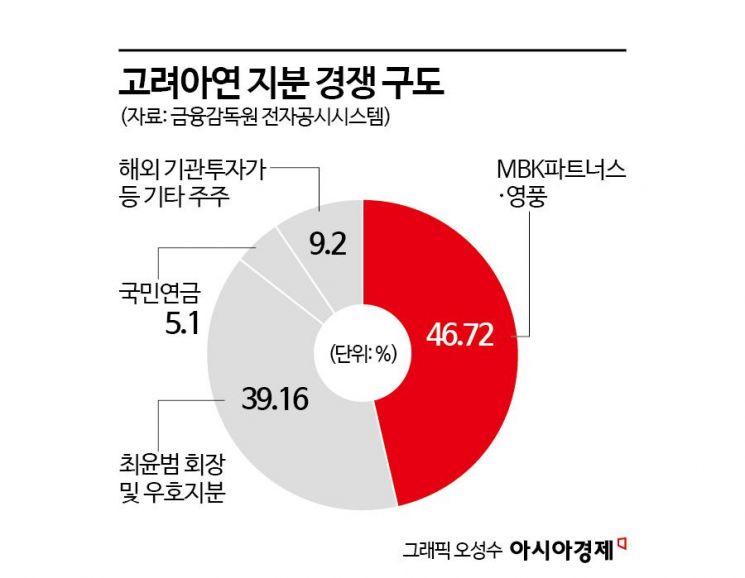
The court ruling does not immediately confirm the introduction of the cumulative voting system. If the injunction is dismissed, the agenda to introduce the cumulative voting system will be submitted as planned at the temporary shareholders' meeting, allowing for discussion. Whether the agenda passes will depend on the stance taken by foreign and institutional shareholders. So far, the National Pension Service (with a 4.51% stake and 5.1% voting rights) voted in favor of introducing the cumulative voting system on the 17th, signaling a ‘green light’ for Chairman Choi and the current management of Korea Zinc. However, the largest U.S. pension funds, the California Public Employees’ Retirement System (CalPERS) and the California State Teachers’ Retirement System (CalSTRS), as well as the world’s largest sovereign wealth fund, the Norwegian Government Pension Fund, maintain opposition, so the outcome remains uncertain.
Meanwhile, the agenda items for the upcoming temporary shareholders' meeting include ▲introduction of the cumulative voting system ▲setting an upper limit of 19 directors ▲par value split of issued shares ▲protection of minority shareholders ▲appointment of an outside director as board chair ▲change of dividend record date ▲introduction of quarterly dividends ▲introduction of an executive officer system. Apart from the introduction of the cumulative voting system, there is disagreement over the agenda to ‘set an upper limit of 19 directors.’ However, since both domestic and international proxy advisors have recommended approval of this agenda, it is expected to pass.
© The Asia Business Daily(www.asiae.co.kr). All rights reserved.
![Clutching a Stolen Dior Bag, Saying "I Hate Being Poor but Real"... The Grotesque Con of a "Human Knockoff" [Slate]](https://cwcontent.asiae.co.kr/asiaresize/183/2026021902243444107_1771435474.jpg)











