Appeared on KBS's 'Sunday Diagnosis' on the 19th
"Export-led economic model needs change"
Proposes global solidarity, investment diversification, and influx of foreign citizens
On AI hegemony war strategy: "Selection and focus are necessary"
Choi Tae-won, Chairman of the Korea Chamber of Commerce and Industry and SK Group, appeared on KBS's current affairs talk show 'Sunday Diagnosis' on the morning of the 19th, a day before the inauguration of the second Trump administration. He emphasized that "the global trade order is shifting from 'multilateralism' centered on the World Trade Organization (WTO) to a one-on-one 'bilateralism' system," and stressed that we must reset the 'rules' ourselves and find partner countries to unite with and raise our voices together.
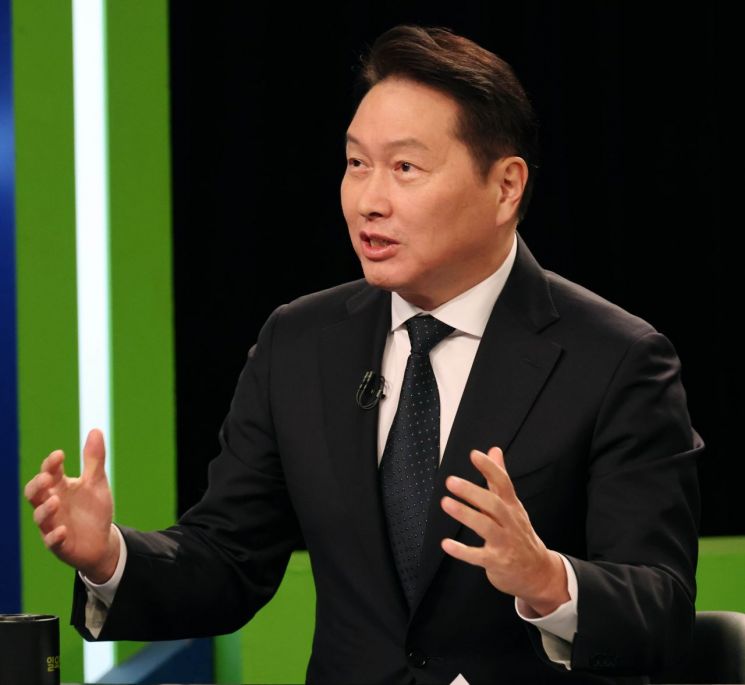 Choi Tae-won, Chairman of the Korea Chamber of Commerce and Industry and SK Group, appeared on KBS current affairs talk show 'Sunday Diagnosis' on the 19th to share his views. Photo by Korea Chamber of Commerce and Industry
Chairman Choi stated, "The export-led economic model that has been used for decades is difficult to operate as it did in the past under the current trade order." He explained, "The change in the global economic order is like switching the sport from ssireum (Korean wrestling) to swimming. Even a player who has been good at ssireum will inevitably face difficulties if competing in swimming using ssireum methods." His point was that we need to reset the rules by making a strenuous effort to transform into swimmers or at least wrestle in the water.
He identified 'global economic solidarity' as the top priority that South Korea should pursue. Chairman Choi said, "The countries currently deciding the (world economic) rules are the United States in first place, China second, and the EU economic bloc third," adding, "We alone lack the power to change the rules of the international order. We need to consider partners to unite with and the direction to pursue together." He continued, "Countries like Japan come to mind at first glance. Although their economic scale is larger than ours, they are similarly accustomed to accepting rules rather than making them."
When asked about this year's economic outlook, he analyzed, "Various economic indicators such as consumption, employment, and exports are not favorable," and added, "Uncertainties such as U.S.-led tariff increases, resulting inflationary pressures, and rapid technological changes in artificial intelligence (AI) are approaching like a triple wave." He also predicted that South Korea's trade surplus with the U.S., which was about $60 billion during the first Trump administration, rose to about $150 billion under the Biden administration, making it highly likely to become a source of trade pressure.
Chairman Choi also proposed models to replace traditional export methods, such as 'overseas investment' and 'software over hardware.' He said, "Compared to our economic size, we are not systematically making strategic investments overseas," and questioned, "When Nvidia grew significantly, how much portion (investment share) did South Korea have in Nvidia?" emphasizing the need for 'investment diversification.' Regarding 'soft power,' he said, "We need to more systematically produce and sell cultural products that are relatively free from trade pressures," adding, "If Korean cuisine becomes more globalized in terms of recipes, eating methods, tableware or kitchen structure, and training of cooks than it is now, the added value we gain from it will be much greater."
He also stressed the need to 'expand domestic demand through the influx of foreign citizens,' citing the difficulty of resolving low birthrate and aging population issues in the near future. Chairman Choi said, "We need to create a structure where foreign citizens come not just for simple tourism but for long-term residence, working, paying taxes, and increasing consumption domestically." He specifically mentioned, "We are in a situation where we need to bring in about 5 million foreign workers, approximately 10% of our population."
Chairman Choi also proposed the idea of rewarding people who solve social problems. He argued, "If many creative people are provided with systematic methodologies to solve social problems, social costs will be reduced accordingly."
He presented a strategy regarding the AI hegemony war. Chairman Choi emphasized, "Above all, a national-level consensus and strategy on how to respond to AI is important," adding, "Because the scope of AI is so broad, it is necessary to select and focus on areas where we can excel rather than trying to do everything well." For example, he elaborated that 'manufacturing AI' that improves manufacturing process efficiency and a 'Korea-level large language model (LLM)' are essential. While he expressed doubts about researching and replicating foundation models like ChatGPT among big tech companies, he stressed the need to develop fields where South Korea has unique advantages to enter the AI industry. He said, "South Korea must not become an AI-poor country dependent on global AI companies," and emphasized, "Urgent development of AI in the manufacturing sector is necessary."
Finally, Chairman Choi said, "Economic policy is fundamentally about how to allocate resources efficiently, and to respond to external changes, resources must be reallocated," urging, "Our economy must quickly proceed with resource allocation in line with changes, and rather than solving everything through laws, all economic actors need to break through with speed through discussions and consensus."
© The Asia Business Daily(www.asiae.co.kr). All rights reserved.

















