Decline Continues Since 2022
Last Year, Number of Seats Fell Below 30 Million
As the number of domestic tourists visiting Jeju declines, the number of domestic flight seats to and from the island has also been decreasing continuously since 2022. In particular, the number of domestic flight seats to and from Jeju fell below 30 million last year.

According to recent data received by Jeju Province from Korea Airports Corporation at Jeju Airport, the number of domestic flights at Jeju Airport over the past three years was 171,754 in 2022, 161,632 in 2023, and 156,533 in 2024, showing an 8.9% decrease over two years. Domestic seat supply also decreased by 10% over two years, from 33,153,946 seats in 2022 to 30,653,954 in 2023 and 29,816,923 in 2024. Passenger numbers during the same period also dropped by 8.7%, from 29,485,873 in 2022 to 27,759,212 in 2023 and 26,920,409 in 2024.
During the COVID-19 pandemic, overseas travel was restricted, but as daily life recovered, demand for international travel revived. Airlines prioritized deploying medium and large aircraft on international routes, which intensified the shortage of domestic flight seats. As a result, it has become more difficult to obtain domestic flight tickets, and prices have risen, causing inconvenience and dissatisfaction among Jeju residents and tourists.
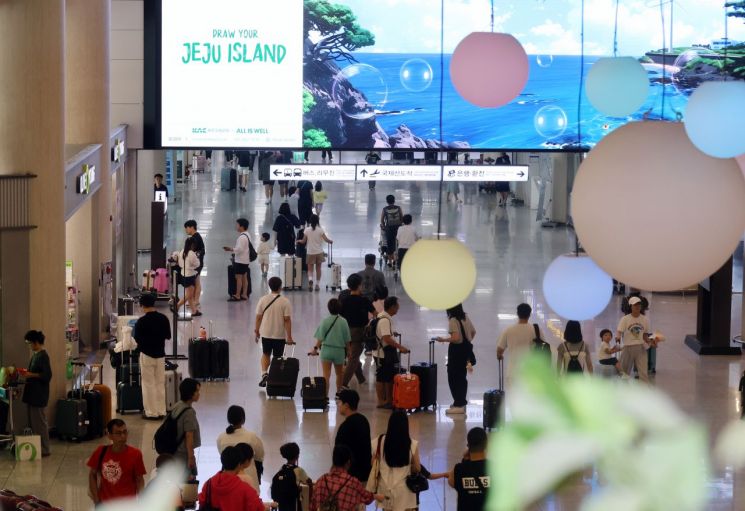 On the last day of the Chuseok holiday, September 18th of last year, returning travelers and tourists are heading to the departure area of Jeju International Airport to leave Jeju. Photo by Yonhap News
On the other hand, international seat supply and passenger numbers at Jeju Airport have surged.
The number of international flights at Jeju Airport increased sharply from just 647 flights in 2022 to 8,134 in 2023 and 16,220 in 2024. The supply of seats also jumped from 130,490 in 2022 to 1,500,642 in 2023 and 2,969,110 in 2024, nearly recovering to pre-COVID-19 pandemic levels.
Similarly, the number of international passengers surged to 93,385 in 2022, 1,189,539 in 2023, and 2,437,053 in 2024.
Due to the increase in international flights, the total number of flights at Jeju Airport last year was 172,753, up 1.8% compared to 169,766 flights in 2023. Seat supply also rose by 2%, from 32,154,596 seats in 2023 to 32,786,033 seats last year. Passenger numbers increased by 1.4%, from 28,948,751 in 2023 to 29,357,462 last year.
Last year, the market share by airline at Jeju Airport was as follows: Korean Air 18%, Jeju Air 16.8%, Asiana Airlines 16%, Jin Air 14.3%, T’way Air 13.7%, Eastar Jet 9.5%, Air Busan 9.0%, and others 2.7%. The total number of tourists who visited Jeju last year was 13,783,911 (provisional), an increase of 2.9% compared to the previous year. However, the number of domestic tourists was only 11,876,303, down 6.4% from 12,681,999 in 2023.
© The Asia Business Daily(www.asiae.co.kr). All rights reserved.


















